Hiring Freelance vs Full-Time EHR Developers: Cost, Compliance & Scalability Explained
When it comes to hiring EHR developers, it’s not just a simple staffing decision, like generic software developer hiring. It impacts the cost structure, compliance, and scalability of the EHR software. If you don’t choose the right hiring model, this mistake can lead to compliance gaps, integration failures, unscalable EHR, timeline delays, and budget overruns.
However, every healthcare organization building or modernizing its EHR faces the same decision: hiring freelancers or choosing full-time EHR developers. This is where many practices don’t understand which one to choose.
And to make the right decision, you must have a complete understanding of what both of these hiring models have to offer, along with their trade-offs. For instance, hiring freelancers has a low initial cost, but they can have less expertise, knowledge gaps, and no project ownership or continuity.
On the other hand, for full-time EHR developer hiring, the investment is higher, but they offer long-term ownership, expertise, and healthcare domain knowledge. So, when you are finalizing the hiring process, building it around all these factors helps in making the right choice.
In this blog, we will break down the difference between freelance EHR developers and full-time EHR developers, along with how the pros and cons can change depending on small clinics and multi-location clinics, so you can build a future-ready and compliant EHR.
Freelance EHR Developers
First things first, who are freelance developers? In simple terms, they are independent contractors hired for a specific task or project. They are not on complete payroll, and are paid hourly or on short-term service contracts.
These developers have a focused area of expertise rather than a full set of development skills. They may be skilled in HL7 and FHIR integration, HIPAA compliance, or API development. If you are a small clinic or have time-bound projects, then hiring freelance EHR developers can reduce upfront investment.
One of the biggest advantages of freelance EHR developers is their flexibility. You can onboard them quickly without lengthy training and onboarding processes. Moreover, they can be hired for niche needs that are not needed in the long term.
However, there are also some trade-offs that need to be considered before making the decision. Due to the lack of long-term contracts, freelancers rarely offer long-term ownership of the EHR. More importantly, the governance, maintenance, HIPAA-compliant developer hiring, and data access control become the healthcare organization’s responsibility.
Furthermore, once the contract ends, retaining knowledge is difficult, and you may face scalability and continuity issues by relying on a single contractor.
In short, freelancers are the best choice only when the project is small, so it’s important to understand the pros and cons of freelance EHR developers for small clinics and multi-location clinics.
Full-Time EHR Developers
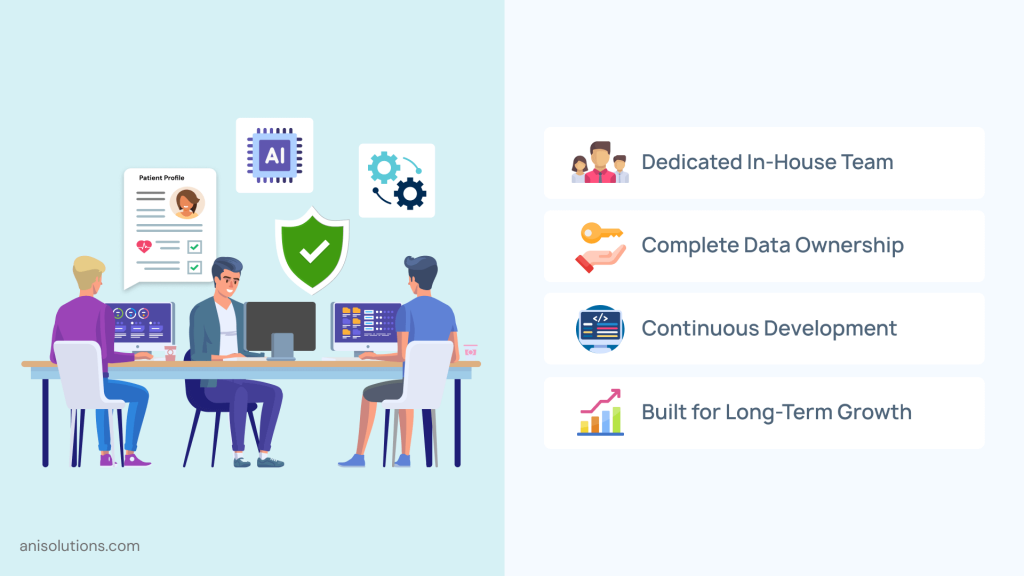
Unlike freelancers, full-time EHR developers are the in-house developers hired exclusively for your organization. They are responsible for ongoing development, maintenance, compliance updates, and long-term platform evolution, with complete ownership of EHR software.
These developers are part of a complete team of compliance officers, clinical and administrative staff, developing a compliant, interoperable, and scalable EHR system. With this collaboration, they deeply understand the architecture, integrations, security, and regulatory requirements of your system, ensuring continuity and minimizing operational disruptions.
Another advantage, apart from complete ownership and continuity, is the predictability of investment. Alongside this, full-time developers are better aligned with AI integration, interoperability expansion, and security governance, as they understand your organizational structure.
However, hiring full-time EHR developers is expensive upfront and makes sense when you are planning for long-term growth or need an in-house team for full data ownership and control. For instance, multi-location clinics or projects for building an AI-driven EHR system need full-time EHR developers.
In short, if you are planning a long-term expansion where continuity and ownership are non-negotiable, then investing in full-time EHR developer hiring is the right choice.
Freelance or Full-Time? Make the Right EHR Hiring Decision
DownloadFreelance vs Full-Time EHR Developers: Detailed Comparison
The best way to choose between hiring freelance vs full-time EHR developers is to compare both while evaluating their pros and cons. Although both models deliver results, their cost structures, long-term ownership, expertise, and other factors differ significantly. So, only choosing based on results or investment needs can lead to costly and time-consuming mistakes.
Here is a detailed comparison to help you assess which model aligns with your goals, project timeline, compliance environment, and growth plans:
| Parameter | Freelance EHR Developers | Full-Time EHR Developers |
| Cost Structure | Hourly or project-based payments | Fixed salary plus benefits |
| Upfront Investment | Low initial commitment | Higher hiring and onboarding cost |
| Long-Term Cost | Can increase with extended contracts | More predictable over time |
| Scalability | Limited for sustained platform growth | Strong support for long-term expansion |
| Compliance Ownership | Shared or contract-defined | Internal accountability and oversight |
| Knowledge Retention | Lower after contract completion | High due to continuous involvement |
| Availability | Based on the contract scope | Dedicated and ongoing availability |
| Speed of Onboarding | Faster for defined projects | Moderate due to the hiring process |
| System Ownership | Limited to assigned tasks | Full platform ownership |
| AI & Innovation Support | Focused feature delivery | Continuous AI and system evolution |
| Risk Level | Higher dependency and continuity risk | Lower risk due to team stability |
| Best For | Small clinics, short-term builds | Enterprise systems, long-term EHR platforms |
Is Your EHR Built for Long-Term Growth? Assess Technical Debt and Expansion Readiness
Assess NowCompliance & Risk Considerations
In healthcare IT, hiring decisions are directly tied to compliance exposure. Whether you hire freelance EHR developers or invest in full-time EHR developer hiring, regulatory accountability does not shift. Your organization remains responsible for protecting patient data and maintaining audit readiness.
A major factor in HIPAA-compliant developer hiring is access control. Developers often require access to protected health information during integrations, testing, data migration, or system upgrades. Without strict role-based access, encryption protocols, and audit logging, even a well-intentioned engagement can create compliance vulnerabilities. This becomes especially critical when working with remote contractors.
With freelance developers, compliance ownership must be clearly defined in contracts. Business Associate Agreements, secure VPN access, device security policies, and monitored system permissions are essential. Since freelancers are not embedded long-term, internal teams must actively monitor data handling, credential management, and documentation standards.
Full-time developers offer stronger internal accountability. They operate within established security policies and are continuously trained on HIPAA updates, interoperability requirements, and organizational compliance protocols. Over time, they build institutional awareness of regulatory expectations, reducing oversight gaps.
Risk management also includes knowledge continuity. If a contractor exits abruptly, unresolved integrations or undocumented configurations can disrupt operations. In contrast, dedicated teams provide stability and controlled transitions.
Ultimately, compliance risk is not determined by employment type alone. It depends on governance structure, documentation rigor, and security enforcement. The hiring model you choose should strengthen, not complicate, your regulatory posture.
AI & Future Growth Considerations
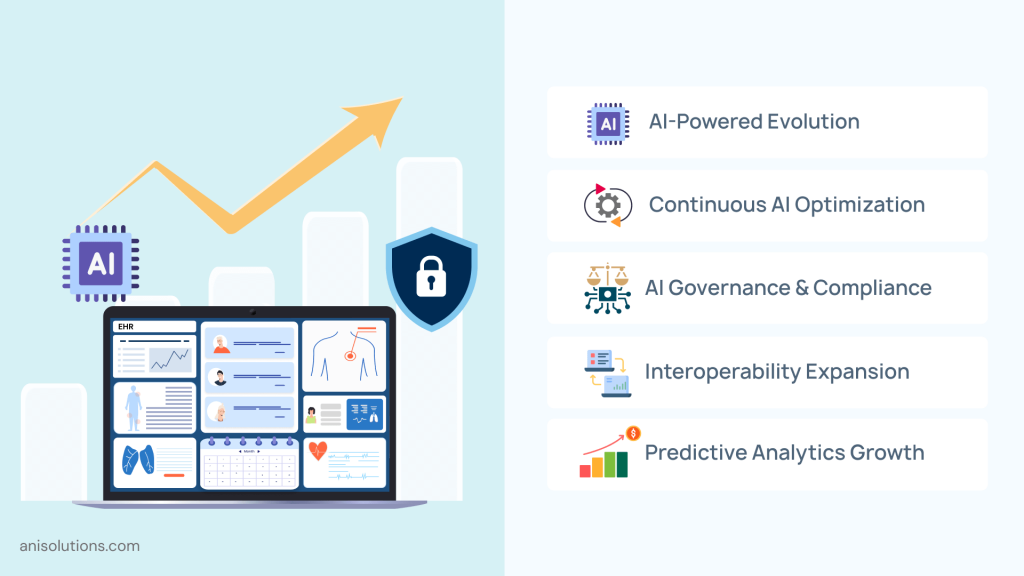
Right now, modern healthcare systems are no longer just record-keeping tools; they are evolving into intelligent systems. With automation, predictive analytics, clinical decision support, and AI-driven workflows, the EHR developers’ skill set has also evolved. And your hiring model directly influences how effectively you can support this change.
Moreover, if your roadmap includes AI-enabled documentation, automated coding, predictive population health analytics, or interoperability expansion, development continuity becomes critical. AI systems require ongoing model tuning, data validation, security oversight, and workflow optimization. These are not one-time projects. They demand sustained ownership.
Freelance EHR developers can contribute to short-term AI feature development. They may build a documentation module, integrate an API, or configure automation workflows. However, long-term AI governance, monitoring bias, ensuring regulatory alignment, and maintaining performance stability require continuous oversight. Project-based contractors may not stay long enough to manage these responsibilities.
Full-time EHR developer hiring offers stronger alignment with long-term innovation. Dedicated teams understand internal architecture, data flows, and clinical workflows. This allows them to refine AI tools over time, improve model accuracy, and ensure compliance with evolving healthcare regulations. Continuous involvement also supports smoother upgrades and integration of emerging technologies.
Future growth is not just about adding features. It is about building a scalable foundation that adapts to regulatory updates, interoperability standards, and expanding patient volumes. The right hiring model should support roadmap alignment, reduce technical debt, and enable sustainable innovation.
So, evaluate the scalability of full-time EHR teams vs. project-based contractors, along with AI understanding for choosing the right hiring model. If your vision includes a future-ready, AI-enabled EHR, continuity and ownership become strategic advantages.
Building an AI-Enabled EHR? Start with the Right Hiring Model
Get FrameworkConclusion: Choosing the Right EHR Developer Hiring Model
Long story short, hiring freelance vs full-time EHR developers depends on your project scope and growth plan. If your project is small and time-bound, then hire freelance EHR developers who have low upfront cost and specialized expertise in a niche such as interoperability, compliance, or scalability.
However, if your project is a long-term one, then hiring full-time EHR developers is the right choice. These developers take complete ownership and responsibility for ongoing development, maintenance, and compliance updates, which is the right choice.
So, the right formula for selecting a hiring model is to define your compliance needs, project costs, and project scalability. Want to know which one suits you the best? Then click here to talk to our experts and evaluate or hire EHR developers as per your requirements.
Frequently Asked Questions
Q. What is the average cost difference between hiring a freelance vs. a full-time EHR developer in 2026?
Freelance EHR developers typically charge higher hourly rates but require no benefits or long-term commitments. Full-time hires involve salaries, benefits, and onboarding costs. In the short term, freelancers are cheaper. Long-term, full-time developers often provide more predictable and scalable cost structures.
Q. How do I ensure HIPAA compliance when working with remote freelance EHR contractors?
Start with a signed Business Associate Agreement. Limit PHI access through role-based controls. Use secure VPNs, encrypted environments, and audit logging. Enforce device security policies and regularly monitor access. Compliance oversight remains your responsibility, even with external contractors.
Q. Which employment model is better for integrating AI and Machine Learning into an existing EMR system?
For short-term AI feature implementation, freelancers can help. For continuous AI tuning, governance, and regulatory alignment, full-time developers are stronger. AI integration requires long-term ownership, ongoing monitoring, and system-level knowledge that project-based engagement rarely provides.
Q. Can a small clinic manage a complex EHR migration using only project-based developers?
It’s possible but risky. Project-based developers can handle technical migration tasks, but knowledge continuity and post-migration stabilization often suffer. Without internal oversight, integration gaps and compliance oversights may surface after go-live.
Q. What are the long-term scalability risks of relying on independent EHR consultants?
Dependency risk is the biggest concern. If consultants exit mid-project, undocumented configurations and incomplete integrations can stall growth. Scalability requires architectural continuity, roadmap alignment, and institutional knowledge, which independent consultants may not provide in the long term.
Q. How does onboarding time compare between a full-time EHR hire and a specialized freelancer?
Freelancers usually onboard more quickly because they are hired for specific tasks. Full-time hires require recruitment, orientation, and system immersion. However, once onboarded, full-time developers gain a deeper institutional understanding and reduce the need for repeated ramp-up cycles.
Q. Should I use a managed EHR service provider or build an in-house team for data security?
Managed providers offer structured compliance frameworks and operational efficiency. In-house teams provide tighter control and internal accountability. The better choice depends on your security maturity, budget, and long-term platform ownership goals.
Freelance EHR developers typically charge higher hourly rates but require no benefits or long-term commitments. Full-time hires involve salaries, benefits, and onboarding costs. In the short term, freelancers are cheaper. Long-term, full-time developers often provide more predictable and scalable cost structures.
Start with a signed Business Associate Agreement. Limit PHI access through role-based controls. Use secure VPNs, encrypted environments, and audit logging. Enforce device security policies and regularly monitor access. Compliance oversight remains your responsibility, even with external contractors.
For short-term AI feature implementation, freelancers can help. For continuous AI tuning, governance, and regulatory alignment, full-time developers are stronger. AI integration requires long-term ownership, ongoing monitoring, and system-level knowledge that project-based engagement rarely provides.
It’s possible but risky. Project-based developers can handle technical migration tasks, but knowledge continuity and post-migration stabilization often suffer. Without internal oversight, integration gaps and compliance oversights may surface after go-live.
Dependency risk is the biggest concern. If consultants exit mid-project, undocumented configurations and incomplete integrations can stall growth. Scalability requires architectural continuity, roadmap alignment, and institutional knowledge, which independent consultants may not provide in the long term.
Freelancers usually onboard more quickly because they are hired for specific tasks. Full-time hires require recruitment, orientation, and system immersion. However, once onboarded, full-time developers gain a deeper institutional understanding and reduce the need for repeated ramp-up cycles.
Managed providers offer structured compliance frameworks and operational efficiency. In-house teams provide tighter control and internal accountability. The better choice depends on your security maturity, budget, and long-term platform ownership goals.
- On March 4, 2026
- 0 Comment