EHR Developer Interview Questions for Hiring Compliance, Integration & AI Specialists
When you are hiring an EHR developer, it is not the same as hiring a general software developer. You need to carefully plan the entire process, tailoring it for evaluating the specialties required for choosing the right developer.
The reason I am saying this is that, unlike general software developers, EHR software developers need knowledge beyond how to code. They need to understand healthcare interoperability, API-ready architecture, cloud infrastructure, how clinicians work, and most importantly, regulatory compliance.
However, generic interview questions don’t evaluate all this expertise; they only focus on testing technical knowledge. Yet, healthcare organizations often rely on these questions and tests to hire EHR developers, rather than asking questions that can evaluate understanding of clinical workflows or HL7 integration.
And this leads to weak system integrations, increased non-compliance risks, workflow disruption, and hard-to-scale EHRs, impacting long-term stability. But if you have structured EHR developer interview questions that can test developers on their healthcare domain expertise, you can avoid these costly mistakes.
In this guide, we have sorted out some essential healthcare software developer interview questions to assess expertise in healthcare compliance, interoperability, scalability, and building an AI-ready EHR system.
So, let’s get started without further ado!
Foundational Healthcare Software Developer Interview Questions
Before assessing any other expertise, what you need to know is how well the developers you are hiring understand the healthcare domain. Here are the questions that will help you evaluate their domain knowledge clearly and effectively:
- What are the biggest challenges in developing software for clinical environments compared to traditional SaaS?
This question evaluates whether the developer understands how healthcare works under regulatory challenges, patient safety needs, and interoperability requirements. When a candidate has experience, they will answer in a way that reflects seamless integration challenges, the complexity of embedding compliance into EHR architecture, and workflow optimization, not just development differences.
- How do you design UI/UX for clinicians to reduce click fatigue?
With this question, you can easily assess how much the candidate knows about how clinicians work and clinical workflows. In healthcare, the interfaces need to be simple with features easy to find and patient data easily accessible. A strong candidate knows this, and the answer shows workflow mapping, minimizing navigation steps, and usability validation with clinicians.
- How do you gather requirements from healthcare stakeholders?
This question evaluates how well the developer navigates the complexity of healthcare decision-making. Whether they understand how clinical, administrative, and other teams impact EHR design. The right candidate’s answer will include conducting stakeholder interviews, workflow observation, documentation validation, and clearly understanding clinical requirements.
- What performance considerations are critical in high-volume healthcare systems?
You can assess how well the candidate understands the impact of performance failure on patient care and finances. The EHRs must work smoothly even under high patient volume without breaking real-time data access or disrupting workflows. A strong answer will have reference to scalable architecture, database optimization, load testing, and balancing, not just general performance tuning strategies.
Technical Deep Dive: FHIR & HL7 Interview Questions
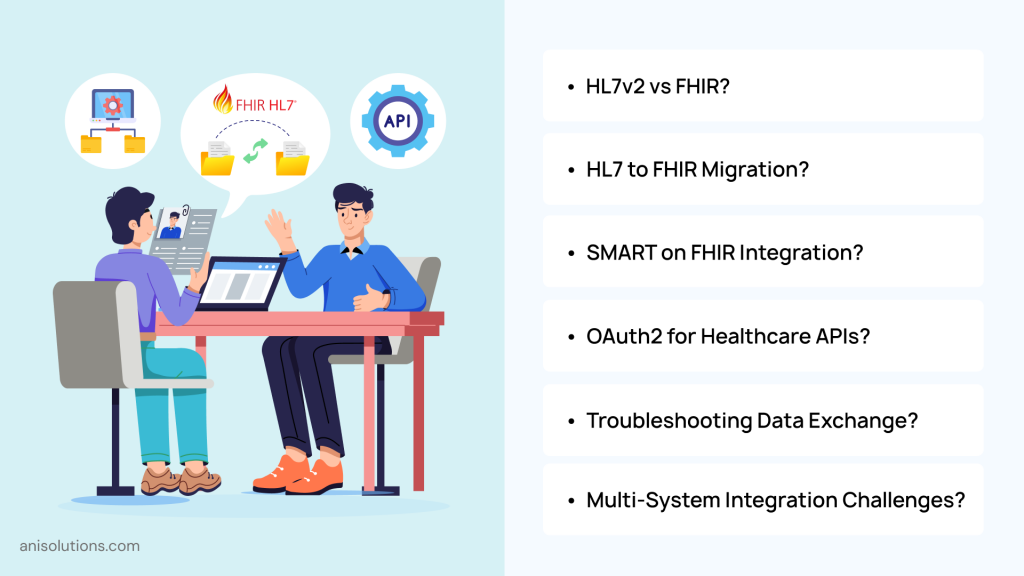
In modern healthcare, interoperability is a must-have feature, and EHR developers you are hiring must have qualifications in seamlessly integrating external systems with EHR. Here are some essential FHIR and HL7 interview questions, along with technical interview questions for EHR integration specialists:
- What is the difference between HL7v2 and FHIR?
This is the question that evaluates whether the candidate understands the evolution in healthcare interoperability standards. The HL7 v2 is a message-based data exchange, whereas FHIR is based on API-driven resources. An experienced developer will answer based on RESTful architecture, flexibility, and real-world integration challenges in connection with systems.
- Explain how you would map legacy HL7 messages to FHIR resources during migration
With this, you can understand the developers’ real-world experience in integrating systems using these two interoperability standards. Because a successful migration requires careful data mapping, data normalization, validation, and handling of inconsistencies in legacy systems. So the answer should reflect transformation layers, middleware strategies, testing, and validation processes for ensuring data integrity.
- How do SMART on FHIR applications interact with EHR systems?
SMART on FHIR is a modern integration tool; if the developer is aware of this, then they can securely enable third-party applications integration. Their answer will include information about OAuth2 authorization, token-based access, scope management, and secure app embedding within clinical workflows, not answers about generic API connections.
- How would you implement OAuth2 authentication for healthcare APIs?
This helps you understand how much the developer understands about secure integration designs. As PHI is sensitive data and must be protected, the developer requires expertise in measures such as role-based access control, token expiration policies, and encrypted data exchange, along with audit tracking.
- How do you troubleshoot failed data exchanges between connected systems?
In this question, you can gauge the developer’s mindset on problem-solving. The healthcare integration mainly fails due to message formatting errors, version mismatches, network legacy, or mapping inconsistencies. The solutions from the EHR developer must talk about log analysis, validation tools, sandbox testing, and systematic root cause analysis.
- What challenges arise when integrating multiple external healthcare services?
This question tells you how much architectural knowledge the candidate has. While integrating multiple systems, there are data inconsistencies, schema mismatches, security risks, and latency challenges. So, the answer from the developer you are interviewing should include API orchestrization, data standardization, middleware governance, and maintaining compliance across connected environments.
All these EHR interoperability and data security interview questions help you hire the right specialists who can build a truly interoperable system.
Want to Hire EHR Developers with Real Healthcare Expertise? Get the Complete Interview Toolkit
Get NowSecurity & HIPAA Compliance Interview Questions
After assessing the ability to integrate, the next expertise you need is how much they understand about the regulatory landscape of healthcare. These HIPAA compliance interview questions can help you choose the right EHR developers:
- What encryption practices do you follow for PHI in transit and at rest?
By asking this question, you can evaluate whether the developer knows the baseline for protecting patient data. If the developers understand the importance of keeping data secure at rest and during transmission, then the answer will include AES-256 and TLS encryption standards. Along with these measures, secure key management and HIPAA standards will also be included.
- How do you implement role-based access control (RBAC)?
This is another data security question related to least privilege access in HIPAA compliance. The RBAC requires a granular permission model across providers, staff, and administrators. When a developer has strong knowledge of this, the answer will be about role hierarchies, permission mapping, audit tracking, and dynamic access policies.
- Describe a time you identified a potential PHI leak. How do you handle it?
With this question, you understand the real-world experience and accountability of the developer. To identify a PHI leak, developer must be proactive about risk mitigation, so the answer should include incident detection and containment procedures, along with proper documentation, root-cause analysis, and fixing the vulnerability.
- How do you design audit logging systems to meet compliance requirements?
Under HIPAA compliance tracking, access is essential for accountability, and a HIPAA-compliant developer understands this. So the answers must refer to how audit systems track data access, changes, and record time with alert systems, access monitoring protocols, and secure retention policies.
Don’t Let Compliance Gaps Slip Through. Get the HIPAA & Interoperability Interview Checklist
Access NowAI & Automation Interview Questions for Modern EHR Systems
Another important skill that an EHR developer should have is the ability integrate AI-powered features into the EHR architecture. Below are some of the necessary interview questions that will help you assess the developer’s AI and automation capabilities:
- Have you implemented AI-assisted clinical documentation or predictive analytics in an EHR?
Integrating AI is a crucial skill because developers need to properly align AI features with clinical workflows and compliance standards. When the EHR developer has hands-on experience, they know model validation, clinic feedback loops, and measurable impact, ensuring you hire the right EHR developer.
- How do you validate AI outputs in clinical decision-support systems?
This question assesses the risk awareness and patient safety prioritization because AI outputs influencing care decisions require a structured validation process. So, the answer should include testing against clinical benchmarks, human-in-the-loop review, bias detection, performance monitoring, and ongoing model evaluation.
- What safeguards are necessary when integrating large language models (LLMs) into healthcare platforms?
By asking this question, you can evaluate the governance capabilities of the developer. When LLMs handle patient data, they need strict privacy and access controls along with output monitoring. That’s why the answer should be referred to PHI protection, data anonymization, output auditing, hallucination mitigation, access controls, and compliance alignment, not just using secure APIs.
- How do you ensure explainability and bias mitigation in healthcare AI systems?
The results from AI can be influenced by the data it is feeded so it is important to pay attention to bias mitigation and make sure that AI generates interpretable outputs. The experienced developer will answer with transparent model logic, documented training data evaluation, bias testing frameworks, and audit trails.
Scenario-Based EHR Development Interview Questions
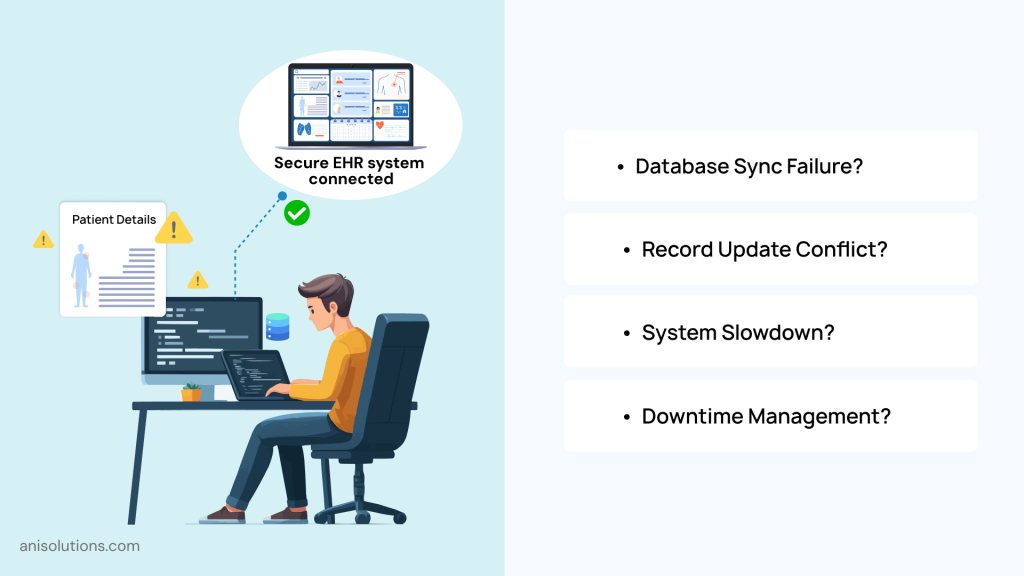
One of the best ways to evaluate the expertise and experience of EHR developers is to ask scenario-based EHR development interview questions. Here are some questions you must ask the developers during the interview:
- A legacy database fails to sync with a mobile patient portal. How would you debug it?
This is a question that tests the troubleshooting ability of a developer in complex healthcare integration. If the developer has faced this scenario previously, then the answer will include log analysis, message validation, API endpoint testing, version compatibility checks, and identifying data mapping inconsistencies.
- How would you handle data conflicts when two providers update the same patient record simultaneously?
With this scenario-based question, you can gauge the understanding of concurrency control in a clinical system. The ideal answer would be implementing optimistic or pessimistic locking, version control, timestamp validation, audit logging, and clear conflict resolution workflows, not assuming overwrites are acceptable in healthcare.
- A system slowdown occurs during peak clinical hours—what steps would you take?
This evaluates performance triage under operational pressure; the answer should include monitoring resource utilization, analyzing database queries, reviewing load-balancer behavior, and scaling infrastructure if necessary. Moreover, ensuring minimal disruption to care delivery, not generic optimizing code answers.
- How would you manage system downtime without disrupting patient care?
With this question, you can test operational resilience planning. The right EHR developer should reference failover systems, redundancy architecture, offline access protocols, communication plans, and post-incident documentation.
Is Your EHR Hiring Process Future-Ready? Evaluate with the EHR Developer Evaluation Framework
Get NowBrief Red Flags to Watch During Interviews
Even strong technical resumes can mask critical gaps in healthcare-specific competence. During interviews, certain behavioral and knowledge signals indicate deeper risk. Recognizing these early can prevent costly hiring mistakes in regulated, high-stakes environments.
| Red Flag | Why It’s Risky in Healthcare |
| Overconfidence without healthcare domain knowledge | Indicates a lack of awareness about regulatory complexity and patient safety implications. |
| Weak understanding of HL7/FHIR standards | Suggests limited interoperability experience, increasing integration risk. |
| Treating compliance as secondary | Signals potential exposure to HIPAA violations and audit failures. |
| Poor documentation habits | Creates long-term maintainability and regulatory traceability issues. |
| Dismissing workflow constraints | Leads to clinician frustration and adoption resistance. |
Conclusion: Conducting Smarter EHR Developer Interviews
In a nutshell, hiring an EHR developer is not just about evaluating a developer’s technical capabilities; you also need to assess their healthcare domain familiarity. And for this, you need tailored EHR developer interview questions that help test EHR developers’ ability to develop, build reliable, interoperable, compliant, and scalable EHR systems.
So, when you hire EHR developers, remember to ask the right questions to understand the expertise and experience of the developers. The questions discussed above can help you assess technical, compliance, and AI capabilities together.
Click here to contact our EHR development teams and hire HIPAA-compliant, integration, and scalability-oriented developers.
Frequently Asked Questions
Q. How do you test EHR integrations for data accuracy and security?
We use structured validation processes, including message-level testing, field mapping verification, and end-to-end workflow simulations. Security testing involves encrypted transmission checks, role-based access validation, audit logging reviews, and penetration testing to ensure PHI integrity and compliance across connected systems.
Q. What is the difference between HL7 v2 and FHIR in modern EHR development?
HL7 v2 is message-based and widely adopted for legacy system communication, while FHIR uses modern RESTful APIs and standardized resources for flexible, real-time data exchange. FHIR simplifies third-party integrations and enables more effective support for mobile and cloud-based healthcare applications.
Q. How can an EHR developer assist in achieving “Meaningful Use” or MIPS compliance?
An EHR developer supports compliance by ensuring accurate clinical documentation capture, standardized reporting capabilities, secure patient data exchange, and audit-ready workflows. They design systems that align with CMS reporting requirements, quality metrics tracking, and interoperability mandates.
Q. What role does an EHR developer play in ensuring HIPAA-compliant data migrations?
The developer ensures encrypted data transfer, access-controlled migration processes, audit logging, and secure temporary storage. They validate data integrity post-migration and minimize exposure risk by implementing role-based permissions and structured testing throughout the transition.
Q. How do you handle real-world clinical workflow interruptions during a system upgrade?
We implement phased rollouts, parallel system validation, and scheduled maintenance windows to minimize disruption. Backup protocols, failover systems, and clear communication with clinical staff ensure continuity of care during upgrades.
Q. In what ways can AI and Machine Learning be integrated into existing EHR architectures for predictive diagnostics?
AI can be embedded through clinical decision-support modules, predictive risk scoring, automated documentation assistance, and anomaly detection. Integration typically uses API-based model deployment, with strong governance, validation layers, and human-in-the-loop review to maintain safety and compliance.
Q. How do you resolve “Data Silo” issues when connecting an EHR with third-party laboratory or imaging systems?
Resolving data silos requires standardized APIs, FHIR-based integration, middleware orchestration, and consistent data normalization. Developers must ensure secure bidirectional data flow, schema mapping, and monitoring tools to maintain interoperability across disparate systems.
We use structured validation processes, including message-level testing, field mapping verification, and end-to-end workflow simulations. Security testing involves encrypted transmission checks, role-based access validation, audit logging reviews, and penetration testing to ensure PHI integrity and compliance across connected systems.
HL7 v2 is message-based and widely adopted for legacy system communication, while FHIR uses modern RESTful APIs and standardized resources for flexible, real-time data exchange. FHIR simplifies third-party integrations and enables more effective support for mobile and cloud-based healthcare applications.
An EHR developer supports compliance by ensuring accurate clinical documentation capture, standardized reporting capabilities, secure patient data exchange, and audit-ready workflows. They design systems that align with CMS reporting requirements, quality metrics tracking, and interoperability mandates.
The developer ensures encrypted data transfer, access-controlled migration processes, audit logging, and secure temporary storage. They validate data integrity post-migration and minimize exposure risk by implementing role-based permissions and structured testing throughout the transition.
We implement phased rollouts, parallel system validation, and scheduled maintenance windows to minimize disruption. Backup protocols, failover systems, and clear communication with clinical staff ensure continuity of care during upgrades.
AI can be embedded through clinical decision-support modules, predictive risk scoring, automated documentation assistance, and anomaly detection. Integration typically uses API-based model deployment, with strong governance, validation layers, and human-in-the-loop review to maintain safety and compliance.
Resolving data silos requires standardized APIs, FHIR-based integration, middleware orchestration, and consistent data normalization. Developers must ensure secure bidirectional data flow, schema mapping, and monitoring tools to maintain interoperability across disparate systems.
- On February 25, 2026
- 0 Comment