
How to Plan a Realistic EHR Development Timeline
When developing a custom EHR software, the first question that is asked is: how long will it take to build the EHR? The timeline is definitely not six months, and it is rarely realistic despite what multiple vendors claim.
Because building an EHR from scratch involves multiple factors that take time, and as per our experience, even a basic EHR can take nine to 12 months to be completed. There is no definitive answer for the EHR development timeline, because it changes based on the scope, features, and complexity of the project.
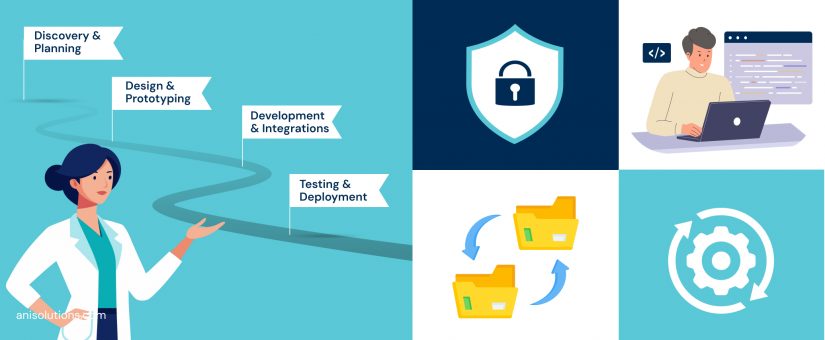
But you can get a realistic timeline for EHR development by carefully planning each phase. For instance, the first phase of discovery and planning can take 1-2 months, depending on the scope of the project and features to add.
Then the designing and prototyping phase can go up to 3-4 months, and this is before development even begins. With each phase taking months to finish, most of the time going into the core development phase. However, if you don’t take this into account and plan based on assumptions, then timelines get unrealistic.
The result is extra time, budget overruns, constant rework, and limited scalability, affecting long-term growth.
So, how do you plan for an EHR development timeline that actually works?
In this blog, we will explore how to get a realistic EHR development timeline, along with getting a basic understanding of how long it takes to build an EHR, including MVP, mid-scale, and enterprise-grade.
Let’s dive in!
Is Your Organization Ready to Build an EHR? Score Yourself
Assess NowWhat Determines the EHR Development Timeline?
An EHR development timeline cannot be decided solely by the time it takes to develop a system. It is mainly defined by the scope of the project, regulatory requirements, integration, and features to add, which decides the complexity of EHR development. That’s why it’s important to understand these factors and how they impact the development timeline:
- Scope & Clinical Feature Complexity: The scope of the EHR depends on the features you are going to add to the EHR software, and this also decides the time needed to develop the EHR. If you are going to add only charting, scheduling, and documentation features, then development is quicker than a system supporting AI features, predictive analytics, and specialty-specific workflows.
- Compliance & Regulatory Readiness: In healthcare software development, compliance and regulatory requirements are a must. This means you need time for adding HIPAA, ONC, and other regulatory standards, along with audit trails, role-based access, and data protection standards. If it is added after development, then the timeline extends and needs rework, leading to additional costs.
- Integration & Interoperability Dependencies: EHR software needs connectivity to operate at its full potential. This is where integration with labs, billing systems, HIEs, and other third-party platforms adds external dependencies impacting timelines. Moreover, each integration requires mapping, testing, and coordination, which requires time.
- Customization vs Configuration Decisions: Although customization is necessary and enables flexibility, it also increases development time and long-term maintenance. However, configuration-first approaches in which workflows are adapted using existing components, shortening timelines while preserving scalability. If you understand early, it prevents scope creep in the later development phases.
- Organizational Readiness & Stakeholder Involvement: Even the best technical plan fails without engaged stakeholders. The delays often come from unclear ownership, slow clinical feedback, or misaligned decision-making. This is why practices with defined governance, active clinician involvement, and timely approvals move significantly faster.
- How Early Automation & AI-Assisted Analysis Reduce Ambiguity: Modern EHR projects increasingly use automation and AI-assisted analysis during discovery. With tools that analyze workflows, documentation patterns, and integration requirements decided early, help reduce ambiguity, identify hidden dependencies, and prevent late-stage pitfalls, while keeping timelines realistic.
Phase-Based EHR Development Timeline (With Time Expectation)
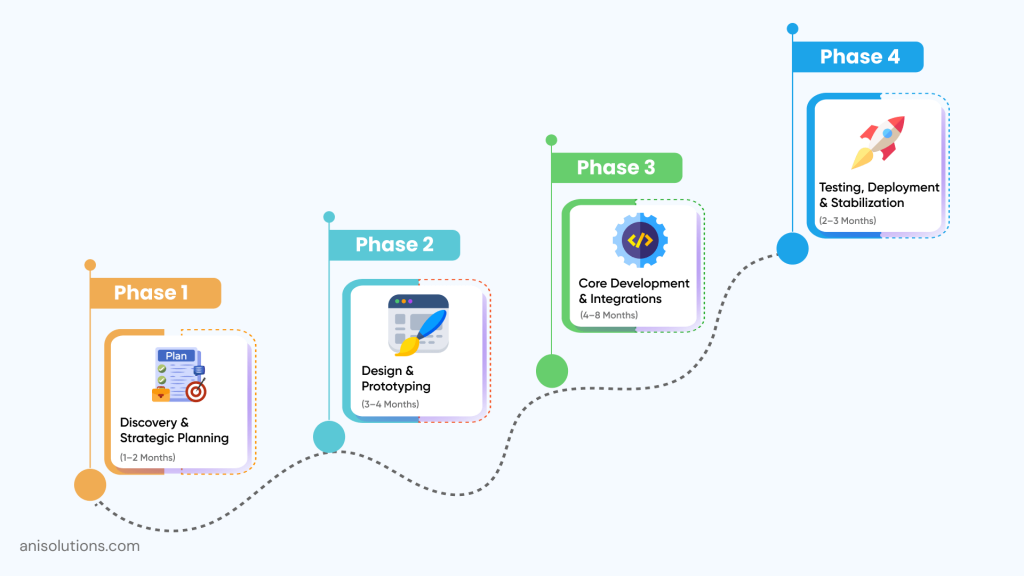
As mentioned in the introduction, EHR development is done in a phased development approach for better efficiency. And each phase has its own objective, dependencies, and time requirements, so let’s understand how much time each phase takes to help you set realistic expectations from day one:
- Phase 1: Discovery & Strategic Planning (1-2 Months)
This is the stage that sets the foundation of the entire EHR development process and takes an initial one to two months to plan out everything. Moreover, it includes clinical workflow mapping, requirement validation, and stakeholder alignment across clinical, operational, and IT teams. The planning phase also includes architecture with security, compliance, and scalability ,and these components of discovery take time to be completed accurately to avoid delays later by incomplete discovery.
- Phase 2: Design & Prototyping (3-4 Months)
In this phase, the development focuses on clinician-centric UI/UX, and developing the workflow aligned design is crucial. Here, rapid prototyping helps early validation with end users, minimizing late-stage changes that can derail timelines. Moreover, AI-supported design insights, such as usability pattern analysis, speed up iteration while maintaining consistency and adoption readiness. All of this needs at least three to four months to complete efficiently and effectively.
- Phase 3: Core Development & Integrations (4-8 Months)
Out of all the phases, this is the most time-intensive, taking nearly four to eight months to finish. It is also a complex stage with the backend and frontend structure. The time goes into developing interoperability with connecting labs, billing systems, and third-party platforms using HL7 and FHIR. But you can reduce the time by using AI-powered engineering tools as they eliminate repetitive development tasks, accelerate testing, and improve code consistency across modules.
- Phase 4: Testing, Deployment, & Stabilization (2-3 Months)
This is the final stage of development, taking two to three months to be completed. It includes testing of functionality, security validation, compliance checks, and performance testing. Most importantly, data migration, user training, and implementation. However, AI-supported testing and monitoring tools can reduce validation cycles by identifying issues and helps stabilizing EHRs much more quickly.
Before You Build Your EHR Check our 27-Point EHR Timeline Readiness Checklist
Click HereOverall Timeline: How Long Does It Really Take to Build an EHR System?
Although each development timelines vary based on complexity, features, and organizational readiness. Moreover, while many vendors promise early deployment, it is limited to some EHRs that have low complexity and feature requirements.
For instance, a minimum viable product (MVP) would have only basic features such as charting, scheduling, basic reporting, and limited integration. This is why the EHR implementation timeline will only be six to nine months. The scope is focused on clearly defined workflows and early compliance considerations.
Whereas a mid-scale EHR has a broader scope, multiple roles, and integrations with labs, billing, pharmacies, and other external systems. With more complex features, it might take nine to 12 months to deploy an EHR system. This custom EHR development time includes deeper workflow validation, interoperability testing, and more extensive user training, all of which increase time.
Then come the enterprise-grade EHR systems designed for multi-site operations, complex specialties, advanced analytics, and long-term scalability. All of this requires 18 to 24 months or more to finish development and implementation. These timelines reflect layered compliance requirements, extensive integrations, phased rollouts, and extended stabilization periods.
While these are the timelines are based on our experience of developing the EHRs, they are not concrete. That’s why you need to plan the development with your needs, workflow complexity, and regulatory requirements that your clinic and state require. And doing this helps you avoid delays, cost overruns, and rushed deployments while understanding how long to build an ehr system with all your needs met.
Common Challenges That Delay EHR Timelines
Even a well-planned EHR projects face challenges if the issues are not addressed properly and early. The table below highlights the most frequent causes of EHR timeline delays and how you can avoid them:
| Common Challenge | How It Delays EHR Timelines | How to Mitigate the Risk |
| Scope creep and late requirement changes | Expands development and testing cycles, forces rework, and disrupts sprint planning | Lock requirements early, use phased releases, and enforce change control |
| Underestimating compliance and security validation | Triggers redesigns, extended testing, and delayed go-live approvals | Build compliance into architecture and test continuously |
| Delayed stakeholder feedback and approvals | Creates decision bottlenecks and idle development cycles | Define governance, assign clinical owners, and set feedback SLAs |
| Third-party integration dependencies | Causes delays due to vendor timelines, data mapping issues, and failed testing cycles | Start integrations early and plan buffers for external dependencies |
Estimate Your Realistic EHR Development Timeline in 15 Minutes
Check NowConclusion: Setting the Right Timeline Expectation
Long story short, the timeline for build EHR system varies from one system to another, depending on complexity, requirements, and features. Most importantly, you can’t decide the timeline to build an EHR on assumptions, rather you need to base it on clinical needs and development phases.
With the approach of developing EHR in phases, you can break the timeline into predictable parts, creating a realistic EHR development timeline. The biggest advantage of doing this is you know where your organization stands in readiness while identifying places that can delay the timeline, preventing any derailing.
So, if you want to plan the timeline efficiently, the first step is to understand what the scope and needs. click here to assess your organization’s readiness and requirements today and get started with EHR development.
Frequently Asked Questions
Q. How long does it take to develop a custom EHR MVP compared to a full-scale enterprise system?
A custom EHR MVP typically takes 6–9 months, while a full-scale enterprise system can take 18–24 months or longer, depending on compliance depth, integrations, scalability requirements, and organizational readiness.
Q. Which phases of EHR development are most susceptible to timeline bottlenecks and delays?
The discovery, integration, and testing phases are the most vulnerable. Incomplete requirements, delayed stakeholder feedback, third-party dependencies, and late compliance validation often create cascading delays that impact the entire development timeline.
Q. How does integrating AI-driven capabilities impact the overall EHR development timeline?
AI can slightly extend early planning but often shortens the overall timeline by reducing ambiguity, accelerating documentation analysis, improving testing efficiency, and minimizing rework during development and post-go-live stabilization.
Q. How much additional time should be allocated for data migration from legacy systems?
Data migration typically adds 1–3 months, depending on data quality, system complexity, and validation requirements. Poorly structured legacy data or incomplete mappings can significantly increase timelines if not planned early.
Q. Can pre-built components and AI-assisted development shorten EHR build timelines?
Yes, when used strategically. Pre-built modules and AI-assisted development reduce repetitive work, accelerate integrations, and speed testing—often cutting 10–25% off timelines without compromising compliance or scalability.
Q. What are the critical success factors for keeping an EHR implementation timeline on track?
Clear scope definition, early compliance planning, engaged clinical stakeholders, disciplined change management, realistic integration buffers, and continuous validation are key to maintaining momentum and avoiding costly timeline overruns.
A custom EHR MVP typically takes 6–9 months, while a full-scale enterprise system can take 18–24 months or longer, depending on compliance depth, integrations, scalability requirements, and organizational readiness.
The discovery, integration, and testing phases are the most vulnerable. Incomplete requirements, delayed stakeholder feedback, third-party dependencies, and late compliance validation often create cascading delays that impact the entire development timeline.
AI can slightly extend early planning but often shortens the overall timeline by reducing ambiguity, accelerating documentation analysis, improving testing efficiency, and minimizing rework during development and post-go-live stabilization.
Data migration typically adds 1–3 months, depending on data quality, system complexity, and validation requirements. Poorly structured legacy data or incomplete mappings can significantly increase timelines if not planned early.
Yes, when used strategically. Pre-built modules and AI-assisted development reduce repetitive work, accelerate integrations, and speed testing—often cutting 10–25% off timelines without compromising compliance or scalability.
Clear scope definition, early compliance planning, engaged clinical stakeholders, disciplined change management, realistic integration buffers, and continuous validation are key to maintaining momentum and avoiding costly timeline overruns.
- On February 18, 2026
- 0 Comment