Future Trends in EHR Automation: What’s Next for Digital Healthcare
Before landing here, you might have searched for EHR automation or the future trends in EHR. And might have found multiple blogs discussing this topic and how AI is changing the whole EHR development process, towards developing more intelligent and automated workflows.
In the beginning, the automation worked on rule-based logic. For instance, in 1972, Mayo Clinic’s Regenstrief Medical Record System automated workflows such as data entry and lab orders. However, these early efforts focused on storage and coordination of care because of the lack of interoperability and better technology.
However, this changed during the pandemic of COVID-19 with advancements in machine learning, NLP (Natural Language Processing), taking systems from rule-based to intelligent EHR automation. These advancements set the foundation for the future evolution of automation in EHR.
According to a recent report in the Journal of Medical Internet Research, nearly 75% of the US healthcare organizations have integrated machine learning (ML) for predicting patient risks and automating billing as well as scheduling.
Furthermore, this not only made EHR much more efficient but also reduced the physician burnout by eliminating redundant processes. And now with future trends in EHR automation, such as agentic AI, the EHR development is moving towards proactive and agentic systems.
This is the big step from the initial rule-based automation in EHR systems. But there are many more future trends in EHR automation that are changing how automation in EHR works.
In this blog, we will explore which automation trends in EHR automation will impact EHRs in the future, key challenges in implementing these automation features in EHR, and how to overcome them.
Let’s dive in!
From Rule-Based Automation to Intelligence Workflows
Initially, the workflow automation was not what you see today; before the integration of AI and ML, the automation was built on static, rule-based logic. It worked on features such as pre-defined templates, macros, and simple if-then rules.
Although this streamlined repetitive tasks and reduced manual efforts to some extent, the automation remained rigid, did not remain context-aware, and specialty-specific. The rules had to be predefined, maintained manually, and applied uniformly, without considering clinician behavior and workflow variations.
But this approach came with many limitations, as care rarely happens uniformly, and it leads to alert fatigue, poor adaptability, and limited scalability. For instance, the if-then rules work as if the BP is more than X, then show an alert. This works well in controlled environments, but fails when patient complexity increases.
And this is where AI and machine learning shift the systems toward context-aware and intelligent automation. With this automation, EHR does not follow rigid rules and adapts as per the patient data, user behavior, and real-time insights.
With these intelligent workflows, EHR prioritizes tasks based on patient risk, auto-suggests next steps in care plans, and adapts documentation flows based on specialty and visit type. Most importantly, they enable proactive care coordination, reduce cognitive load for clinicians, and support personalized, efficient care delivery.
Moreover, the EHR automation in EHR is continuously evolving, and the future trends in EHR are making it more efficient. Let’s see how these features are changing automation.
Are Your Systems Ready for Automation? Assess them Right Now
Click HereThe Rise of Agentic & Autonomous EHR Automation
As EHR platforms are growing, automation is also evolving beyond isolated task execution into agentic and autonomous systems. The traditional EHR automation focuses on completing predefined tasks, triggered by clinician input or static rules.
Whereas the first trend in automaton is agentic AI systems designed to perceive context, make decisions, and initiate actions independently, with clinicians providing oversight rather than constant direction. This shift represents a fundamental change in how automation in EHRs supports care delivery and operations.
| Aspect | Traditional Task Automation | Agentic & Autonomous EHR Automation |
| Trigger | Manual input or predefined rule | System-initiated based on real-time context |
| Intelligence | Static, rule-based logic | Context-aware, learning-driven |
| Decision-making | Executes predefined actions | Evaluates situations and chooses next steps |
| Workflow scope | Single-step tasks | Multi-step, end-to-end workflows |
| Adaptability | No learning over time | Continuously improves with data and feedback |
| Clinician involvement | Constant manual supervision | Oversight-by-exception |
| Examples | Auto-filled templates, rule-based alerts | Auto-coordinated follow-ups, draft discharge summaries |
The benefit of agentic workflows enables EHR systems to act proactively. For example, autonomous agents can coordinate follow-up care by reviewing discharge instructions, scheduling appointments, and sending reminders without explicit clinician prompts.
These agents can pre-draft discharge summaries by creating clinical notes, lab results, and treatment plans, allowing clinicians to review rather than start from scratch. As for the administrative side, agentic systems can manage multi-step processes such as eligibility checks, documentation completion, and handoffs across departments.
With these capabilities, define the future trends in EHR automation. Instead of serving as passive record systems, EHRs are becoming intelligent, easily streamlining complex workflows. For healthcare organizations to scale and improve clinician satisfaction, agentic and autonomous automation are crucial.
Hyper-Automation Across Clinical & Administrative Operations
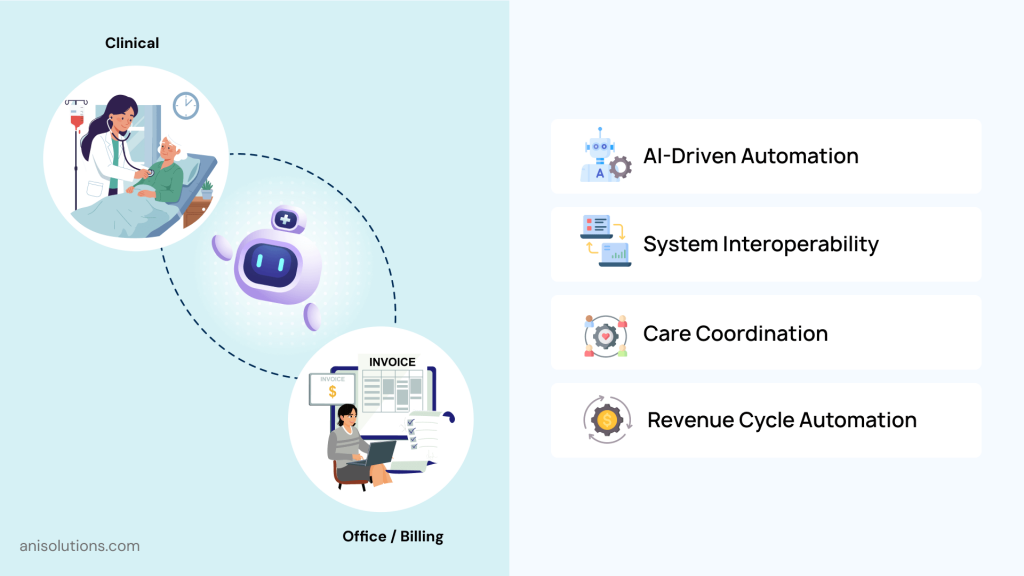
Then the next trend in automation in EHR is hyper-automation, where AI, workflow engines, interoperability standards, and predictive analytics work together. This shift entirely changes how automation in EHRs delivers value to the entire healthcare organization.
Along with this, the automation features in EHR are also increasing across everyday workflows. Before the AI, the workflows that were automated were just lab orders and data entry. But now everything from patient intake and clinical documentation to order management and care plan updates can be automated.
One more feature that is improved by hyper-automation is care coordination and clinical operations. Because automated workflows can easily connect physicians, care managers, nurses, and external providers by organizing referrals, follow-ups, and care transitions automatically.
Beyond clinical workflows, automation is transforming revenue cycle management and administrative processes. It can handle tasks such as eligibility verification, coding assistance, prior authorizations, and denial management, reducing delays, minimizing errors, and improving financial performance.
However, all of this becomes possible if the system is interoperable and can exchange data seamlessly. That’s why you need standards-based integration with labs, pharmacies, billing platforms, and third-party systems. Without this, hyper-automation cannot function at its full potential, limiting the capabilities of intelligent healthcare systems.
Download Checklist to Reduce Clicks with Hyper Automation Features
Click HerePredictive & Proactive Automation in Future EHRs
The rule-based automation is reactive and only responds after a clinician enters data or a predefined condition gets triggered. The future of EHR automation, however, is moving decisively toward predictive and proactive systems that anticipate needs before issues escalate. And this shifts automation from just documenting care to supporting clinical decision-making and operational planning.
Predictive automation uses historical and real-time data to identify risks early. By analyzing patterns across diagnoses, vitals, lab results, medication adherence, and social factors, future EHRs identify patients at higher risk for readmission and care gaps.
Based on these predictions, prescriptive automation recommends the best next steps for clinicians. These systems don’t just highlight a problem; they suggest actions based on evidence, patient context, and past outcomes.
For example, a future-ready EHR may recommend adjusting a care plan, scheduling a follow-up, initiating remote monitoring, or coordinating with care managers. So, predictive and prescriptive automation, when used together, transform automation in future EHR platforms.
And these features are becoming the core capabilities of EHR, enabling healthcare organizations to shift from reactive to proactive and outcome-focused healthcare.
Patient-Centric Automation: Expanding Beyond the Clinician
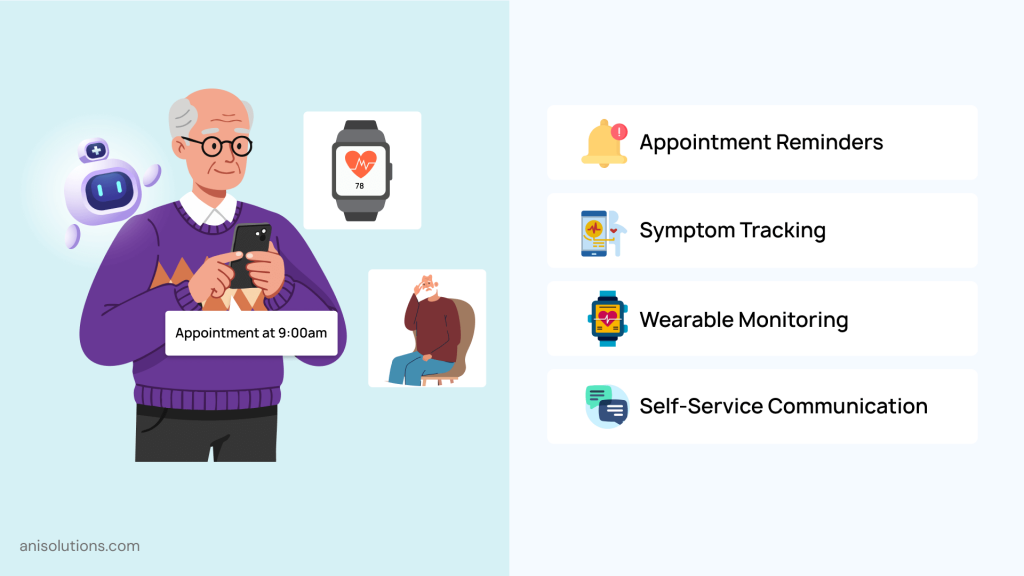
When it comes to future trends in EHR, automation is no longer confined to clinician workflows alone. As healthcare shifts toward value-based and continuous care models, automation is increasingly extending into patient-facing experiences.
Additionally, modern EHR platforms are evolving to support not just providers, but also patients, making them active participants in their own care journeys. One of the most visible changes is the expansion of automation into patient-facing workflows.
It automates scheduling, digital check-ins, reminders, and follow-ups reduce friction for patients while easing administrative burden for care teams. These workflows ensure consistent engagement without requiring constant manual outreach from staff.
Moreover, patient-centric automation also enables self-updating health records through intelligent intake and engagement tools. Automated questionnaires, symptom checkers, and conversational interfaces can collect structured and unstructured data directly from patients before and between visits. This information flows into the EHR in real time, keeping records current while reducing manual documentation for clinicians.
The growing use of remote patient monitoring (RPM) and patient-generated health data further accelerates this shift. Data from wearables, home devices, and mobile apps can be automatically ingested, analyzed, and linked to care plans. These systems can monitor trends, detect anomalies, and trigger alerts when interventions are needed, without waiting for in-person visits.
Finally, patient-centric automation empowers patients through automated insights and alerts. Patients receive personalized notifications, progress updates, and care reminders tailored to their conditions and goals.
By expanding automation beyond the clinician, future EHR platforms build stronger engagement, improve outcomes, and support a more personalized and collaborative approach to healthcare delivery.
Understand How Automation Makes Engaging Patients Easier with Our Guide
Click NowKey Challenges: Trust, Security, & Ethics in the Future of EHR Automation
As automation in EHR systems becomes more intelligent and autonomous, healthcare organizations face a new set of challenges. And these challenges are trust, security, and ethical accountability because clinicians must be confident that automated workflows are reliable, explainable, and aligned with clinical judgment.
Moreover, organizations face growing concerns about bias, variability in edge cases, and the security risks associated with automated data flows. Without transparency and clear safeguards, even advanced automation features in EHRs risk limited adoption or resistance at scale.
| Challenge Area | What the Challenge Looks Like | Why It Matters |
| Trust & Adoption | Clinicians hesitate to rely on automated or system-initiated actions | Limits real-world usage and automation ROI |
| Explainability & Transparency | AI-driven decisions lack clear reasoning or audit trails | Reduces confidence and raises compliance concerns |
| Bias & Variability | Inconsistent performance across populations and edge cases | Risks of inequitable or unsafe clinical outcomes |
| Security & Data Protection | Automated workflows expand access points and data exposure | Increases vulnerability to breaches and misuse |
| Accountability & Governance | Unclear responsibility between humans and autonomous systems | Creates legal, ethical, and operational risk |
| Organizational Readiness | Limited governance, skills, and change management | Slows large-scale automation adoption |
Addressing these challenges requires a balanced approach that combines secure system design, ethical AI practices, and strong governance frameworks. With future-ready EHR platforms must ensure data protection, audiatability, and human oversight while allowing automation to operate at scale.
So, to get the full potential of the EHR automation, it’s important to have intelligent, ethical, and sustainable healthcare automation.
Conclusion: Preparing for the Autonomous EHR Era
In a nutshell, EHR automation has progressed from a rule-based system to AI-powered intelligent workflows. Initially, the system only automated data entry and sending lab orders, but over time, it has become a context-aware and autonomous system that supports clinical decisions and streamlines operations.
Moreover, the trends in EHR automation are continuously evolving, and future-ready automation is becoming a strategic decision rather than an option. That’s why, the healthcare organizations invest early in automation frameworks that are ethical, interoperable, and scalable.
So, if you are ready to build an EHR that supports agentic AI and free clinicians from repetitive tasks, then click here to book your free consultation and start the AI-powered EHR development.
Frequently Asked Questions
Q. What are the emerging trends in EHR automation for 2025–2030?
From 2025 to 2030, EHR automation will shift toward agentic AI, predictive workflows, hyper-automation across clinical and administrative operations, patient-centric automation, and real-time interoperability-driven orchestration rather than isolated task automation.
Q. How will Generative AI change the future of electronic health records?
Generative AI will transform EHRs by automating clinical documentation, summarizing patient histories, generating discharge notes, and enabling conversational interfaces—reducing clinician burden while turning EHRs into intelligent, context-aware clinical assistants.
Q. What is the difference between basic EHR automation and agentic AI workflows?
Basic EHR automation executes predefined tasks using static rules, while agentic AI workflows independently evaluate context, initiate actions, and manage multi-step processes—shifting EHRs from reactive tools to proactive, autonomous systems.
Q. How does predictive automation in EHRs improve patient outcomes?
Predictive automation analyzes clinical and operational data to identify risks early, flag care gaps, and enable timely interventions—helping clinicians prevent complications, reduce readmissions, and deliver more proactive, outcome-driven care.
Q. What role does blockchain play in the future of automated health data exchange?
Blockchain can enhance automated health data exchange by enabling tamper-proof audit trails, decentralized data sharing, and stronger trust between systems—supporting secure interoperability, consent management, and accountability in highly automated EHR ecosystems.
From 2025 to 2030, EHR automation will shift toward agentic AI, predictive workflows, hyper-automation across clinical and administrative operations, patient-centric automation, and real-time interoperability-driven orchestration rather than isolated task automation.
Generative AI will transform EHRs by automating clinical documentation, summarizing patient histories, generating discharge notes, and enabling conversational interfaces—reducing clinician burden while turning EHRs into intelligent, context-aware clinical assistants.
Basic EHR automation executes predefined tasks using static rules, while agentic AI workflows independently evaluate context, initiate actions, and manage multi-step processes—shifting EHRs from reactive tools to proactive, autonomous systems.
Predictive automation analyzes clinical and operational data to identify risks early, flag care gaps, and enable timely interventions—helping clinicians prevent complications, reduce readmissions, and deliver more proactive, outcome-driven care.
Blockchain can enhance automated health data exchange by enabling tamper-proof audit trails, decentralized data sharing, and stronger trust between systems—supporting secure interoperability, consent management, and accountability in highly automated EHR ecosystems.
- On February 16, 2026
- 0 Comment