Telehealth-Ready EHRs: The New Baseline for Modern Virtual Care
The time of treating telehealth as an external tool is long past. Today, telehealth is an integral part of entire healthcare systems, so it is crucial to build your custom EHR with telehealth EHR integration. Because even if your EHR is telehealth-ready, if it can’t sync the data from a virtual visit to a patient record, then it becomes more complicated than an in-person visit.
It leads to providers constantly switching screens and re-entering data manually across the system, creating inefficiencies and risking inaccurate patient records. This happens when EHR telehealth capabilities rely on disconnected workflows.
However, when the telehealth is directly embedded into the EHR, then everything becomes much easier.
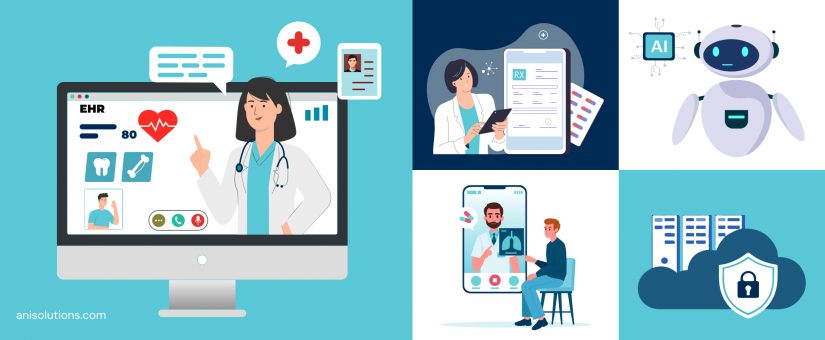
A true telemedicine integration just doesn’t enable video calls; it becomes the core component of the system, connecting scheduling, intake, clinical documentation, prescribing, and follow-ups within a single workflow. The telehealth-ready EHR modules help visit data flow directly into the patient record, eliminating gaps and keeping care continuous.
But building telhealth-ready EHR systems requires some crucial telehealth EHR features that support efficiency, scalable virtual care without compromising safety and care quality.
In this blog, we will walk you through the features that make the EHR system truly telehealth-ready, along with explaining how you can eliminate data gaps through integration.
What Makes an EHR System Truly Telehealth-Ready?
At first glance, every EHR seems telehealth-ready, but when you use it, it becomes clear that telehealth is not seamlessly built into it. There is a big difference between EHR supporting telehealth and a truly telehealth-ready EHR system, and that difference is telehealth integration.
Before choosing any system for supporting virtual care, the first thing you need to check is how deeply the system is integrated into the system. If the systems are connected loosely, then virtual care will happen in isolation, not in connected, single workflow environments mentioned above.
This is where unified workflows, shared data, and AI-assisted features become a must-have for building telehealth-ready EHR systems. The table below highlights the differences in basic and telehealth-ready EHRs:
| Aspect | Basic Telehealth Add-On | Telehealth-Ready EHR Modules |
| Integration Depth | External video tool loosely connected to the EHR | Native EHR telehealth functionality embedded in the system |
| Workflow Experience | Separate scheduling, visits, and documentation | Unified workflow across scheduling, visits, and charting |
| Clinical Context | Limited access to patient history during visits | Full patient record available in real time |
| Documentation | Manual data entry after the visit | One-screen documentation during the encounter |
| Data Synchronization | Delayed or partial sync | Real-time telemedicine integration with the patient record |
| AI Support | Minimal or none | AI-assisted surfacing of relevant data and visit summaries |
| Scalability | Struggles as virtual visit volume grows | Designed for scalable virtual care delivery |
So, if you want a system that connects virtual care and in-person care, keeps the care continuous, and workflows connected, then telehealth- ready EHR modules are necessary to eliminate data gaps. Moreover, there are some core features that help you develop seamless telemedicine integration. Let’s take a look at those features.
Core Telehealth EHR Features That Support Virtual Care
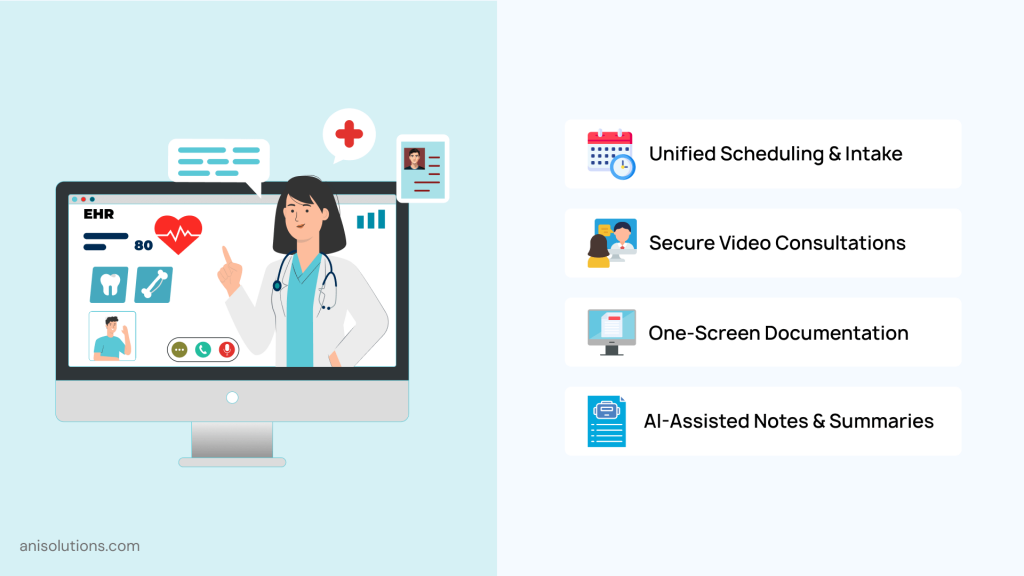
Similar to how you can’t build EHR systems on a single feature, developing a seamless EHR telehealth capability is not possible without some core features. When all of the features, such as unified scheduling and secure video consultations, are built into the EHR architecture, clinicians can easily deliver efficient remote care without sacrificing patient safety and care quality.
- Unified Scheduling, Intake, & Virtual Access: To keep the virtual workflows connected and efficient, unifying scheduling and intake is crucial. When these are connected, the patient can fill the intake form, and providers can access the patient histories and previous treatments on a single platform. This reduces delays, eliminates manual handoffs, and ensures virtual encounters with the right context.
- Secure, EHR-Embedded Video Consultations: Keeping the virtual care secure is crucial, and when the EHR telehealth happens through a secure EHR embedded with security controls, clinicians can provide care confidently. With HIPAA-aligned controls such as encrypted calls and access control, patient data is protected during virtual encounters while simplifying the auditing process.
- One-Screen Documentation During Virtual Visits: This feature is crucial for documenting patient details in real-time without switching screens and missing what the patient is saying. In addition, clinicians can review patient history, take notes, place lab orders, and update care plans on a single screen. This reduces cognitive load and improves documentation accuracy, especially during high-volume telehealth sessions.
- AI-Assisted Note Generation & Visit Summaries: Modern telehealth EHR features increasingly rely on AI to reduce documentation burden. AI-assisted note generation helps providers summarize conversations, highlight key clinical details, and structure visit notes automatically. This saves time, along with improving consistency across telehealth encounters.
Is Your EHR Truly Telehealth-Ready? Find Out with this Checklist
Click HereEliminating Data Gaps Through Telemedicine Integration
One of the biggest risks in virtual care is not video quality, but fragmented data. When telehealth encounters operate outside the EHR, critical clinical information can arrive late, land in the wrong place, or fail to connect to the patient record.
This is where effective telemedicine integration becomes crucial in closing all of these gaps by ensuring virtual care data moves seamlessly across the system in real-time.
- Real-Time Syncing of Telehealth Encounter Data: In telehealth-ready EHR systems, data generated during virtual visits is written directly to the patient record as the encounter happens. Notes, diagnoses, timestamps, and care decisions are immediately available to the care team. This real-time telehealth EHR integration preserves clinical continuity and ensures downstream workflows such as billing and follow-ups are not disrupted.
- E-Prescribing & Lab Orders from Virtual Visits: Virtual encounters often require immediate next steps, and telehealth-ready EHR modules allow clinicians to initiate e-prescriptions, lab orders, and referrals directly from the virtual visit workspace. This is done the same way it happens in-person, with all validation, keeping telehealth aligned with standard clinical practice.
- AI-Supported Data Organization & Searchability: Along with the virtual visit volume, the data complexity also increases. AI-supported telehealth EHR features help organize encounter data, tag relevant clinical information, and keep records searchable over time. This structured approach ensures telehealth interactions remain usable for future visits, analytics, and population health initiatives rather than siloing the data.
When the data flows from a virtual visit to a patient record without any gaps, then it becomes as seamless as an in-person visit.
Expanding Access & Continuity of Care
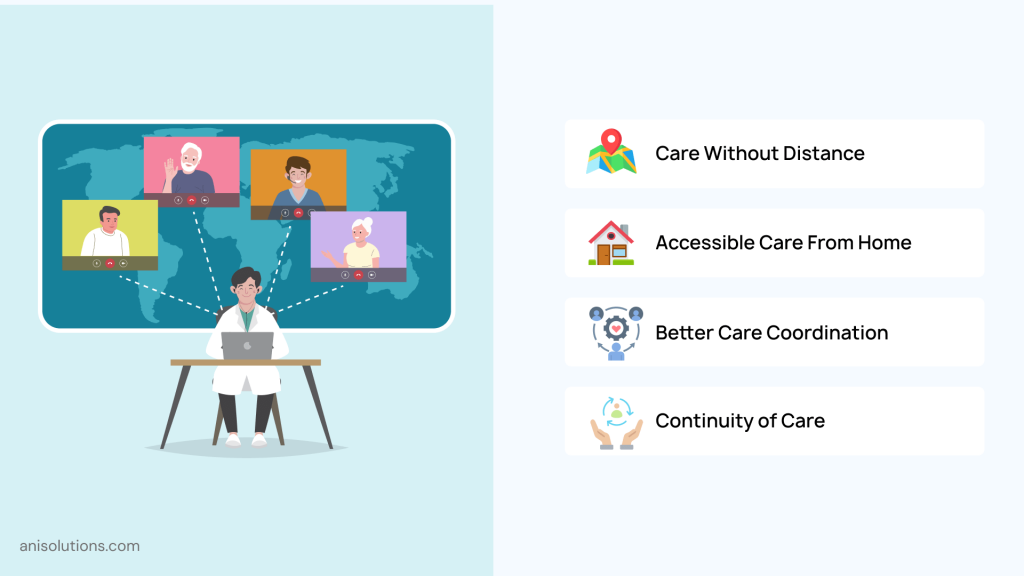
The biggest advantage of virtual care is that it eliminates geographical barriers. Clinicians can even reach the remote areas where providing care was difficult. This has given everyone access to care, and when the telehealth is integrated into the EHR, this access expands and becomes even more efficient to maintain continuity of care.
With telemedicine integration, patients with disabilities who can’t leave their homes for in-person care can access care conveniently. This plays a significant role in reducing no-shows during follow-ups, and also, providing behavioral health care has become much easier with telehealth.
Most importantly, people in underserved areas can now reach specialists without traveling hundreds of kilometers. The general physicians can coordinate with specialists and provide the necessary care to the patient without sacrificing quality or delaying the care.
In addition, all this happens while keeping the patient records updated. Telehealth-ready EHR modules ensure virtual visits feed seamlessly into ongoing care plans, follow-up scheduling, and longitudinal records. If we put it simply, due to EHR, telehealth patients can access care flexibly and on time.
Want to Scale Your Systems? Download this Strategy Guide for Framework that Truly Works
Get NowSecurity, Compliance, & Reliability EHR Modules
As telehealth has become mainstream practice and many patients are using it to receive care, securing it and their patient data is crucial. This is where the HIPAA-compliant development becomes important to protect access points, data flows, and user behavior.
Telehealth-ready EHR systems ensure that all data from visit videos, clinical notes, shared files, and communications is encrypted end-to-end. Data encryption, secure session handling, and controlled data storage are built into the EHR itself, reducing reliance on external platforms. This approach helps in maintaining data integrity across every virtual encounter.
With virtual care, the access points also increase, and controlling who can access these points is crucial. The EHR telehealth systems bring role-based access controls, maintain detailed audit logs, and manage digital patient consent within the system. Every access and activity is documented and traceable, supporting compliance requirements and simplifying audits.
With the growing patient and data volume, manual governance can’t keep up. However, integrating AI for monitoring helps detect unusual access patterns, integration failures, or data inconsistencies in real-time. This proactive layer improves system stability and reduces the risk of unnoticed security or integration issues disrupting care delivery.
In virtual care, security, compliance, and transparency are foundations for maintaining trust in the patients. So, you need to pay attention to developing a compliant and secure telehealth EHR integration.
Conclusion: Telehealth-Ready EHRs Are No Longer Optional
Long story short, today, telehealth is tightly linked to the healthcare industry, and patients now expect to be treated remotely. That’s why having a telehealth supporting EHR is a baseline expectation for clinics.
However, many EHRs still don’t provide a seamless and truly telehealth-ready EHR; they just add external apps for providing virtual care. In this, telehealth-ready EHR modules play a significant role as they connect scheduling, intake, and follow-up care in a single workflow.
So, if you are building telehealth-ready EHR systems, then these EHR modules are the building blocks for achieving it. We can help you develop a true telehealth EHR integration that simplifies virtual care without compromising security, efficiency, and convenience. click here to book your free demo and get started with seamless telehealth EHR integration.
Frequently Asked Questions
Q. How does telehealth EHR integration improve patient data security compared to using standalone video applications?
Telehealth EHR integration keeps virtual visit data inside secure EHR systems, reducing data transfer risks. Embedded access controls, encryption, audit trails, and centralized storage provide stronger protection than standalone video applications.
Q. What are the must-have telehealth EHR features for healthcare organizations scaling remote care?
Must-have telehealth EHR features include embedded video visits, unified scheduling and intake, real-time documentation, e-prescribing, lab ordering, and AI-assisted clinical support to scale virtual care efficiently without workflow fragmentation.
Q. Can a custom EHR support integration with existing remote patient monitoring (RPM) devices?
Yes, custom EHR systems can integrate with existing RPM devices using APIs and interoperability standards, enabling continuous data ingestion, real-time alerts, and seamless synchronization with patient records for ongoing remote care management.
Q. How does an integrated EHR telehealth module support clinicians by reducing workflow friction during virtual visits?
An integrated EHR telehealth module unifies scheduling, video visits, documentation, and orders in one workspace. This reduces screen switching, manual data entry, and cognitive load, allowing clinicians to focus on patient care.
Q. What HIPAA compliance considerations apply when building telehealth-ready EHR systems?
Telehealth-ready EHR systems must ensure encrypted data transmission, role-based access control, audit logging, secure data storage, patient consent management, and vendor compliance to meet HIPAA privacy and security requirements.
Telehealth EHR integration keeps virtual visit data inside secure EHR systems, reducing data transfer risks. Embedded access controls, encryption, audit trails, and centralized storage provide stronger protection than standalone video applications.
Must-have telehealth EHR features include embedded video visits, unified scheduling and intake, real-time documentation, e-prescribing, lab ordering, and AI-assisted clinical support to scale virtual care efficiently without workflow fragmentation.
Yes, custom EHR systems can integrate with existing RPM devices using APIs and interoperability standards, enabling continuous data ingestion, real-time alerts, and seamless synchronization with patient records for ongoing remote care management.
An integrated EHR telehealth module unifies scheduling, video visits, documentation, and orders in one workspace. This reduces screen switching, manual data entry, and cognitive load, allowing clinicians to focus on patient care.
Telehealth-ready EHR systems must ensure encrypted data transmission, role-based access control, audit logging, secure data storage, patient consent management, and vendor compliance to meet HIPAA privacy and security requirements.
- On February 9, 2026
- 0 Comment