Building EHR Systems With Seamless Integrations: A Complete Guide
Over the last decade, with the rise of AI and the EHR system integrations, EHRs have gone beyond just being digital shelves. They have become the operational backbone of the entire modern healthcare system.
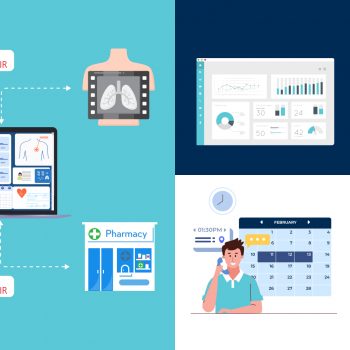
By connecting labs, imaging systems, billing platforms, and pharmacies, patient data flows seamlessly between teams. Yet, many healthcare organizations believe that integration is achieved simply by adding APIs. While APIs are essential, they are just one of the layers of the architecture that make integration possible.
And this misconception leads to clinics thinking basic connectivity is equal to having integrated EHR systems. However, in reality, the right way to build EHR systems with integrations is to design interoperability directly into the architecture.
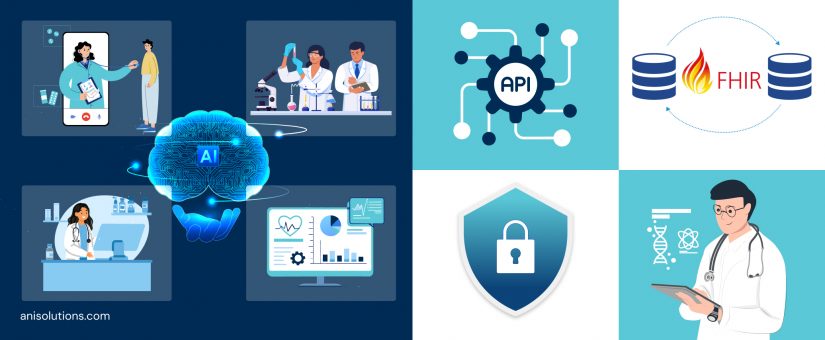
It becomes much more efficient with standards such as HL7 and FHIR by enabling structured, interoperable data exchange across systems.
When integration is built as a foundation, instead of an extension, the way clinicians interact with the system changes completely. Rather than navigating fragmented data and manually reconciling data across platforms, clinicians work with systems that update and sync data automatically.
Most importantly, context-driven integrated systems eliminate redundant tasks, reduce data entry errors, and allow clinicians to focus on patient care. So, before you begin building your EHR, what you need to understand is how to build integration as a foundation during your EHR software development.
In this guide, we will walk you through the whole process of building EHR systems with seamless integrations and what you need to achieve it. We will also explore how AI, telehealth, and patient portals empower EHR software integration.
What Seamless EHR Integration Really Means & Why Architecture Matters?
As said earlier in the introduction, seamless EHR integration is not limited to connecting systems through APIs. While APIs are a critical part of the integration, they only ensure that data is exchanged between systems, but they do not support clinical workflows, nor do they consistently behave.
A true seamless integration is built into the architecture of how deeply data, workflows, and clinical context are embedded into the system. These are the capabilities of an integrated EHR system:
- Real-Time Data Exchange: When the systems are integrated, they support real-time data exchange across the entire healthcare network. This means that lab results, imaging reports, medication updates, and billing information are updated immediately in all connected systems after the changes are made in one system. This ensures clinicians are always in the loop and have the latest patient information, reducing clinical risk.
- Workflow-Aware Information Flow: The patient data delivery is aligned with clinical workflows. With this alignment, clinicians find the right at the right time without going through data manually. This makes the patient encounter and care journey efficient and uninterrupted clinical workflows.
- Context Preservation Across Systems: In integrated EHR systems, data retains its clinical context as it moves between systems. Every diagnosis, order, result, and note is linked to the right appropriate encounters, provider, and care plans. This prevents data fragmentation and ensures that information remains meaningful, actionable, and traceable throughout the patient journey.
- Resilience to Change & Scale: A true EHR integration is designed to scale with the clinic and system. With each new tool, care modules, and regulatory requirements, the integrated EHR architecture adapts to each change without breaking existing workflows.
Many off-the-shelf EHRs do not have these architectural capabilities, and that’s why they struggle to support care at the foundational level. Instead, integration is layered on through vendor-specific interfaces, limiting flexibility and scalability. Over time, this approach increases technical debt and makes the evolving system complex.
To achieve a scalable and seamless EHR, you need to take an approach to EHR software development, prioritizing interoperability, scalability, and workflow alignment from day one.
Interoperability as the Foundation of Modern EHR Systems

One of the most important factors that makes EHR integration seamless is interoperability. It is the ability that ensures data can move across systems in a consistent, structured, and meaningful way, without losing clinical context. Without interoperability, even well-connected systems struggle to scale, adapt, or support modern care delivery.
From a clinical standpoint, interoperability enables:
- A longitudinal patient record: Interoperability brings together data from labs, imaging, pharmacies, specialists, and care transitions into a unified patient record, giving clinicians continuous visibility into medical history, treatment progress, and outcomes across the entire care journey.
- Better care coordination: By ensuring timely, accurate data sharing across care settings, interoperability allows clinicians, specialists, and care teams to collaborate effectively without manual data reconciliation, reducing delays, miscommunication, and errors during transitions of care.
From an operational standpoint, interoperability supports:
- System flexibility & Scalability: Interoperable EHR systems allow healthcare organizations to add new tools, integrate emerging care models, and scale operations without rebuilding existing integrations, reducing development effort while maintaining system stability and workflow continuity.
- Reduced vendor lock-in: Interoperability standards enable organizations to maintain control over their technology ecosystem, making it easier to replace vendors, adopt solutions, and evolve systems based on clinical and business needs rather than technical constraints.
Modern EHR system integrations rely on established interoperability standards, including:
- HL7: HL7 enables the structured exchange of clinical and administrative data between healthcare systems, ensuring information such as patient demographics, orders, and results can be shared reliably across organizations and care environments.
- FHIR: FHIR supports real-time, API-driven access to standardized healthcare data, making it easier to build flexible, scalable EHR integrations that support modern applications, mobile experiences, and interoperable digital health workflows.
- DICOM: DICOM standardizes the exchange and management of medical imaging data, ensuring images and related metadata can be securely shared, stored, and interpreted consistently across imaging systems and clinical platforms.
Together, these standards from the foundation for building EHR systems with seamless integrations, making interoperability reliable, scalable, and future-ready.
Get Your Checklist to Building an Interoperable EHR System
Get NowThe Blueprint: Essential Categories of EHR Integration
The first step in building EHR systems integrations is understanding that not all integrations are for the same purpose. For instance, some integrations support clinical decision-making, while others ensure operational continuity and financial stability.
That’s why each integration needs a different approach, and if you ignore this, then it leads to fragmented workflows and inefficiencies. A successful integration strategy begins by prioritizing the foundational categories that drive day-to-day healthcare operations. Here are the essential integrations for modern EHR systems:
- Clinical System Integrations:
These integrations are the core of patient care delivery and ensure critical patient data flows into the EHR in real time. When these integrations are done right, the data is delivered directly into the EHR, and clinicians can maintain accurate patient records. But if the systems are isolated, clinicians are forced to reconcile information manually, increasing cognitive load and clinical risk.
- Administrative & Financial Integrations:
Another integration category is administrative and financial integrations, which support the business side of healthcare. It connects systems such as scheduling systems, billing platforms, claims processing tools, and eligibility verification systems, ensuring operational workflows run smoothly behind the scenes.
By integrating these systems, patient encounters naturally flow from clinical documentation to billing and reimbursement without duplicate data entry. This reduces administrative overhead, improves revenue cycle accuracy, and minimizes delays caused by missing or inconsistent information.
These clinical and administrative integrations bring a connected ecosystem where care delivery and operations are aligned. Most importantly, these systems are essential building blocks. Without them, even the most feature-rich EHR struggles to support efficient workflows, scalable growth, and consistent patient experiences.
If you want to explore how these integrations work in practice and which ones are truly essential, we break them down in Essential Integration Every EHR Needs.
Optimizing Clinical Workflows by Reducing Administrative Burden

One of the biggest reasons for administrative burden in healthcare is fragmented systems. When EHRs, lab platforms, imaging tools, billing systems, and care management applications operate in silos, clinicians are forced to manually enter, verify, and reconcile the same information across multiple interfaces.
This repetition not only consumes time but also increases the likelihood of documentation errors, missed updates, and workflow disruptions. With seamless EHR integration, you can address this problem at its root by eliminating unnecessary handoffs between systems.
Instead of treating administrative work as an unavoidable byproduct of care delivery, integration embeds automation directly into clinical workflows. This impact becomes visible across key workflow areas:
- Reduction in Duplicate Documentation: Integrated systems ensure that patient demographics, clinical notes, orders, and results are captured once and reused across workflows, significantly reducing repetitive data entry.
- Improved Data Accuracy & Consistency: When systems sync in real time, discrepancies between records are minimized, lowering the risk of billing errors, compliance issues, and clinical misinterpretation.
- More Time for Patient Care: By removing administrative burden, clinicians spend less time navigating systems and more time engaging with patients, improving both job satisfaction and care quality.
Integration is the most sustainable solution to clinician overload because it scales with the system. Rather than adding staff or workarounds to compensate for inefficiencies, integrated EHR systems streamline workflow by design. This creates a clinical environment where technology supports care instead of slowing it down.
Telehealth & Remote Care: From Add-On to Native EHR Capability
In EHR, telehealth has moved from a temporary solution to a permanent care delivery model. Virtual visits, remote monitoring, and asynchronous care are now embedded in how healthcare organizations serve patients across locations and care settings.
However, many EHR platforms still treat telehealth as a standalone tool, added after completing the development of EHR, not as a core workflow. This approach introduces significant challenges because when telehealth operates independently, the data captured also remains isolated.
Moreover, the care becomes inconsistent, and care teams are forced to switch between systems. This happens as virtual encounters are not integrated with patient histories, care plans, or billing workflows, creating gaps that affect both clinical quality and operational efficiency.
For telehealth to deliver long-term value, it must function as a native EHR capability:
- Unified Clinical Documentation: Telehealth encounters should automatically populate patient charts, linking notes, orders, and follow-ups to the same clinical record used for in-person visits.
- Integrated Care Workflows: Scheduling, consent, clinical intake, and post-visit actions must flow seamlessly within existing EHR workflows, without requiring separate tools or manual reconciliation.
- Continuity Across Care Settings: Whether care is delivered virtually or in person, integrated telehealth ensures clinicians have access to complete, up-to-date patient information, supporting consistent decision-making and coordinated follow-up.
- Operational & Billing Alignment: Integrated telehealth ensures virtual encounters align with billing, coding, and compliance workflows, reducing revenue leakage and administrative complexity.
So, integrating telehealth as a core component of EHR aligns virtual care with clinical and operational workflows. When fully integrated, telehealth enhances access without introducing fragmentation, ensuring remote care strengthens, rather than complicates, the healthcare ecosystem.
Empowering Patients Through Integrated Portals

Patient portals were originally introduced to give patients basic access to their health information. Over time, expectations have changed, and now patients expect the same level of convenience, transparency, and responsiveness from healthcare systems that they experience in other digital services.
Meeting these expectations requires more than a standalone portal; it requires deep integration with the EHR. When portals are not connected properly to the EHR, information is often delayed, incomplete, or inconsistent.
That’s why patients may see outdated lab results, struggle to schedule appointments, or encounter gaps in communication with care teams. These limitations reduce engagement and undermine trust. If the truly integrated patient portals function as an extension of the EHR, not a separate application.
When built on seamless EHR integrations, portals enable meaningful patient participation across the care journey:
- Real-Time Access to Health Information: Integrated portals surface up-to-date clinical data, including lab results, visit summaries, medications, and care plans, directly from the EHR, ensuring patients always see accurate information.
- Seamless Scheduling & Communication: Appointment scheduling, secure messaging, and care coordination workflows are tied directly to provider calendars and clinical records, reducing delays and administrative back-and-forth communication.
- Actionable Patient Engagement: Patients can complete intake forms, consent documents, remote assessments, and follow-up tasks that automatically flow into the EHR, minimizing manual data entry for care teams.
- Improved Transparency & Trust: When patients have consistent visibility into their care, billing, and next steps, they are more likely to stay engaged, adhere to treatment plans, and communicate proactively with providers.
Integrated patient portals shift patients from passive recipients of care to active participants. By embedding portals into the EHR architecture, healthcare organizations create a unified experience where patient interactions directly support clinical workflows, operational efficiency, and better health outcomes.
Patient Engagement Readiness Check: Evaluate Your Tech, Workflows, and Gaps
Click HereAI as the Intelligence Layer for Seamless EHR Integrations
As EHR systems become more deeply integrated, AI emerges as the layer that turns connected data into actionable intelligence. On its own, AI cannot fix fragmented systems— its effectiveness depends entirely on the quality, consistency, and context of the data flowing through the EHR.
When integrations are superficial, AI outputs are limited, unreliable, or clinically irrelevant. When integrations are seamless, AI amplifies their value. In integrated EHR environments, AI does not operate as a separate feature.
Rather, it works across clinical and operational workflows, analyzing data from multiple sources, identifying patterns, and delivering insights at the right moment. This transforms EHRs from passive systems of record into active systems of support.
The capabilities below illustrate how AI builds on seamless EHR integrations:
| AI Capability | What Integrated EHRs Enable | Clinical / Operational Impact |
| Intelligent data normalization | Unified, structured data from labs, imaging, pharmacies, and devices | Cleaner patient records, reduced inconsistencies, and more reliable analytics |
| Ambient clinical documentation | Real-time access to encounter context and patient history | Less manual documentation, reduced clinician burnout, and more complete notes |
| Context-aware clinical decision support | Longitudinal patient data across care settings | More accurate alerts, personalized recommendations, and safer clinical decisions |
| Predictive risk stratification | Integrated historical, behavioral, and clinical data | Early identification of high-risk patients and proactive care interventions |
| Workflow automation | End-to-end visibility across clinical and administrative systems | Fewer manual handoffs, faster task completion, and improved operational efficiency |
What is important to understand is that AI success is not driven by algorithms alone; it is driven by integration maturity. Without interoperable data flows, AI models lack context and consistency. With seamless EHR integrations in place, AI enhances clinical decision-making, reduces cognitive load, and supports scalable care delivery.
In this way, AI becomes the intelligence layer that sits on top of an integrated EHR architecture, augmenting workflows, improving outcomes, and enabling healthcare systems to operate more proactively and efficiently.
Managing Security, Compliance, & Data Integrity in Integrated EHRs
Every new integration, whether with labs, telehealth platforms, patient portals, or AI services, introduces additional access points, data flows, and dependencies. Without a strong security and governance framework, seamless integration can quickly turn into systemic risk.
One of the primary challenges in integrated EHR environments is the expanded attack surface. Data no longer resides in a single system; it moves continuously across internal modules, third-party applications, and external networks.
This makes consistent access control, authentication, and monitoring essential. Integration-first EHRs must enforce role-based access, least-privilege principles, and secure API management to ensure sensitive health data is only accessible to authorized users and systems.
Another factor that increases complexity is compliance. Integrated EHR systems must support auditability across all connected components, tracking who accessed what data, when, and for what purpose. When integrations are loosely managed or poorly documented, maintaining compliance becomes difficult and risky.
Whereas, architecture-driven integrations enable centralized logging, standardized controls, and consistent enforcement of regulatory requirements across the ecosystem. Equally important is data integrity, as in fragmented environments, inconsistent synchronization can lead to mismatched records and duplicated entries.
Seamless integrations protect data integrity by ensuring that updates propagate reliably and consistently across systems, preserving accuracy and clinical context at every touchpoint. Ultimately, secure and compliant integration is not about restricting interoperability; it’s about enabling it safely.
When security, governance, and data integrity are built into the EHR architecture from the start, healthcare organizations can scale integrations with confidence and protect patient trust.
Hidden Compliance Gaps in Your EHR Integrations? Check Your Audit Readiness Now
Assess NowCommon Challenges & Mistakes in EHR Software Integration
Despite growing awareness around interoperability and integration-first design, many EHR integration initiatives still struggle in execution. In most cases, the problem isn’t a lack of technology; it’s a decision made early in architecture, governance, and implementation.
These mistakes often seem reasonable in the short term but create compounding challenges as systems scale, workflows evolve, and new integrations are added. Understanding these common pitfalls helps organizations avoid fragile architectures and build EHR systems that remain stable, adaptable, and future-ready.
| Common Mistake | Why It Happens | Impact on the EHR System | Better Approach |
| Treating integrations as a post-launch task | Focus is placed on core features first, with integrations planned later | Retrofitted workflows, brittle connections, and growing technical debt | Design integrations as a core architectural requirement from day one |
| Over-customized point-to-point integrations | Quick fixes are used to meet immediate operational needs | Poor scalability, high maintenance effort, and increased failure points | Use standardized, reusable integration layers and patterns |
| Assuming static vendors and workflows | Integration strategies are built around current tools only | Vendor lock-in and limited ability to adopt new systems or care models | Build for flexibility using interoperable standards and modular design |
| Ignoring scalability and future growth | Early integrations are not stress-tested for volume or expansion | Performance degradation and frequent rework as usage increases | Design integrations to scale alongside users, data, and services |
| Lack of clear ownership and documentation | No defined governance for integrations | Difficult troubleshooting, audit risks, and loss of institutional knowledge | Establish clear ownership, documentation, and monitoring processes |
You can avoid these challenges with the right mindset; successful EHR software integration requires treating interoperability as a long-term strategy. By prioritizing architectural consistency, scalability, and governance, healthcare organizations can avoid common pitfalls and build integration-ready EHR platforms.
Conclusion: Why Integration-First EHRs Win in the Long Run
Long story short, today, integration and connectivity have become the baseline for the healthcare environment. However, APIs are not enough to have this connectivity or integrated systems. What healthcare organizations need is an architecture where integration is treated as a foundational decision.
So, rather than adding APIs after deciding workflows and features, design an API-first EHR software so you can be ready for future changes and an evolving landscape. We have explored more on this topic in our other blogs; please read them to get even deeper insights into seamless EHR integration.
If you are interested in building an EHR system that connects teams and empowers decision makers with AI, then click here to book your free demo today.
Frequently Asked Questions
Q. How does AI-driven interoperability help eliminate data silos across legacy EHR systems in 2026?
AI-driven interoperability uses intelligent mapping, normalization, and semantic understanding to reconcile disparate data models across legacy EHRs. This allows fragmented systems to exchange meaningful data without costly reengineering, gradually dissolving silos while preserving existing infrastructure.
Q. What compliance measures are required when integrating AI-powered modules into modern EHR systems?
AI-powered EHR integrations must comply with HIPAA, audit logging requirements, access controls, data provenance tracking, and explainability standards. Organizations must ensure AI outputs are traceable, monitored, and governed to support regulatory audits and clinical accountability.
Q. How do integrated EHR systems use AI to surface actionable insights from fragmented clinical data?
Integrated EHR systems use AI to aggregate and contextualize data across encounters, systems, and timelines. Machine learning models identify patterns, trends, and anomalies, transforming raw clinical inputs into prioritized insights that clinicians can act on in real time.
Q. What role does Natural Language Processing (NLP) play in reducing physician documentation burden within integrated workflows?
NLP extracts structured clinical data from unstructured notes, conversations, and documents. Within integrated EHR workflows, it automates charting, updates problem lists, and supports ambient documentation—significantly reducing manual data entry and physician burnout.
Q. How can AI-enhanced EHR integrations support early identification of high-risk patients?
AI-enhanced integrations analyze longitudinal clinical data, utilization patterns, and behavioral signals across systems. By combining structured and unstructured data, AI models flag early risk indicators, enabling proactive interventions before conditions escalate.
Q. What are the risks of algorithmic bias when embedding AI decision-support tools into EHR systems?
Algorithmic bias can arise from incomplete, skewed, or historically biased clinical data. Without governance and monitoring, biased AI models may reinforce disparities, leading to unequal recommendations. Integrated systems must support bias detection, transparency, and continuous validation.
Q. Can AI-powered integration layers normalize data from non-standard sources like wearables and remote monitoring devices?
Yes. AI-powered integration layers can normalize device data by translating varied formats, filtering noise, and aligning signals with clinical standards. This enables wearable and remote monitoring data to integrate meaningfully into EHR workflows and decision-making.
Q. Why is data quality critical for AI to work effectively within integrated EHR environments?
AI models are only as reliable as the data they consume. Poor data quality—duplicates, gaps, or inconsistencies—undermines predictions and trust. Integrated EHR architectures ensure cleaner, contextualized data pipelines that AI can safely learn from.
Q. How do healthcare organizations manage AI model drift as clinical guidelines and patient populations evolve?
Organizations manage AI model drift through continuous monitoring, retraining, and governance workflows. Integrated EHR systems provide updated clinical data and feedback loops, allowing models to adapt as guidelines, populations, and care practices change.
Q. What security and privacy challenges arise when AI systems interact with multiple integrated EHR endpoints?
AI interacting with multiple endpoints increases exposure risk. Challenges include securing APIs, managing access privileges, protecting data in transit, and preventing unauthorized inference. Strong identity management, encryption, and auditability are essential in integrated environments.
Q. How does strong EHR software development influence the long-term success of AI-enabled integrations?
Strong EHR software development ensures modular architecture, interoperable data models, and governance-ready integrations. This foundation allows AI capabilities to scale safely, adapt over time, and deliver consistent value without destabilizing clinical or operational workflows.
AI-driven interoperability uses intelligent mapping, normalization, and semantic understanding to reconcile disparate data models across legacy EHRs. This allows fragmented systems to exchange meaningful data without costly reengineering, gradually dissolving silos while preserving existing infrastructure.
AI-powered EHR integrations must comply with HIPAA, audit logging requirements, access controls, data provenance tracking, and explainability standards. Organizations must ensure AI outputs are traceable, monitored, and governed to support regulatory audits and clinical accountability.
Integrated EHR systems use AI to aggregate and contextualize data across encounters, systems, and timelines. Machine learning models identify patterns, trends, and anomalies, transforming raw clinical inputs into prioritized insights that clinicians can act on in real time.
NLP extracts structured clinical data from unstructured notes, conversations, and documents. Within integrated EHR workflows, it automates charting, updates problem lists, and supports ambient documentation—significantly reducing manual data entry and physician burnout.
AI-enhanced integrations analyze longitudinal clinical data, utilization patterns, and behavioral signals across systems. By combining structured and unstructured data, AI models flag early risk indicators, enabling proactive interventions before conditions escalate.
Algorithmic bias can arise from incomplete, skewed, or historically biased clinical data. Without governance and monitoring, biased AI models may reinforce disparities, leading to unequal recommendations. Integrated systems must support bias detection, transparency, and continuous validation.
Yes. AI-powered integration layers can normalize device data by translating varied formats, filtering noise, and aligning signals with clinical standards. This enables wearable and remote monitoring data to integrate meaningfully into EHR workflows and decision-making.
AI models are only as reliable as the data they consume. Poor data quality—duplicates, gaps, or inconsistencies—undermines predictions and trust. Integrated EHR architectures ensure cleaner, contextualized data pipelines that AI can safely learn from.
Organizations manage AI model drift through continuous monitoring, retraining, and governance workflows. Integrated EHR systems provide updated clinical data and feedback loops, allowing models to adapt as guidelines, populations, and care practices change.
AI interacting with multiple endpoints increases exposure risk. Challenges include securing APIs, managing access privileges, protecting data in transit, and preventing unauthorized inference. Strong identity management, encryption, and auditability are essential in integrated environments.
Strong EHR software development ensures modular architecture, interoperable data models, and governance-ready integrations. This foundation allows AI capabilities to scale safely, adapt over time, and deliver consistent value without destabilizing clinical or operational workflows.
- On February 6, 2026
- 0 Comment