
API-First EHR Architecture: Designing Modern, Scalable Healthcare Systems
Have you ever wondered why a new lab integration breaks after a routine EHR update, or how AI modules need deep rework just months after deployment?
If you have, then these are the symptoms of treating API not as a foundation but as an extension of your EHR software development. However, there is no one person to blame here, as for many years the system was built around monolithic workflows, where each service and workflow was tightly coupled and rigid.
The result? Fragile connections that break even with minor changes, and systems that resist evolving technology.
But now, healthcare organizations have realized that this needs to change, and the change is coming in the form of API-first EHR architecture in custom EHR software development. The modern EHR architecture needs to be flexible and built on well-defined and reusable APIs.
And that’s what an API-first approach brings to the table – the flexibility to evolve without slowing down care or constant rework. More importantly, it gives you a future-ready foundation that can seamlessly integrate new technologies, such as new care models, platforms, or advanced analytics.
In this blog, we will explore what API-first EHR architecture really means, why it’s essential, and how it enables long-term scalability and growth for modern EHR systems.
What API-First EHR Architecture Really Means?
Before we understand what API-based EHR architecture is, it’s important to understand what it is not. Many healthcare organizations think that adding APIs to their EHR is enough, or adding REST points means they have an API-first design.
However, these approaches still treat APIs as just implementation details, not as the core point. A true API-first approach starts with treating APIs as first-class system contracts, defined before user interfaces, workflows, or even services are finalized. These APIs decide how data is accessed, how workflows interact, and how internal and external consumers communicate with the EHR.
Another benefit of this contract-first approach is that it ensures consistency across teams, preventing disconnect between frontend development, backend services, and data models. Every point from front desk apps, mobile apps, third-party tools, and internal services uses the same API layer, rather than using custom logic for each component.
Most importantly, this API-first design decouples architecture layers. Meaning, presentation layer, business services, and data storage evolve independently, without impacting the whole system. You can add a new patient portal or integrate a new system without rewriting entire workflows.
At the same time, API-driven EHR systems are designed with reusability and documentation in mind. So, APIs are built in a way that they can support multiple users from day one and even the systems that will come in the future. Moreover, having clear, standardized documentation makes onboarding for teams and partners much easier.
Over time, this approach reduces the technical burden of the system. Rather than relying on fragile connections, it provides systems with flexibility and lets EHR evolve through stable APIs that support change without breaking existing functionality.
What you must remember is that in API-first EHR architecture, APIs are the system, and not an interface layered on top of it.
Is Your EHR Truly API-First? Check with AI-Readiness Checklist
Get NowStrategic Benefits of an API-First Approch for EHR Systems
An API-first approach for an EHR system is not just an architectural decision; in fact, it’s also a strategic one. This decision determines how quickly a system evolves, how easily it integrates, and how well it supports future growth. When APIs are treated as foundational building blocks, the benefits multiply across development, operations, and long-term modernization.
The table below highlights the core benefits of API-first EHR architecture and their strategic impact on modern healthcare systems:
| API-First Capability | What It Enables | Strategic Impact on EHR Systems |
| Parallel API development | Frontend and backend teams work independently | Faster releases and reduced delivery risk |
| Reusable APIs across channels | Shared APIs power web portals, mobile apps, and internal tools | Lower rebuild costs and consistent user experiences |
| Decoupled system architecture | Services evolve without cascading system changes | Greater stability and simpler upgrades |
| API-driven extensibility | New integrations added without core rewrites | Faster innovation and ecosystem expansion |
| Future-ready integration layer | Easy adoption of new platforms and emerging tools | Long-term scalability and modernization readiness |
One of the biggest advantages of modern EHR API architecture is parallel development. The frontend teams can continue their development without waiting for backend development logic, and backend teams can scale services independently. This reduces bottlenecks and shortens release cycles, making adapting to new changes quicker.
API-first EHR design is the foundation of building a system that can adapt, scale, and evolve with healthcare’s changing technology. By treating APIs as core system contracts, organizations gain the flexibility to update workflows and integrations, along with supporting new use cases without destabilizing the entire system.
Still Deciding How to Modernize Your EHR? Download the Architecture Comparison Guide
Click HereWhere AI Fits Naturally in an API-First EHR Architecture?
Like everything else, AI is a part of API-first EHR architecture, but the difference is that it’s not embedded deep inside the core system. Your AI system is connected via APIs, just like any other service; this separation gives it access to patient data for tasks such as analytics and decision support without tightly integrating it into internal workflows.
This gives AI the freedom to evolve without disrupting the operations or other services. Healthcare organizations can replace, scale, or update AI models without changing the whole system. Similarly, AI-generated insights can be directly input into EHR through APIs, ensuring that they remain modular rather than hard-coded into the system.
A common use case for this is AI-assisted documentation. An AI module gets data from EHR APIs, analyses it, and generates a detailed report or visit summary, which again is transferred to EHR through APIs. If the model needs to be updated, only the AI service is affected; the entire system needs to stop working.
So, an API-first design simplifies adopting AI services in the EHR, along with enabling long-term evolution of AI capabilities. More importantly, with an API-based approach, healthcare organizations can add AI services gradually and refine them over time, without destabilizing existing systems.
Best Practices for Designing API-First EHRs
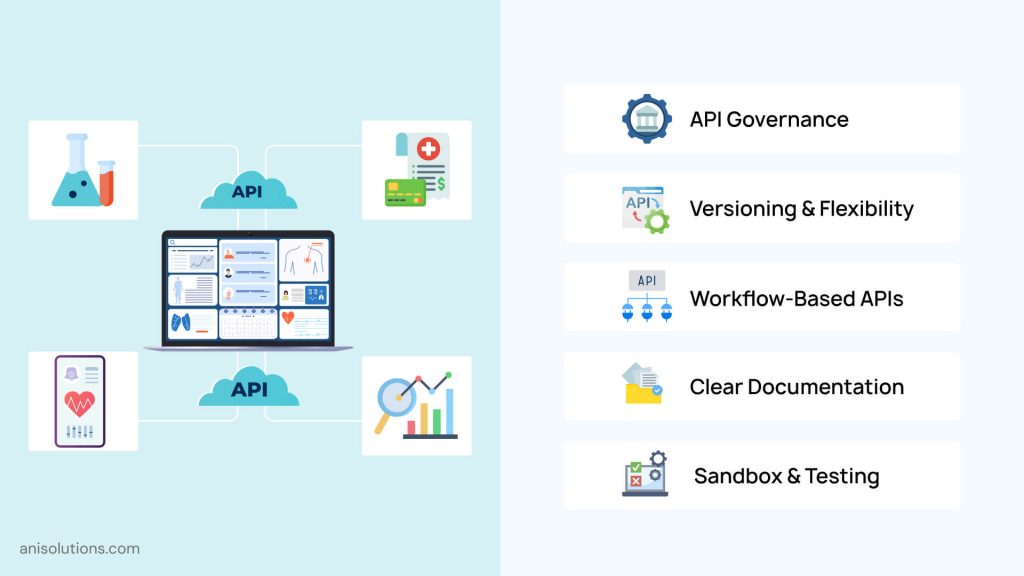
When it comes to designing API-first EHR architecture, it not only requires endpoints, but it also requires governance and long-term thinking. If you don’t set any clear standards, even a well-planned API strategy can quickly become a fragmented and fragile system.
The first step for setting these standards is strong API governance. Define clear ownership, versioning policies, and review processes for all EHR APIs. These policies, especially the versioning policies, make it easier to update APIs without breaking the established processes in versions. It becomes important when AI modules consume and produce data through APIs, as model updates should never impact core systems.
Another best practice is to design APIs to evolve and adapt to change quickly. When designing APIs, they should reflect healthcare concepts and workflows rather than UI-specific needs. For example, in AI-assisted clinical documentation, APIs should expose encounter data and clinical context generically. This way, AI models can improve or change over time without requiring API redesigns. This future-proofing prevents constant refactoring as new capabilities are introduced.
One thing that makes the API-based approch more successful is prioritizing consistency and documentation from day one. Standardized API documentation makes onboarding new teams, partners, and vendors significantly easier. It also reduces misinterpretation when multiple users, such as clinician apps, analytics platforms, and AI services, interact with the same data. Well-documented APIs become a shared language across the EHR ecosystem.
Finally, provide sandbox and testing environments for integrations, as safe, isolated environments allow teams to test new integrations without risking production stability. This enables experimentation while maintaining clinical reliability, an essential balance for healthcare systems.
When these best practices are followed, API-first EHR architecture becomes a durable foundation rather than a maintenance burden. It supports innovation such as AI-driven documentation or analytics while protecting system stability, ensuring that new capabilities enhance care delivery instead of disrupting it.
Conclusion: API-First Architecture as a Foundation for Future-Ready EHRs
In a nutshell, the API-first approach is not optional anymore, but a necessity or a foundational decision for custom EHR software development. With API-first architecture, you can build a system that can adapt, scale, and evolve with modern healthcare demands.
By treating APIs as core system contracts, organizations gain the flexibility to update workflows, integrate new capabilities, and support emerging technologies without destabilizing existing operations.
With this approach, you can reduce technical debt and stabilize EHR for future expansion. More importantly, API-first design future-proofs EHR systems against constant change, whether driven by new care models, advanced analytics, or evolving clinical needs.
So, if you are building an EHR, then taking an API-first EHR architecture is the right choice. We can help you build an EHR that is scalable and AI-ready with an API as a foundation. Click here to book your demo to learn more.
Frequently Asked Questions
Q. How does an API-first approach differ from traditional EHR integration models?
Traditional EHR integrations add APIs after core systems are built, often resulting in fragile, tightly coupled connections. An API-first approach designs APIs as the foundation from the start, enabling cleaner integrations, independent system evolution, and far greater flexibility as clinical and operational needs change.
Q. What are the key benefits of adopting an API-first EHR architecture?
API-first EHR architecture enables faster development, reusable integrations, and easier system upgrades. It reduces technical debt, improves system stability, and allows healthcare organizations to adopt new tools—such as patient portals or analytics—without disrupting core clinical workflows.
Q. Why is FHIR R4/R5 commonly used as the foundation of modern EHR APIs?
FHIR R4 and R5 provide standardized healthcare data models and consistent API patterns, making interoperability easier and more predictable. They support real-world clinical workflows while allowing flexibility for extensions, which is why they are widely adopted for modern, scalable EHR API architectures.
Q. How do AI services interact with an EHR’s API layer to deliver real-time insights?
AI services consume structured clinical and operational data through EHR APIs, process it externally, and return insights—such as risk alerts or documentation suggestions—via APIs. This keeps AI modular, allowing models to evolve without tightly coupling them to the EHR’s core system.
Q. What role does a developer portal play in an API-driven EHR ecosystem?
A developer portal serves as the central access point for API documentation, versioning details, testing tools, and onboarding resources. It enables internal teams, partners, and vendors to integrate consistently, reducing implementation errors and accelerating innovation across the EHR ecosystem.
Q. Can legacy EHR systems be modernized using an API-first approach?
Yes, legacy EHRs can be incrementally modernized by introducing an API layer around existing systems. This allows new applications, integrations, and AI services to connect without rewriting the core platform, enabling gradual transformation while maintaining operational continuity.
Traditional EHR integrations add APIs after core systems are built, often resulting in fragile, tightly coupled connections. An API-first approach designs APIs as the foundation from the start, enabling cleaner integrations, independent system evolution, and far greater flexibility as clinical and operational needs change.
API-first EHR architecture enables faster development, reusable integrations, and easier system upgrades. It reduces technical debt, improves system stability, and allows healthcare organizations to adopt new tools—such as patient portals or analytics—without disrupting core clinical workflows.
FHIR R4 and R5 provide standardized healthcare data models and consistent API patterns, making interoperability easier and more predictable. They support real-world clinical workflows while allowing flexibility for extensions, which is why they are widely adopted for modern, scalable EHR API architectures.
AI services consume structured clinical and operational data through EHR APIs, process it externally, and return insights—such as risk alerts or documentation suggestions—via APIs. This keeps AI modular, allowing models to evolve without tightly coupling them to the EHR’s core system.
A developer portal serves as the central access point for API documentation, versioning details, testing tools, and onboarding resources. It enables internal teams, partners, and vendors to integrate consistently, reducing implementation errors and accelerating innovation across the EHR ecosystem.
Yes, legacy EHRs can be incrementally modernized by introducing an API layer around existing systems. This allows new applications, integrations, and AI services to connect without rewriting the core platform, enabling gradual transformation while maintaining operational continuity.
- On February 3, 2026
- 0 Comment