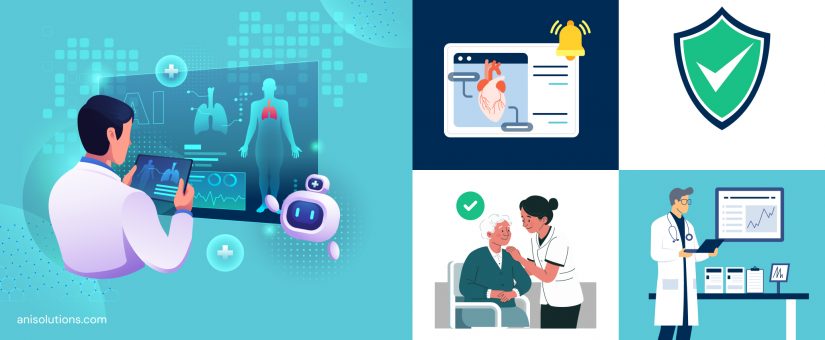
How AI-Powered EHR Features Are Transforming Patient Outcomes
Well, EHRs were never built to optimize care— they were built to record and manage patient data. But in recent years, that has been changing with providers adopting more custom EHR systems. And these systems are becoming increasingly intelligent, helping clinicians deliver safe and effective care to patients.
In 2026, EHRs are shifting towards becoming even more intelligent, with AI-powered EHR features at the center of this change. Rather than relying on manual workflows, endless clicking, and late insights, artificial intelligence is automating providers’ work.
These AI-powered features in EHR systems focus on delivering what matters, when it matters. Clinicians get everything from automated documentation to predictive analysis, giving real-time insights and identifying risks early.
Most importantly, these AI-driven EHR features allow providers to focus more on patients and not screens. However, before you implement artificial intelligence features in EHR, understanding which AI features improve EHR outcomes and how AI improves patient outcomes in EHR systems is important.
So, in this blog, we will be breaking down these points and looking at how smarter workflow and AI EHR development help make safer decisions and deliver more efficient outcomes.
Let’s dive in!
AI-Driven Documentation & Clinical Workflow Assistance
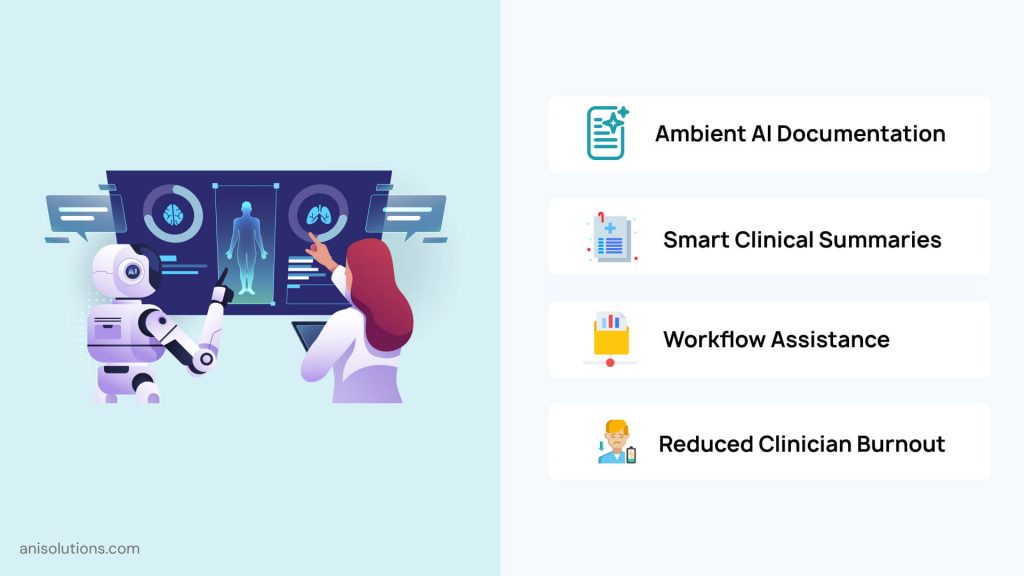
The first step towards improving patient outcomes starts with AI-driven documentation, because to provide efficient care, accurate data capture is crucial. And when documentation is rushed, fragmented, or delayed, clinical decisions are impacted, leading to lower care quality.
However, if you have an AI-powered EHR with features like ambient clinical documentation and voice-assisted dictation, it allows clinicians to speak naturally to patients while the EHR captures notes in the background.
This means no typing, no constant switching between screens, and complete attention to patients during encounters. Moreover, with natural language processing, AI-powered features in EHR can generate automated encounter summaries and structured clinical notes in real time.
You can get key symptoms, diagnoses, medications, and plans without extra clicks and without even touching the keyboard. Over time, this leads to cleaner data and far fewer gaps in the patient record. In addition, AI features in custom EHR systems help providers in their daily routine.
These features effectively suggest next steps, auto-fill repetitive fields, and reduce after-hours documentation. And the outcome is accurate data, less burnout, and seamless care coordination.
AI Clinical Documentation Readiness Guide for 2026
Get NowOutcome-Focused Analytics That Support Clinical Care
For better patient outcomes, having data is not enough—you also need insights. Many EHRs have data, but without intelligence, using it for actual patient care is not possible. However, AI-powered EHR features change that by giving insights at the right time and for the right patient.
Moreover, with AI doing the work, clinicians don’t have to sift through large amounts of data after an encounter. The AI-driven EHR features continuously scan clinical data, identifying care gaps, early risk signals, and follow-up reminders supporting proactive care without overwhelming already stressed clinicians.
Additionally, AI effectively catches the documentation gaps, leading to improved clinical accuracy. Here is how outcome-focused analytics typically show up in practice:
| AI Insight Type | What AI Identifies | Impact on Clinical Care |
| Care gap detection | Missed follow-ups, overdue labs | Earlier intervention |
| Risk signal analysis | Deterioration trends, abnormal patterns | Prevents escalation |
| Follow-up prioritization | Patients needing timely outreach | Proactive care delivery |
| Documentation gap flags | Missing or inconsistent structured data | More accurate decisions |
In short, when analytics stay outcome-focused and embedded in workflows, AI becomes a clinical assistant, not just another feature on the list.
AI-Enhanced Clinical Decision Support (CDS) & Patient Safety
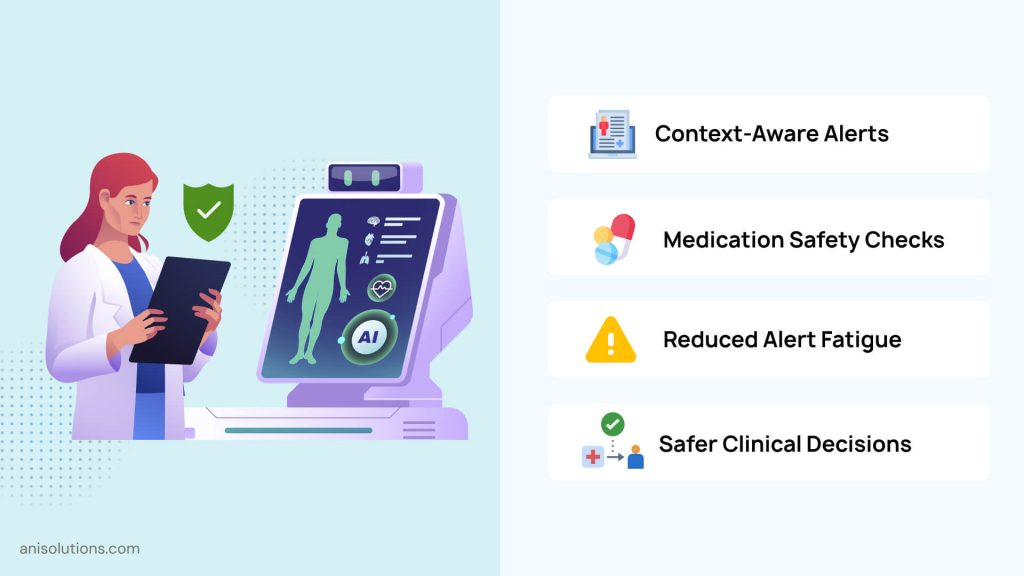
For years, clinicians have been using clinical decision support, but again, without a proper intelligent system, it has not helped much. With just static alerts, generic reminders, and endless pop-ups, it has led to important data being buried under noise.
However, AI-powered EHR features move these rule-based alerts towards context-aware alerts. Meaning, rather than sending alerts at every trigger, AI understands the complete picture from patient history, medications, and reports, prioritizing the right and urgent alerts.
Another big advantage of AI-powered features in EHR is medication safety, with medication recommendations, interaction checks, and dosage considerations based on patient-specific data. This reduces variability in decision-making and helps prevent avoidable adverse events without overwhelming clinicians.
Most importantly, AI helps reduce alert fatigue. By prioritizing high-risk scenarios and suppressing low-value alerts, artificial intelligence features in EHR systems restore trust in CDS tools. Clinicians are more likely to act on alerts when they are meaningful, and that directly contributes to safer, more consistent clinical outcomes.
Interoperability & Clinical Utilization of AI Insights
One of the most crucial things in healthcare is interoperability, because AI insights are useless if clinicians can’t act on them at the point of care. Many EHRs generate smart analytics and predictions, but bury them in separate dashboards or external tools. If a clinician has to leave their workflows to find insights, it won’t get used, no matter how advanced the AI is.
This is where interoperability becomes critical in 2026. AI-powered EHR features rely on FHIR-based interoperability to pull in external clinical data from labs, imaging systems, pharmacies, and connected care platforms. But access alone is not enough, as raw external data adds noise unless it’s normalized, summarized, and made clinically relevant.
That’s where AI-driven EHR features step in. AI helps reconcile duplicate records, standardize formats, and summarize cross-system data into clear, actionable insights. Instead of scrolling through pages of outside reports, clinicians see a concise clinical story—what’s changed, what needs attention, and what action makes sense next.
Most importantly, these insights are embedded within existing workflows. No extra logins. No system hopping. Just timely guidance embedded where clinical decisions are already being made. When AI insights are interoperable and usable, they stop being “nice-to-have analytics” and start driving real clinical action.
AI-Powered EHR Outcomes Readiness Checklist for 2026
Click HereAdditional AI Capabilities to Consider Beyond Core Features
The features mentioned above are the core AI-powered EHR features; there are many more AI features that expand the capabilities of your custom EHR. Although these features are not mandatory from day one, you can easily add them to your system for better patient outcomes later on.
But, while doing this, you need to add features that are assistive and explainable, not just overload the system. Because if implemented thoughtfully, they help in handoffs, transitions, and follow-ups; if not, then they become a hindrance rather than a helpful assistant.
Here are several high-value AI capabilities worth considering as your EHR evolves:
| AI Capability | How It Supports Care Outcomes |
| AI-assisted triage | Prioritizes patients based on risk and urgency |
| Intake summarization | Converts patient inputs into structured insights |
| Intelligent follow-ups | Prompts timely outreach and care-plan adherence |
| Handoff summarization | Improves continuity during care transitions |
| Explainable AI | Builds trust by showing why recommendations appear |
| Adaptive learning models | Improves accuracy using real-world clinical data |
These capabilities work best when they remain optional, transparent, and clinician-controlled. In 2026, the most effective EHRs won’t be the most automated; they will adapt and assist without getting in the way.
Conclusion: Using AI to Improve Outcomes Without Adding Complexity
Long story short, AI-powered EHR features are going to be a focus of this year, and you need to understand which AI features improve EHR outcomes. So, the core features are AI documentation, decision support, and AI-driven predictive analysis.
With these capabilities added to your custom EHR, you get more time with patients and spend way less on screens. This increases care quality and reduces burnout, giving you better job satisfaction while boosting the final patient outcomes.
So, if you want to build a custom EHR that matches your workflows and is powered by AI-driven EHR features, then click here to book your free consultation.
Frequently Asked Questions
Q. How do AI-powered EHR features directly reduce clinician burnout in 2026?
AI-powered EHR features reduce burnout by automating documentation, minimizing clicks, and surfacing relevant insights in real time. Clinicians spend less time charting after hours and more time focusing on patients, which improves job satisfaction.
Q. Which AI features have the highest impact on reducing hospital readmission rates?
Predictive risk analytics, AI-driven follow-up prompts, and care-gap detection have the biggest impact. These features identify high-risk patients early and ensure timely interventions before conditions worsen or patients disengage from care.
Q. How does ambient clinical intelligence differ from traditional medical dictation tools?
Ambient clinical intelligence listens passively during visits, understands clinical context, and automatically generates structured notes. Traditional dictation tools simply transcribe speech and still require manual editing, review, and workflow integration.
Q. Are AI-driven EHR insights HIPAA-compliant and secure for patient data?
Yes, when implemented correctly. AI-driven EHR insights operate within HIPAA-compliant environments using encryption, access controls, audit logs, and role-based permissions to protect patient data and maintain regulatory compliance.
Q. How can small healthcare practices implement AI features in a custom EHR without a large budget?
Small practices can start with focused AI features like ambient documentation or care-gap detection. Phased implementation, cloud-based AI services, and prioritizing high-impact workflows help control costs while still delivering measurable benefits.
Q. What role does predictive analytics play in managing chronic diseases within an EHR system?
Predictive analytics helps identify early deterioration trends, adherence risks, and patients needing intervention. This allows care teams to act sooner, adjust care plans proactively, and reduce complications in chronic disease management.
Q. How does AI help close care gaps in value-based care models?
AI continuously analyzes patient data to flag missed screenings, overdue follow-ups, and gaps in care. By prompting timely actions, AI supports quality measures, improves outcomes, and helps practices succeed in value-based care models.
Q. Can AI-powered EHR systems predict patient no-shows and optimize scheduling workflows?
Yes, AI-powered EHR systems analyze appointment history, patient behavior, and timing patterns to predict no-shows. This enables smarter scheduling, targeted reminders, and improved clinic utilization without increasing staff workload.
AI-powered EHR features reduce burnout by automating documentation, minimizing clicks, and surfacing relevant insights in real time. Clinicians spend less time charting after hours and more time focusing on patients, which improves job satisfaction.
Predictive risk analytics, AI-driven follow-up prompts, and care-gap detection have the biggest impact. These features identify high-risk patients early and ensure timely interventions before conditions worsen or patients disengage from care.
Ambient clinical intelligence listens passively during visits, understands clinical context, and automatically generates structured notes. Traditional dictation tools simply transcribe speech and still require manual editing, review, and workflow integration.
Yes, when implemented correctly. AI-driven EHR insights operate within HIPAA-compliant environments using encryption, access controls, audit logs, and role-based permissions to protect patient data and maintain regulatory compliance.
Small practices can start with focused AI features like ambient documentation or care-gap detection. Phased implementation, cloud-based AI services, and prioritizing high-impact workflows help control costs while still delivering measurable benefits.
Predictive analytics helps identify early deterioration trends, adherence risks, and patients needing intervention. This allows care teams to act sooner, adjust care plans proactively, and reduce complications in chronic disease management.
AI continuously analyzes patient data to flag missed screenings, overdue follow-ups, and gaps in care. By prompting timely actions, AI supports quality measures, improves outcomes, and helps practices succeed in value-based care models.
Yes, AI-powered EHR systems analyze appointment history, patient behavior, and timing patterns to predict no-shows. This enables smarter scheduling, targeted reminders, and improved clinic utilization without increasing staff workload.
- On January 29, 2026
- 0 Comment