
EHR Feature Prioritization: How to Build the Right Features First
One thing that makes the EHR a success is its features. However, if you build the wrong features first, the same thing can be the reason for the failure of your custom EHR.
That’s why it’s crucial to plan your EHR feature prioritization before you dive into full development and waste months perfecting the wrong features first. Because the costs of building may not be visible at first glance, they compound over time, leading to clinician burnout, delayed implementation, and low ROI.
And this is the same reason why healthcare organizations are moving towards a focused, high-impact module rather than feature-packed off-the-shelf EHRs.
However, you can mitigate these hidden costs with a data-driven EHR feature prioritization strategy. By adopting an EHR feature prioritization framework that easily prioritizes EHR features for development.
In this blog, we will break down how to prioritize features in EHR software, along with feature prioritization methods for EHR systems.
Let’s get started without further ado!
Identifying Core EHR Value Drivers
First things first, not all features and workflows are equally important, so you need to sort out the useful ones first. Because if you have too many features from demos or internal opinions, the chances of missing features that actually help clinicians become high. So, here is how aligning EHR features with clinical workflows helps:
- Map Real Clinical Workflows
The first step is to identify high-impact features that will provide real benefits and measurable ROI. That’s why you prioritize EHR features that reduce clicks, quicken handoffs, and eliminate workarounds rather than focusing on complex features used occasionally.
- Separate Clinical Impact from Admistrative Convenience
One of the most common prioritization mistakes is considering administrative efficiency on the same level as clinical efficiency. While billing and reporting matters, you should prioritize faster documentation, intuitive dashboards for better and smoother patient encounters, and better visibility into patient records. Although administrative features might save time later, for seamless adoption, early clinical efficiency features are crucial.
- Understand How User Roles Value Features Differently
In EHR, different roles need different features, so don’t assign equal value to all features. For instance, clinicians prioritize speed, clarity, and minimal disruption. Whereas, care teams value coordination, task visibility, and patient health alerts. That’s why you should consider all this while developing your EHR feature prioritization framework to get the most out of your custom EHR software.
In short, by selecting features based on real needs and practical workflows, prioritizing EHR features for development becomes easier and much more effective.
EHR MVP Prioritization Matrix – A Ready To-Use Scoring Template
Get NowA Practical Framework for EHR Feature Prioritization
After deciding the core features, comes evaluating the features with an EHR feature prioritization framework based on Must/Next/Later criteria. This is one of the most effective feature prioritization methods for EHR systems and helps in keeping decisions consistent and defensible.
Here is how the framework works:
| Priority Tier | What It Means | Evaluation Criteria | Typical EHR Feature Examples |
| Must | Foundational features required for safe care delivery, compliance, and clinician adoption | • Direct impact on patient care • High-frequency workflow usage • Required for security, compliance, or interoperability | Clinical documentation, medication management, role-based access, audit logs, core integrations |
| Next | High-value features that improve efficiency and coordination after stabilization | • Measurable workflow improvement • Moderate adoption risk • Builds on Must features without adding complexity | Smart templates, care coordination views, task management, internal messaging |
| Later | Optimization and advanced capabilities that enhance value but are not essential early | • Low frequency or niche usage • Incremental efficiency gains • Higher build or adoption complexity | Advanced analytics, AI insights, specialty modules, predictive reporting |
While it is not the only way to evaluate feature prioritization, it helps make the right decisions and save months of time during development. Most importantly, it makes the choices with clinical reality, workflow impact, and compliance readiness, rather than choosing the features that look good on paper.
Balancing Compliance Requirements with Innovation
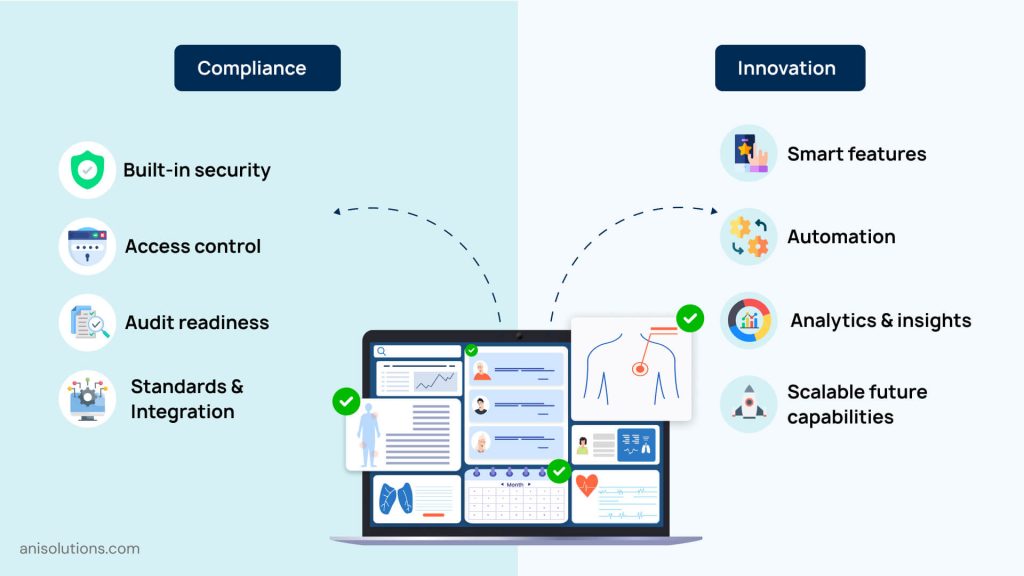
One of the most common misconceptions about custom EHR development is that you can add security and interoperability features later in the development process. However, in reality, doing it later can become a costly mistake.
That’s what you need to start embedding these features from day one of the development process. It is the most crucial part of the EHR feature prioritization strategy.
- Why Security & Interoperability Must be Day One Priorities
These two features are tied to patient data protection and system connectivity, so treating them as low priority can be risky. Delaying features such as role-based access, audit trails, and interoperability standards can result in access limitations, rework during certification or integration phases, and late implementation.
So, by prioritizing compliance-critical features early, teams create a stable foundation for clinical adoption and future expansion.
- Prioritizing Innovation Based on Measurable Workflow Gains
While innovation matters, it must be based on the value it delivers. Basically, the features should measurably improve clinical workflows without introducing risks. So, the criteria must reduce manual steps, improve care coordination, and build on existing compliant data structures.
- Avoiding Technical Debt While Enabling Future Capabilities
One of the fastest ways to accumulate technical debt is by building advanced features on unstable or non-compliant foundations. With AI modules, analytics layer, and specialty extension only scale when underlying security models and data standards are solid.
A compliance-first roadmap ensures new features inherit existing security controls, integration remains predictable and auditable, and future capabilities can be added without refactoring core systems.
With this approach, EHR feature prioritization becomes future-ready without sacrificing safety, trust, or regulatory readiness.
For a detailed breakdown of how compliance, architecture, and feature planning should be structured from the start, read our step-by-step guide to building an EHR system.
The Role of Stakeholders in Feature Prioritization
Without governance, EHR feature prioritization quickly turns into feature bloat. The requests pile up from every direction— clinical leaders, operations, IT, finance— and the roadmap becomes a compromise instead of a strategy. Governance exists to prevent that drift and keep decisions aligned with outcomes.
- A Simple Governance Framework That Works
Effective teams establish a small, accountable governance group with defined roles. You must have clinical representatives to validate workflow impact, IT and security leaders to assess feasibility and compliance, and operational leadership to align priorities with business goals. This group approves priorities based on agreed evaluation criteria.
- Align Vision with Frontline Reality
Leadership sets direction, but frontline clinicians validate usefulness. The fastest way to break alignment is letting influence outweigh impact. Instead of open-ended brainstorming, stakeholders’ input should be structured around real workflows, usage frequency, and friction points identified earlier.
- Collect Input Without Derailing the Roadmap
Use time-bound feedback cycles, workflow-based intake forms, and periodic roadmap reviews. This keeps the roadmap adaptive without becoming reactive. With governance in place, feature decisions stay transparent, defensible, and aligned with clinical reality—ensuring prioritization remains strategic.
Identify Real Pain Points with Clinical Workflow Audit Checklist
Click HereCommon Mistakes That Break EHR Feature Roadmaps
Even with a clear EHR features prioritization framework, roadmaps often derail due to a few predictable mistakes. These aren’t technical failures—they are decision failures. And they usually surface months after development has started, when reversing course is costly.
- Prioritizing Influence Over Impact: A common example is: a senior stakeholder pushes for advanced reporting dashboards early, while clinicians are still struggling with basic documentation speed. The outcome is a feature that looks good in a demo but has little real usage, increasing clinician frustration, impacting productivity, and performance.
- Ignoring Integration & Implementation Complexity: Features rarely exist in isolation, so connecting e-prescribing, labs, and billing modules is a must. However, you must also account for integration timelines and validation requirements, which lead to delays and rework. If you underestimate this complexity, it can stall the entire go-live process.
- Treating the Roadmap as Static: Clinical workflows evolve, regulations change, and adoption patterns reveal new insights. Yet many teams lock their roadmaps too early. When real-world usage contradicts assumptions, they resist change—allowing misaligned features to be built early.
- Chasing Innovation Before Stability: AI insights and advanced analytics are attractive, but building them on unstable workflows or incomplete data models compounds technical debt. Innovation without foundation increases risk, not value.
In short, avoiding these mistakes keeps EHR feature prioritization strategies focused, adaptable, and aligned with how care is actually delivered.
Final Thoughts: Building a Living, Adaptive EHR Roadmap
In a nutshell, successful EHR feature prioritization is not about building more; it’s about building with the right features. The most effective EHRs are shaped by disciplined decisions focused on real clinical workflows and treating compliance as foundational.
With the right prioritization strategy, you can reduce rework, prevent derailing development, and keep teams aligned as care delivery evolves. Most importantly, it turns the roadmap into a living strategy—one that adapts without disrupting clinicians or operations.
If you are struggling to decide what your EHR should build first, click here to connect, and let’s evaluate your roadmap to get your features right from day one.
Frequently Asked Questions
Q. What is EHR feature prioritization, and why does it matter in custom EHR development?
EHR feature prioritization is the process of deciding which features to build first based on clinical impact, workflow efficiency, and compliance needs. It matters because building the wrong features early leads to poor adoption, clinician burnout, and delayed ROI.
Q. How do healthcare organizations decide which EHR features to build first?
Most organizations start by identifying high-frequency, high-friction clinical workflows. Features that reduce documentation time, eliminate workarounds, and support compliance are prioritized first, while advanced or optimization features are intentionally scheduled later.
Q. How can EHR features be aligned with real clinical workflows?
Alignment comes from observing how clinicians actually work—not idealized processes. Mapping real workflows, identifying pain points, and validating priorities with frontline users ensures features support daily care delivery instead of forcing clinicians to adapt to the system.
Q. What frameworks are commonly used for EHR feature prioritization?
Common frameworks include Must / Next / Later models, workflow-first scoring matrices, and impact-effort evaluations. These frameworks help teams balance clinical value, implementation complexity, and compliance requirements without overloading early development phases.
Q. How often should EHR feature priorities be reviewed or updated?
EHR feature priorities should be reviewed regularly—typically every quarter or after major workflow, regulatory, or adoption changes. This keeps the roadmap flexible, prevents misaligned development, and ensures the system evolves with real clinical and operational needs.
EHR feature prioritization is the process of deciding which features to build first based on clinical impact, workflow efficiency, and compliance needs. It matters because building the wrong features early leads to poor adoption, clinician burnout, and delayed ROI.
Most organizations start by identifying high-frequency, high-friction clinical workflows. Features that reduce documentation time, eliminate workarounds, and support compliance are prioritized first, while advanced or optimization features are intentionally scheduled later.
Alignment comes from observing how clinicians actually work—not idealized processes. Mapping real workflows, identifying pain points, and validating priorities with frontline users ensures features support daily care delivery instead of forcing clinicians to adapt to the system.
Common frameworks include Must / Next / Later models, workflow-first scoring matrices, and impact-effort evaluations. These frameworks help teams balance clinical value, implementation complexity, and compliance requirements without overloading early development phases.
EHR feature priorities should be reviewed regularly—typically every quarter or after major workflow, regulatory, or adoption changes. This keeps the roadmap flexible, prevents misaligned development, and ensures the system evolves with real clinical and operational needs.
- On January 26, 2026
- 0 Comment