Why Healthcare Providers Choose Custom EHR Over Off-the-Shelf Software
Today, nearly, if not all healthcare providers have adopted EHRs. As per the 2024 survey by the National Center for Health Statistics, 95% of US office-based physicians are using EHR. Yet, research on the Jama Network shows that 26% of the providers are dissatisfied with their EHR and want to replace it.
Yes, you read it right, not just an upgrade but a complete overhaul. Most importantly, this also explains why healthcare providers choose custom EHRs over off-the-shelf EHRs.
And that’s just the number we have.
What it doesn’t capture is the dissatisfaction playing out every day inside clinics. It goes from the workarounds to parallel space to tracking and clinic clicking through screens that don’t match how they really work.
And at the core of all of this are the off-the-shelf hours that force clinicals into vendor lock-ins, hidden costs, and fear of workflow disruption. These are some of the common limitations of off-the-shelf EHR systems.
Most importantly, this brings to one reality— off-the-shelf EHRs can’t handle the demands of today’s healthcare. They lack flexibility and specificity, and that’s exactly why the custom vs off-the-shelf EHR comparison has gained attention in recent years.
That’s why more healthcare organizations are starting to ask a different question. Not Which EHR should we buy? But should we be building one that actually fits?
This shift reflects the real reasons healthcare providers choose custom EHR platforms—greater alignment with clinical workflows, long-term adaptability, and the flexibility and scalability of custom EHR systems that generic software simply can’t offer.
In this blog, we’ll break down where off-the-shelf EHRs fall short, explore the benefits of custom EHR for healthcare providers, and explain why providers prefer custom EHR software when customization moves from a nice-to-have to mission-critical.
Custom EHR vs Off-the-Shelf: What Providers Are Really Choosing
On paper, off-the-shelf EHRs seem like the obvious choice. They’re standardized, vendor-managed, and relatively quick to deploy. For practices that want a plug-and-play solution, this model promises speed and predictability. But in reality, that convenience often comes at a cost that providers don’t fully see upfront.
Off-the-shelf systems are designed to fulfill the basic needs. In these EHRs, workflows are pre-defined, customization is limited to configuration settings, and core functionality remains tightly controlled by the vendor. As practices grow or diversify, they’re forced to adapt their workflows to the software—not the other way around.
Custom EHRs flip that model. Instead of forcing clinicians into rigid templates, custom platforms are built around how care is actually delivered. They prioritize workflow alignment, adaptability, and long-term scalability from day one. The result isn’t just better usability—it’s a system that evolves alongside the practice.
The real difference shows up in the hidden costs. Productivity losses from excessive clicks, shadow workflows built outside the EHR, add-on fees for basic integrations, and limitations on data access quietly erode the value of off-the-shelf systems. What looks affordable initially often becomes expensive over time.
That’s why upfront cost is no longer the primary decision factor. Healthcare leaders are starting to look beyond licensing fees and ask harder questions about efficiency, clinician satisfaction, and future readiness. Increasingly, the answer points toward custom EHR platforms built for fit, not compromise.
Custom vs Off-the-Shelf EHR Decison Making Checklist
Learn MoreThe 5 Core Reasons Healthcare Providers Prefer Custom EHRs

The growing shift toward custom EHRs isn’t driven by trends or technology hype—it’s driven by daily operational reality. Healthcare providers aren’t looking for more features; they’re looking for systems that reduce friction, scale with their practice, and support how care is actually delivered.
When you look closely at why providers are moving away from off-the-shelf platforms, the same core factors keep coming up. Below are the five most common reasons healthcare providers prefer custom EHRs—and why these advantages become impossible to ignore as clinical and operational demands increase.
- Workflow Alignment That Reduces Clinician Burnout
Custom EHRs are designed to mirror real clinical workflows, not generic assumptions. Documentation flows the way clinicians think, reducing unnecessary clicks and duplicate data entry. This alignment shortens charting time, improves adoption across specialties, and directly addresses one of the biggest drivers of clinician burnout.
- Interoperability Without Vendor Lock-In
Custom EHR platforms enable deep, flexible integrations with labs, imaging centers, health information exchanges, RPM devices, and third-party tools. Providers aren’t limited to vendor-approved connectors or charged extra for basic data exchange. This freedom allows systems to integrate seamlessly into existing ecosystems instead of operating in isolation.
- Scalability That Supports Growth and Innovation
As practices expand—adding locations, services, or new care models—custom EHRs scale without artificial limits. There are no surprise user caps, module restrictions, or data ceilings. The platform grows with the organization, supporting innovation rather than slowing it down.
- Data Ownership, Security & Compliance Control
With a custom EHR, providers maintain full control over their data, security policies, and product roadmap. Updates tied to HIPAA, ONC, or CMS requirements can be implemented faster without waiting for vendor release cycles. This control strengthens compliance while reducing long-term risk.
- Lean Systems Without Feature Bloat
Unlike bloated off-the-shelf systems packed with rarely used features, custom EHRs focus on what actually matters. The result is a cleaner interface, faster performance, and workflows optimized around high-value clinical tasks—improving both efficiency and user satisfaction.
Custom EHR Readiness Assessment (5-Minute Self-Test)
Get NowAI as a Strategic Driver in EHR Decisions
AI is no longer a future add-on—it’s becoming a key reason healthcare providers choose custom EHR platforms over traditional systems. But AI can only deliver value when it’s built on clean, longitudinal, and context-rich clinical data. Without that foundation, even the most advanced algorithms fall flat.
This is where the flexibility and scalability of custom EHR systems start to matter. Because custom platforms are designed around specialty workflows and real care delivery patterns, they create the right environment for specialty-aligned AI insights, workflow-specific automation, and predictive analytics that support clinicians rather than interrupt them.
Off-the-shelf EHRs often offer AI features, but they’re designed for broad applicability. The result is generic automation and insights that don’t fully reflect clinical context. Custom EHRs, on the other hand, allow AI to be embedded directly into workflows—supporting documentation, risk identification, and care planning in ways that actually fit how providers work.
As AI becomes central to clinical efficiency and decision-making, it’s increasingly shaping the custom EHR vs off-the-shelf EHR conversation.
Trade-Offs Providers Should Understand
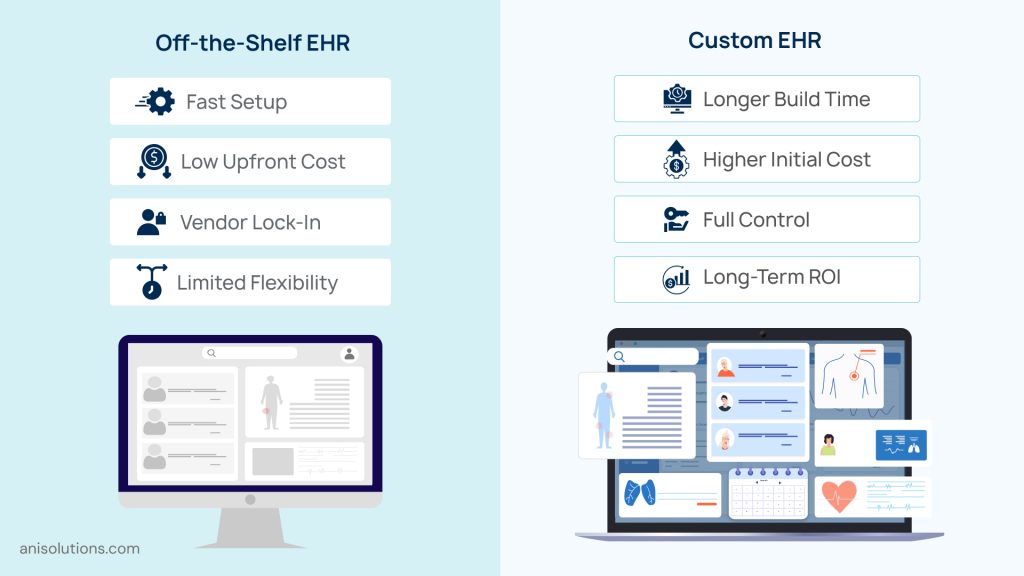
Understanding the trade-offs is essential when evaluating the reasons healthcare providers choose custom EHR solutions. Custom EHRs typically involve higher upfront investment and a longer initial timeline. They require deeper planning, clinical input, and alignment across teams.
Off-the-shelf EHR systems offer faster deployment and lower initial costs, which can be appealing in the short term. However, those advantages often come with long-term limitations—restricted adaptability, add-on fees, integration constraints, and dependence on vendor roadmaps. These limitations of off-the-shelf EHR systems tend to surface as practices grow or workflows become more complex.
For many organizations, long-term ROI outweighs short-term convenience. Reduced productivity loss, fewer workarounds, and better clinician satisfaction often justify the investment in a system designed for fit rather than speed.
When Custom EHR Makes Sense for Healthcare Providers
Custom EHRs are not a universal solution, but they make clear sense in specific scenarios. Specialty practices with complex workflows often outgrow standardized systems quickly, making customization essential rather than optional.
They’re also a strong fit for multi-location or fast-growing organizations that need technology capable of scaling without artificial limits. Providers planning AI-driven care delivery, advanced analytics, or integrated RPM programs benefit significantly from the adaptability and control custom platforms offer.
For organizations seeking long-term ownership of their data, security posture, and technology roadmap, these are some of the clearest reasons healthcare providers choose custom EHR platforms over vendor-controlled alternatives.
See if a Custom EHR Makes Sense for Your Practice
Click HereConclusion: Choosing an EHR That Supports Care, Not Complexity
Long story short, in 2026, healthcare providers will no longer choose EHRs based solely on how fast they can be implemented. They’re prioritizing systems that reduce friction, align with clinical workflows, and scale alongside evolving care models. The benefits of custom EHR for healthcare providers—flexibility, innovation, and clinician satisfaction—are becoming impossible to ignore.
The final takeaway is simple: the right EHR strategy is about fit and future-readiness, not speed alone. That’s why more organizations are rethinking standard solutions and understanding why providers prefer custom EHR software when long-term success is the goal.
If you are also thinking about switching to a custom EHR from an off-the-shelf EHR, then click here to book your free demo.
Frequently Asked Questions
Q. Why do healthcare providers choose custom EHR over off-the-shelf software?
Healthcare providers choose custom EHRs because they align with real clinical workflows, adapt as organizations grow, and avoid vendor-imposed limitations. Custom systems reduce inefficiencies, improve clinician satisfaction, and support long-term technology and care delivery goals.
Q. What are the biggest limitations of off-the-shelf EHR systems for providers?
Off-the-shelf EHRs often limit workflow customization, create integration barriers, and rely on vendor-controlled updates. Over time, these constraints lead to productivity loss, costly add-ons, workarounds outside the system, and growing clinician frustration.
Q. How does custom EHR improve clinical workflow efficiency?
Custom EHRs are designed around how clinicians actually practice, reducing unnecessary clicks, duplicate documentation, and screen switching. This streamlining shortens charting time, improves data accuracy, and allows care teams to focus more on patients.
Q. Is custom EHR more scalable than off-the-shelf EHR solutions?
Yes. Custom EHRs scale more effectively because they aren’t restricted by user caps, module limitations, or fixed vendor roadmaps. Practices can expand locations, services, and care models without redesigning or replacing their core system.
Q. How does custom EHR help reduce clinician burnout and click fatigue?
By aligning workflows with clinical reality, custom EHRs minimize excessive clicks, repetitive tasks, and cognitive overload. Cleaner interfaces and smarter automation reduce documentation burden, helping clinicians spend less time on screens and more time on care.
Q. What interoperability challenges do providers face with off-the-shelf EHRs?
Off-the-shelf EHRs often restrict integrations to vendor-approved connectors, limit data exchange flexibility, and charge extra for interoperability. These barriers make it harder to connect labs, HIEs, RPM devices, and third-party systems seamlessly.
Q. Why is data ownership important when choosing a custom EHR system?
Data ownership gives providers control over access, security policies, and long-term data use. With custom EHRs, organizations aren’t dependent on vendor decisions, making it easier to support analytics, integrations, and future technology initiatives.
Q. How does custom EHR support evolving HIPAA and ONC compliance requirements?
Custom EHRs allow faster implementation of regulatory updates without waiting for vendor release cycles. Providers maintain control over security configurations, audit readiness, and compliance workflows as HIPAA, ONC, and CMS requirements evolve.
Q. What role does AI play in providers choosing custom EHR solutions?
AI works best with clean, contextual data and workflow alignment. Custom EHRs enable specialty-specific AI insights, automation, and predictive analytics, while off-the-shelf AI tools remain generic and less effective in real-world clinical settings.
Healthcare providers choose custom EHRs because they align with real clinical workflows, adapt as organizations grow, and avoid vendor-imposed limitations. Custom systems reduce inefficiencies, improve clinician satisfaction, and support long-term technology and care delivery goals.
Off-the-shelf EHRs often limit workflow customization, create integration barriers, and rely on vendor-controlled updates. Over time, these constraints lead to productivity loss, costly add-ons, workarounds outside the system, and growing clinician frustration.
Custom EHRs are designed around how clinicians actually practice, reducing unnecessary clicks, duplicate documentation, and screen switching. This streamlining shortens charting time, improves data accuracy, and allows care teams to focus more on patients.
Yes. Custom EHRs scale more effectively because they aren’t restricted by user caps, module limitations, or fixed vendor roadmaps. Practices can expand locations, services, and care models without redesigning or replacing their core system.
By aligning workflows with clinical reality, custom EHRs minimize excessive clicks, repetitive tasks, and cognitive overload. Cleaner interfaces and smarter automation reduce documentation burden, helping clinicians spend less time on screens and more time on care.
Off-the-shelf EHRs often restrict integrations to vendor-approved connectors, limit data exchange flexibility, and charge extra for interoperability. These barriers make it harder to connect labs, HIEs, RPM devices, and third-party systems seamlessly.
Data ownership gives providers control over access, security policies, and long-term data use. With custom EHRs, organizations aren’t dependent on vendor decisions, making it easier to support analytics, integrations, and future technology initiatives.
Custom EHRs allow faster implementation of regulatory updates without waiting for vendor release cycles. Providers maintain control over security configurations, audit readiness, and compliance workflows as HIPAA, ONC, and CMS requirements evolve.
AI works best with clean, contextual data and workflow alignment. Custom EHRs enable specialty-specific AI insights, automation, and predictive analytics, while off-the-shelf AI tools remain generic and less effective in real-world clinical settings.
- On December 21, 2025
- 0 Comment