A&I Solutions FHIR-Native EHR Achieves Full Interoperability
How an integrated delivery network replaced fragile point-to-point interfaces with a FHIR-native interoperability layer — enabling secure, real-time healthcare data exchange.
Contact Us
A fragmented, point-to-point integration model that could not scale
The client is a U.S.-based integrated healthcare delivery network providing primary care, specialty services, diagnostics, and pharmacy operations across multiple connected care sites. Its EHR exchanged data with external laboratory, pharmacy, referral, and patient engagement systems through fragmented point-to-point interfaces built up over time — many relying on legacy HL7 v2.x messaging and manual reconciliation.
As the network grew, the number of one-to-one interfaces increased disproportionately, making the landscape difficult to maintain: data moved inconsistently, interface failures required manual intervention, and every new system meant building another custom connection. The client engaged A&I Solutions to re-architect the integration layer around a FHIR-native model, standardizing data exchange on FHIR R4 and enabling reliable, real-time communication between the EHR and connected systems.
Fragile interfaces replaced with a standardized interoperability layer
The Challenge
- Numerous point-to-point interfaces were costly to maintain and broke when any system changed
- Inconsistent data exchange across HL7, file transfers, and manual reconciliation created reliability gaps
- Adding new systems and meeting modern interoperability standards required heavy custom development
Our Solution
- Centralized FHIR-native interoperability layer with a single API gateway
- HL7 v2.x translation so legacy systems join standardized exchange without replacement
- Real-time monitoring, error alerting, and audit logging across every data exchange
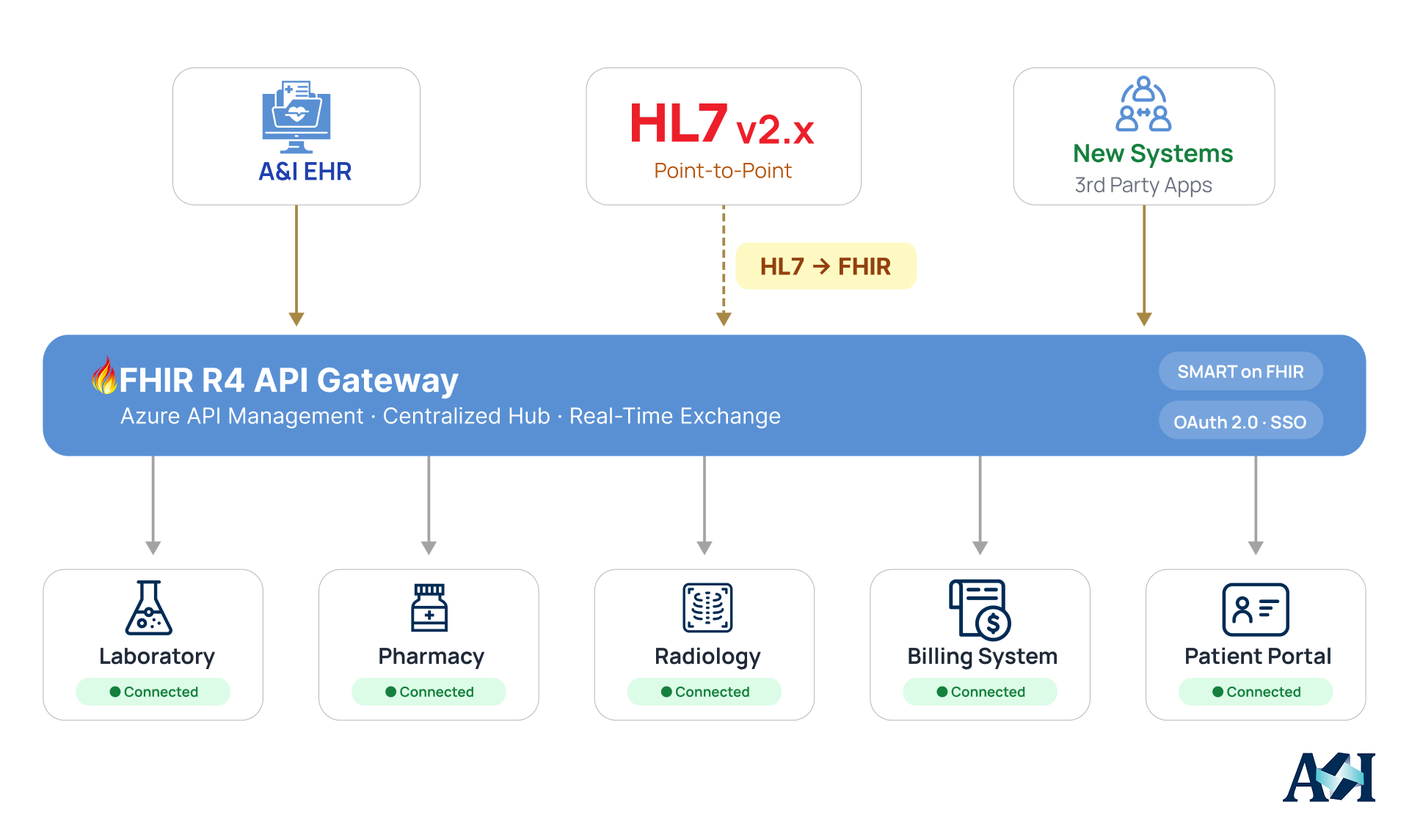
One FHIR-native hub connecting every system
A centralized interoperability layer uses FHIR R4 as the common data model, with a single API gateway managing all exchange and an HL7 v2.x translation capability that lets legacy systems participate without replacement.
A FHIR-native interoperability platform built to scale
A&I Solutions designed and implemented a FHIR-native interoperability layer that replaced the network’s fragmented interfaces with a standardized, API-driven integration model, built on modern cloud infrastructure and aligned to FHIR R4. For organizations facing similar challenges, A&I Solutions provides EHR integration services.
1. Centralized FHIR-native integration layer
A&I Solutions built a centralized interoperability layer using FHIR R4 as the common data model across all connected systems, reducing custom interfaces to a single, maintainable model.
- Standardized FHIR R4 resource mapping across all systems
- A central API gateway managing all data exchange
- A hub-based model replacing point-to-point interfaces
2. Seamless integration
To preserve compatibility with existing systems, an HL7 v2.x translation capability lets legacy applications join standardized exchange, with event-driven workflows propagating updates in real time:
HL7 v2.x messages translated into FHIR resources for standardized, real-time exchange.
Connected through the integration hub with consistent, validated data.
Event-driven workflows propagate updates across systems automatically.
Existing systems participate in standardized exchange without immediate replacement.
Measurable outcomes after go-live
Less integration maintenance
Point-to-point interfaces replaced by one FHIR model.
Less manual reconciliation
Validated data flows in real time across systems.
Faster system onboarding
New systems connect via the central API gateway.