A&I Solutions Delivers Cardiology EHR with ECG Integration
How A&I Solutions built a cardiology-focused EHR that integrated ECG data, connected diagnostic devices, and standardized cardiac documentation across multiple clinics.
Contact Us
Connecting cardiac diagnostics with the clinical record
The client is a U.S.-based cardiology practice providing diagnostic, interventional, and ongoing cardiac care across multiple clinic locations. The practice manages a high volume of diagnostic testing, including ECGs, echocardiograms, and stress tests.
The existing general-purpose EHR did not integrate directly with the practice’s cardiac diagnostic equipment. ECG results and other diagnostic data were generated in separate systems and then scanned, uploaded, or manually summarized into the EHR. Cardiologists also relied on standalone systems to review tracings, creating a fragmented cardiac record.
To address these limitations, the client engaged A&I Solutions to develop a customizable EHR with integrated ECG and diagnostic data, device connectivity, and structured cardiology documentation. The goal was to bring cardiac diagnostic workflows directly into the clinical record and provide cardiologists with a unified view of patient information.
Unifying cardiac diagnostics and clinical workflows
The Challenge
- ECG and diagnostic results were disconnected from the patient’s EHR record.
- Manual data transfer slowed diagnostic review and created duplicate work.
- General-purpose documentation workflows did not adequately support cardiology-specific encounters and interpretations.
Our Solution
- Integrated ECG and diagnostic results directly into the patient record.
- Connected cardiac diagnostic equipment using HL7 v2.x and DICOM-based data exchange.
- Developed structured documentation workflows designed specifically for cardiology.
Connected architecture for cardiac diagnostic workflows
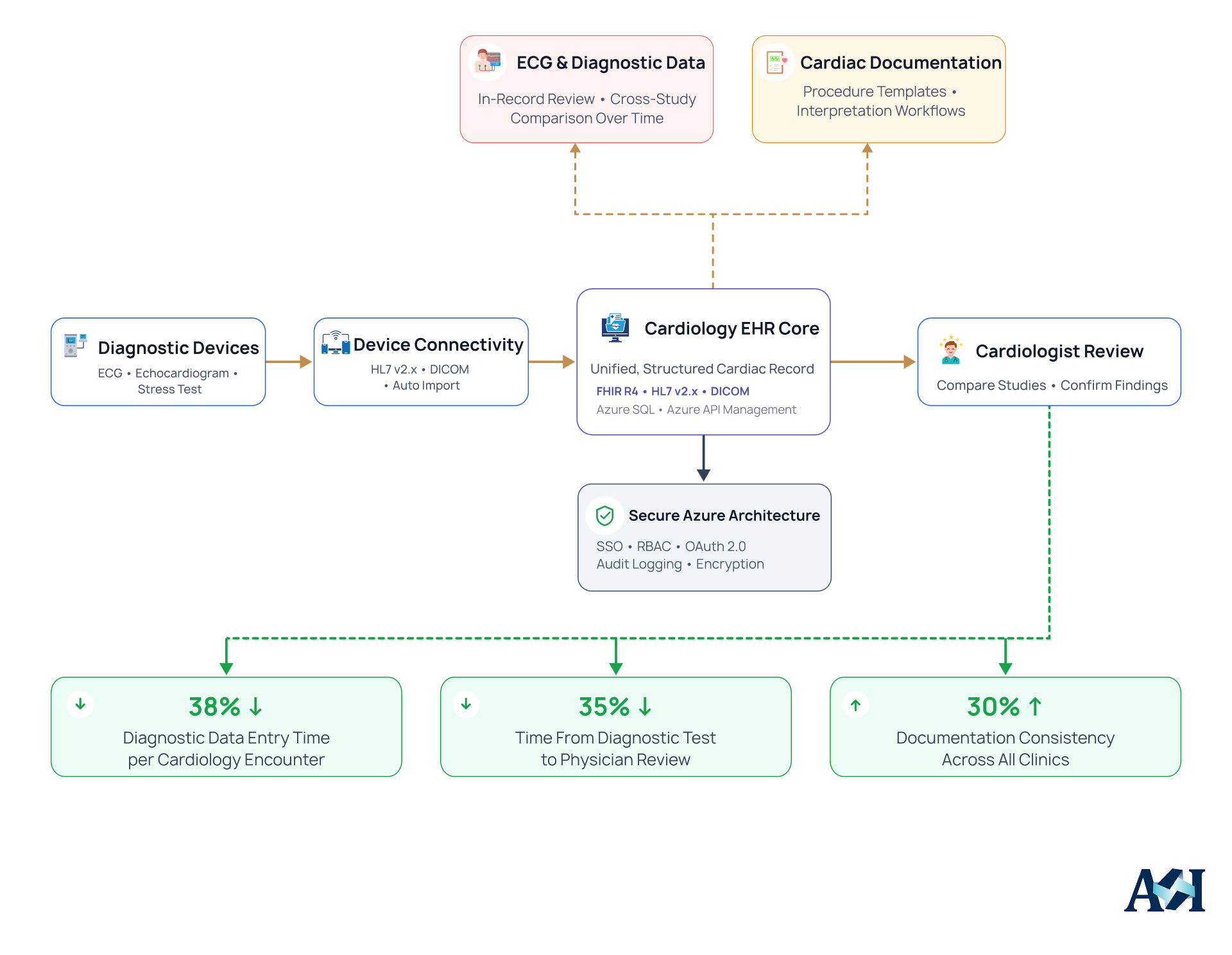
A&I Solutions developed a cloud-based cardiology EHR using Microsoft Azure, React, .NET Core, Azure SQL, FHIR R4, HL7 v2.x, DICOM, SMART on FHIR, Azure API Management, OAuth 2.0, RBAC, and SSO. The architecture connected cardiac diagnostic devices with the EHR, allowing ECG and other diagnostic results to flow into the clinical record while maintaining secure data exchange and auditability.
Specialty EHR software built for cardiology
A&I Solutions developed a customizable EHR that brought ECG data, diagnostic device connectivity, and cardiac documentation into one clinical platform. Cardiologists could review and compare studies within the patient record while documenting procedures and interpretations through structured specialty workflows. Through these A&I Solutions EHR outcomes, the implementation demonstrates how specialty EHR software can replace fragmented diagnostic workflows with a connected cardiology experience.
1. Integrated ECG and diagnostic data
A&I Solutions connected cardiac diagnostic information directly to the patient’s EHR record.
The platform included:
- ECG and diagnostic results integrated into the patient chart
- Structured storage of cardiac diagnostic information
- In-record review of ECG tracings and results
- Comparison of cardiac studies over time
By bringing diagnostic information into the EHR, cardiologists could review and compare studies without switching between separate systems.
2. Connected cardiology workflows
The solution connected diagnostic devices with clinical documentation and physician review.
Interfaces connected diagnostic equipment with the EHR using HL7 v2.x and DICOM-based data exchange, automatically importing diagnostic results.
ECG tracings and results were available within the patient record, reducing the need to retrieve information from standalone systems.
Structured procedure templates, diagnostic interpretation workflows, and cardiology-specific assessment forms standardized documentation across clinics.
Microsoft Azure, OAuth 2.0 authentication, RBAC, SSO, encrypted data storage and transmission, and HIPAA-compliant audit logging secured cardiac diagnostic and patient data.