A&I Solutions Builds Multi-Language EHR for Diverse Clinics
How A&I Solutions built a multi-language custom EHR that localized patient and provider workflows, reduced reliance on manual translation, and improved access for linguistically diverse populations.
Contact Us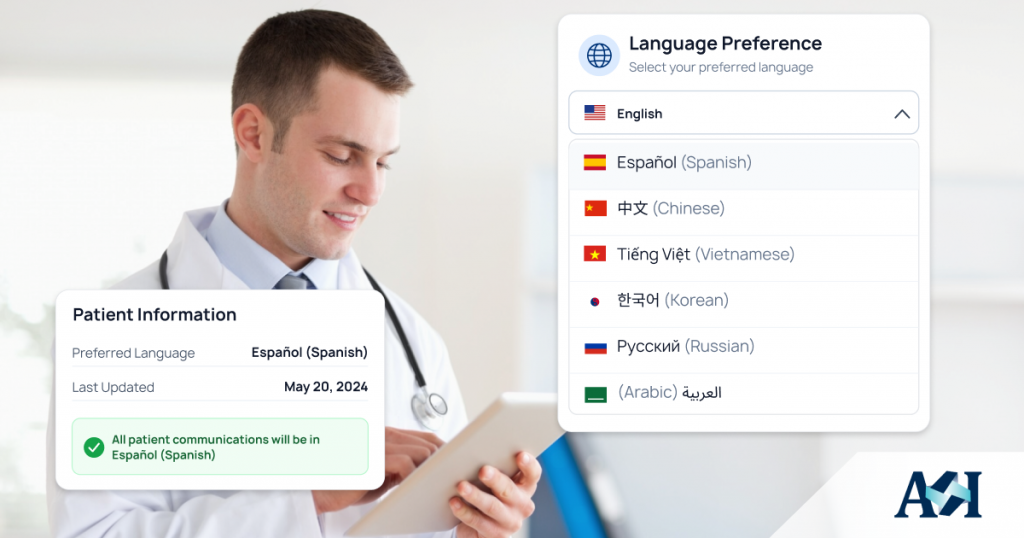
Building an EHR for linguistically diverse patient populations
The client is a U.S.-based multi-site community clinic network providing primary and specialty care to a linguistically diverse patient population across multiple locations. A large share of patients preferred to receive healthcare services and communications in languages other than English.
The organization’s existing general-purpose EHR operated primarily in English, while patient-facing materials such as intake forms, portal content, instructions, and communications were either available only in English or required manual translation. The network also relied heavily on interpreters and ad hoc translation processes.
This created barriers across patient engagement and clinic operations. To address the gap, the client engaged A&I Solutions to build a multi-language custom EHR with localization embedded throughout patient-facing and provider-facing workflows.
Removing language barriers from everyday EHR workflows
The Challenge
- The existing EHR operated primarily in English despite the network serving a linguistically diverse population.
- Patient materials required manual translation, resulting in inconsistent and difficult-to-maintain content.
- Language barriers affected patient understanding, portal engagement, and operational efficiency.
Our Solution
- Built multi-language patient portal, intake, instructions, and communication workflows.
- Added a centralized localization framework for consistent content management.
- Surfaced patient language preferences to staff and generated localized patient-facing outputs.
Multi-language architecture for connected EHR workflows
A&I Solutions developed the platform using React, .NET Core, Azure SQL, an i18n framework, FHIR R4, HL7 v2.x, SMART on FHIR, Azure API Management, OAuth 2.0, RBAC, and SSO.
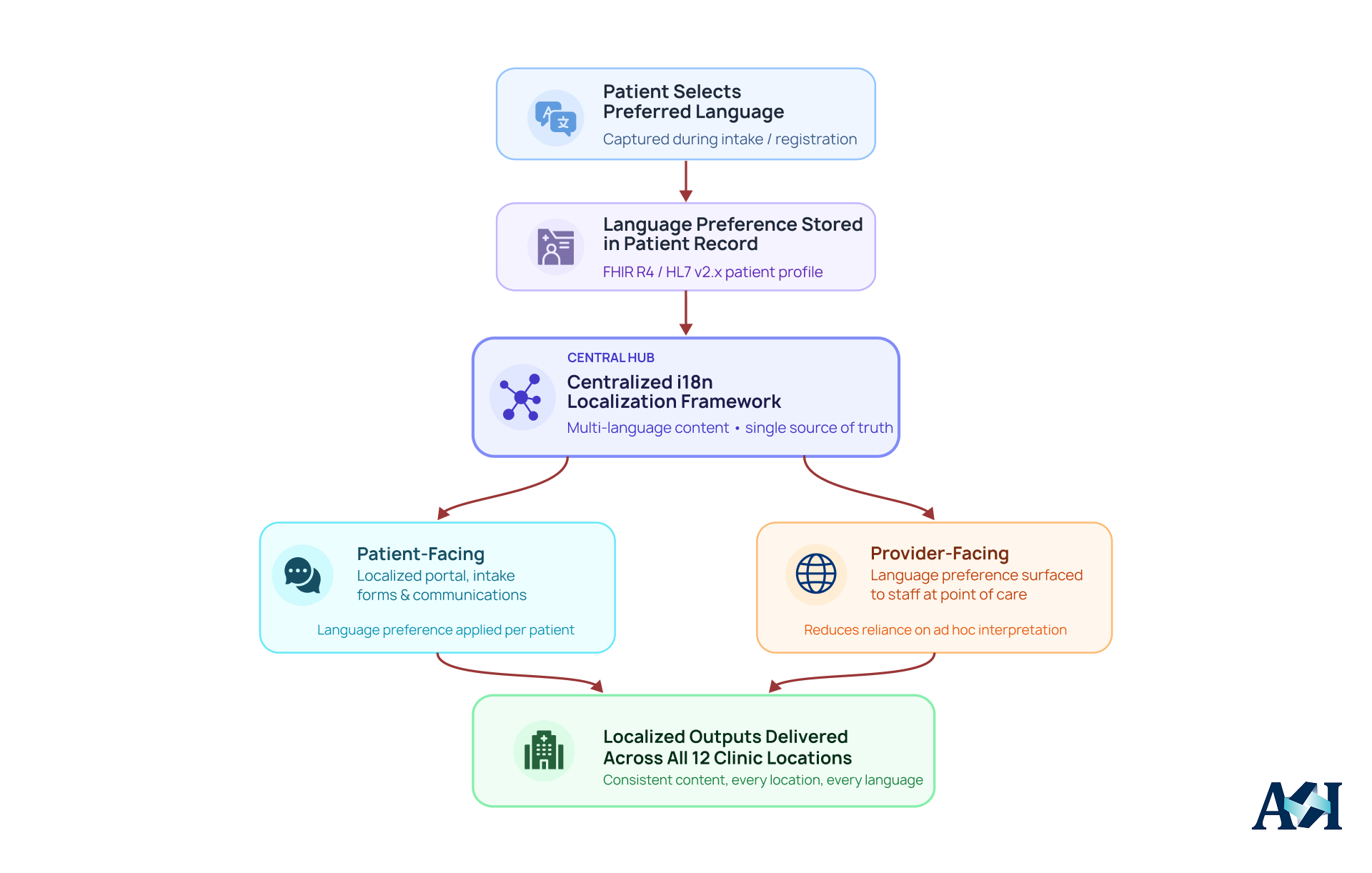
The solution architecture illustrates the workflow from patient language selection → language preference stored in the patient record → centralized i18n framework → localized patient-facing and provider-facing workflows → localized outputs across all clinic locations.
The architecture embedded localization into the EHR rather than treating translation as a separate document-management task.
EHR system development for multi-language healthcare delivery
A&I Solutions built a multi-language custom EHR with localization embedded across patient-facing and provider-facing workflows. The platform allowed patients to engage with intake, portal content, instructions, and communications in their preferred languages while giving staff access to language preferences and localized outputs.
Through its work as an EHR development company, A&I Solutions created a maintainable localization framework rather than relying on one-off translated documents. The implementation demonstrates how EHR system development can be adapted to the linguistic needs of the population a healthcare organization serves.
Explore more success stories in A&I Solutions client success.
1. Multi-language patient experience
A&I Solutions embedded localized patient experiences throughout the EHR. The platform included:
- Multi-language patient portal and intake
- Localized instructions and communications
- Patient language preference captured within the record
- Consistent localized content across clinic locations
Patients could interact with key EHR touchpoints in their preferred languages, reducing barriers to intake, portal use, and understanding.
2. Centralized localization and provider support
The solution connected language management with everyday staff workflows.
An i18n framework supported multiple languages and provided centralized management of localized content.
Translated content was managed centrally, creating a consistent and maintainable process for updating language-specific materials across the system.
Patient language preferences were surfaced to staff so teams could better understand each patient’s communication needs.
Patient-facing outputs could be generated from the patient’s stored language preference rather than requiring staff to manually translate each document.
The embedded localization framework reduced reliance on ad hoc interpretation and manually translated documents.
The platform used SSO, RBAC, OAuth 2.0, HIPAA-compliant audit logging, and encrypted data storage and transmission to protect patient information across all clinic locations.
Improved access and operational efficiency
Improved patient engagement
Before implementation, patient-facing content was primarily available in English, creating barriers for patients who preferred other languages. After deployment, patients could engage with intake, portal content, instructions, and communications in their preferred languages.
Reduced reliance on manual translation
The previous process depended on interpreters and manually translated documents. The centralized localization framework provided consistent translated content directly through the EHR and made updates easier to maintain across locations.
Better support for diverse populations
Language preferences were surfaced to staff and localized outputs were generated from the patient’s record. This helped teams serve linguistically diverse patients more efficiently while reducing the operational burden created by ad hoc translation.