A&I EHR Reduces Claim Denial Rate from 15% to 3%
How A&I Solutions reduced claim denials from 15% to 3% by embedding intelligent claims validation and denial prevention into a custom EHR platform.
Contact Us
Improving revenue cycle performance through intelligent claims validation
The client is a U.S.-based multi-specialty outpatient provider group with a centralized billing department processing claims across multiple clinic locations. High first-pass claim denial rates caused delayed reimbursements, increased manual rework, and unnecessary administrative costs due to preventable eligibility, coding, and documentation errors.
To strengthen revenue cycle performance, A&I Solutions enhanced the organization’s custom EHR with automated claims validation, documentation-driven coding, and denial management workflows that identified billing issues before claims were submitted to payers.
Preventing claim denials before submission
The Challenge
- High first-pass claim denial rates delayed reimbursements and increased billing costs.
- Eligibility, coding, and documentation errors were identified only after claims were submitted.
- Manual denial management made root-cause analysis and timely resubmissions difficult.
Our Solution
- Implemented automated pre-submission claims validation.
- Connected clinical documentation with charge capture and coding workflows.
- Built denial analytics and automated rework management into the EHR.
Intelligent claims validation and revenue cycle architecture
A&I Solutions built a secure cloud-based revenue cycle platform using Microsoft Azure, FHIR R4, X12 EDI (837/835/277), Azure API Management, OAuth 2.0, Role-Based Access Control (RBAC), Single Sign-On (SSO), and HIPAA-compliant audit logging. The architecture integrated clinical documentation, coding, payer validation, eligibility verification, and denial analytics to automate claim validation before submission while maintaining secure financial and clinical data exchange.
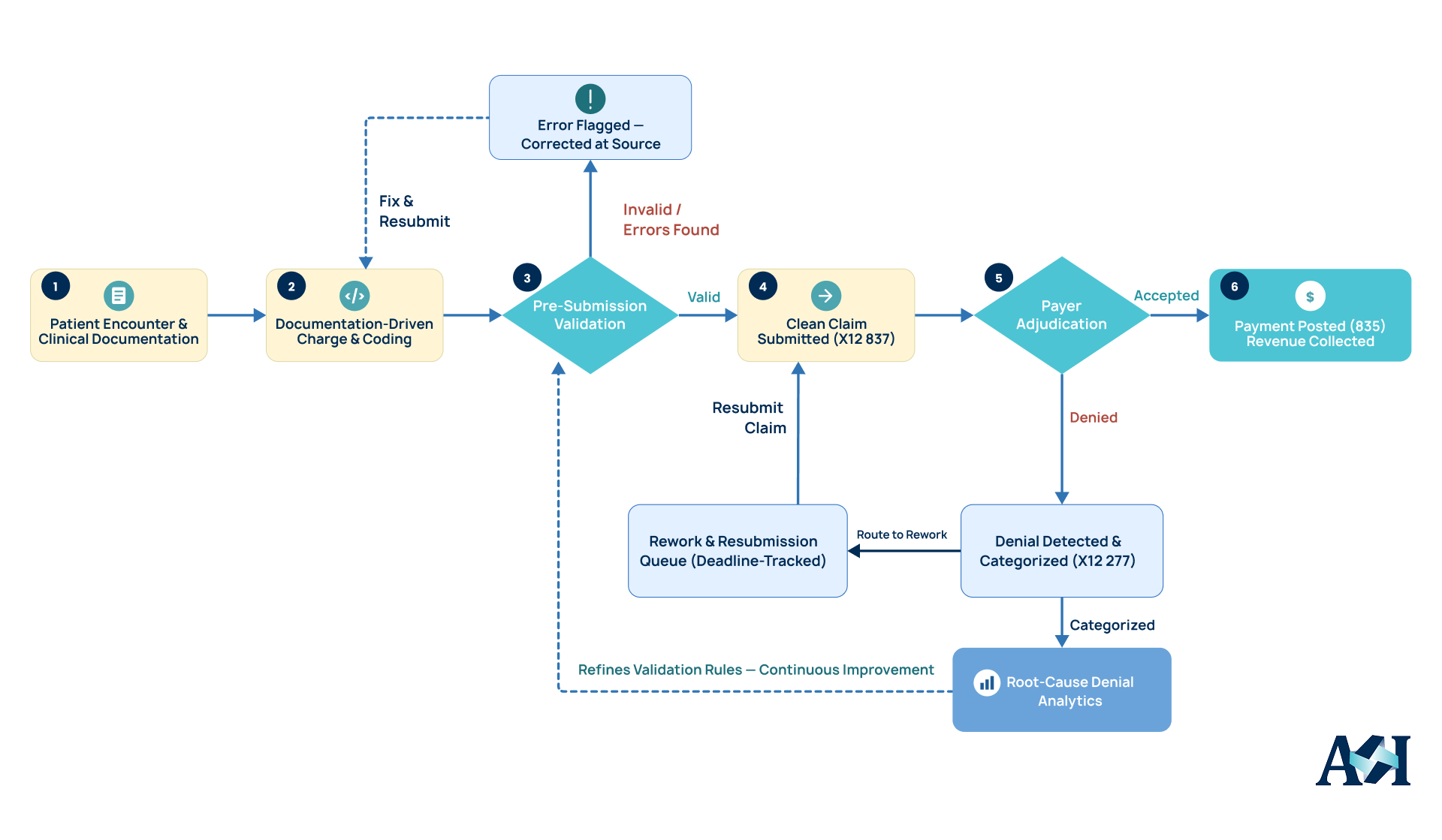
Custom EHR built for intelligent claims management
A&I Solutions enhanced the organization’s custom EHR by embedding intelligent claims validation directly into the revenue cycle workflow. Clinical documentation, coding, eligibility verification, and payer rules were connected to automatically identify billing issues before claim submission, reducing preventable denials and improving first-pass acceptance rates.
Through these A&I healthcare software results, the implementation demonstrates how custom EHR development can improve revenue cycle efficiency while reducing administrative workload.
1. Automated claims validation
To reduce preventable denials, A&I Solutions introduced intelligent validation before claims were submitted.
- Real-time payer rule validation
- Eligibility verification
- Documentation completeness checks
- Automated claim error detection
2. Connected revenue cycle workflows
The platform synchronized clinical documentation with billing operations to improve coding accuracy and accelerate reimbursement.
Clinical documentation automatically supported charge capture and accurate code selection.
Automated denial categorization, rework queues, and filing deadline tracking streamlined claim recovery.
Root-cause dashboards identified recurring denial patterns to support continuous billing improvements.
Microsoft Azure, OAuth 2.0, Role-Based Access Control (RBAC), Single Sign-On (SSO), encrypted data transmission, X12 EDI integration, and HIPAA-compliant audit logging protected financial and clinical information.