A&I EHR Analytics Dashboard Improves Clinical Decisions
How A&I Solutions transformed existing EHR data into actionable clinical insights with a real-time analytics dashboard that helped providers identify care gaps and make informed decisions at the point of care.
Contact Us
Turning healthcare data into point-of-care insights
The client is a U.S.-based multi-specialty outpatient provider group delivering primary and specialty care across multiple clinic locations. The organization had accumulated significant clinical data within its EHR, including diagnoses, medications, lab results, and encounter history.
However, providers struggled to use this information during patient encounters because relevant clinical insights were distributed across multiple screens. Care gaps, overdue screenings, and risk indicators existed within the data but were not proactively surfaced when clinical decisions were being made.
To address this challenge, the client partnered with A&I Solutions to build a clinical analytics and decision-support dashboard into its EHR. The solution consolidated patient information, surfaced actionable insights, and helped providers access relevant clinical context without disrupting existing workflows.
Improving clinical decision-making with actionable insights
The Challenge
- Clinical data was available but difficult to access during patient encounters.
- Existing reports focused on retrospective analysis rather than real-time clinical decisions.
- Care gaps and risk indicators depended on manual review and provider recall.
Our Solution
- Built a patient-specific clinical analytics dashboard within the EHR.
- Created automated care gap and risk indicator identification.
- Developed scalable analytics infrastructure to convert clinical data into actionable insights.
Cloud-based analytics architecture for clinical intelligence
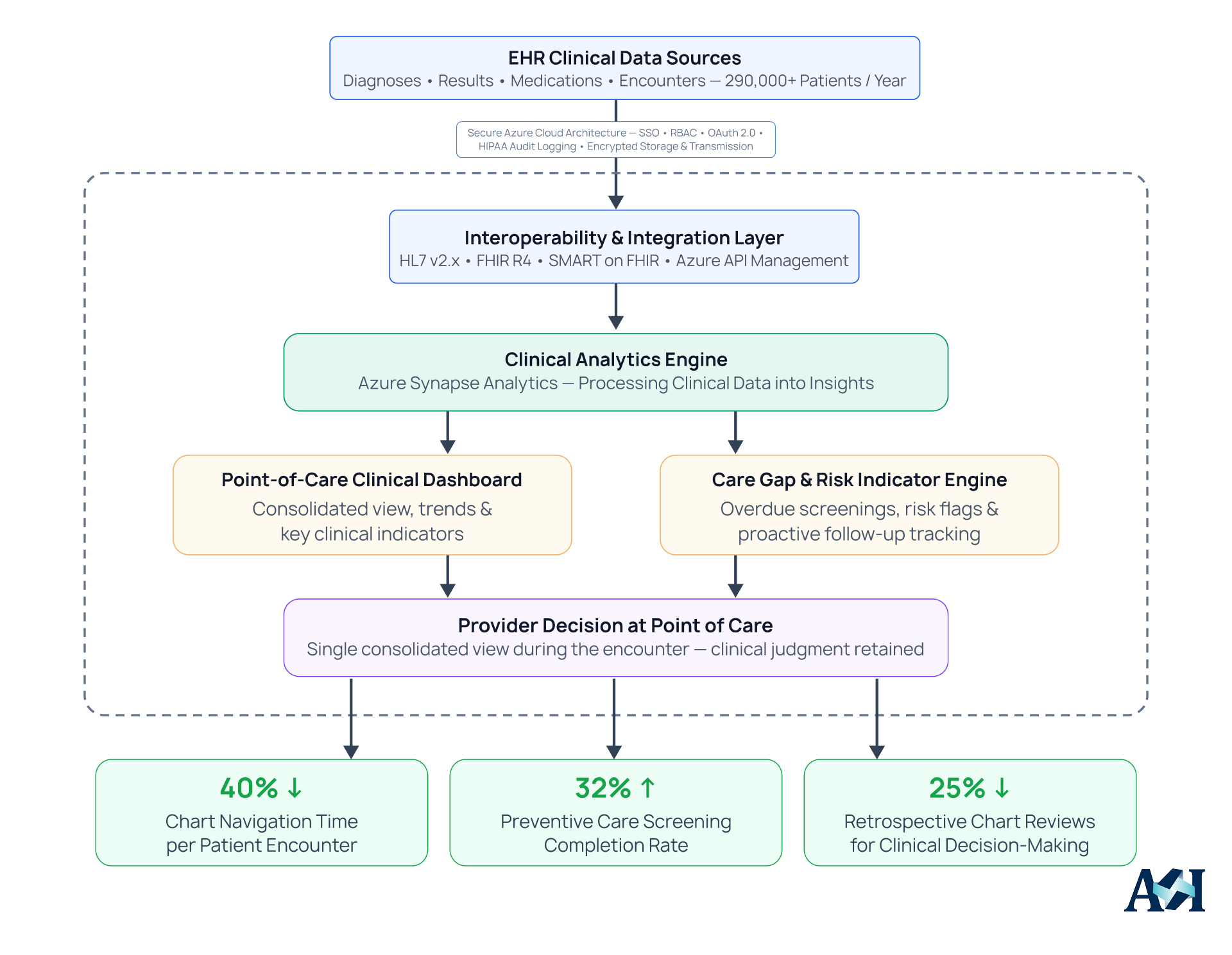
A&I Solutions developed a secure analytics layer using Microsoft Azure, Azure Synapse Analytics, Azure SQL, FHIR R4 APIs, HL7 v2.x messaging, SMART on FHIR, Azure API Management, OAuth 2.0, Role-Based Access Control (RBAC), and Single Sign-On (SSO).
The architecture processed clinical data from multiple sources and transformed it into patient-specific insights, dashboards, and care gap alerts while maintaining HIPAA-compliant security and governance.
EMR software development for clinical analytics and decision support
A&I Solutions developed an analytics-driven platform that extended the capabilities of the existing EHR by transforming stored clinical information into real-time decision support. Through custom EHR by A&I Solutions, the organization gained a centralized view of patient insights, care gaps, and risk indicators directly within clinical workflows.
This implementation demonstrates how an EMR software development company can help healthcare organizations enhance existing platforms through intelligent analytics and how an EHR software development company can build scalable data-driven solutions that improve provider decision-making.
1. Point-of-care clinical dashboard
A&I Solutions created a patient-specific dashboard that presented relevant clinical information during encounters.
The platform included:
- Consolidated patient view at the point of care
- Key clinical indicators for current encounters
- Trends across laboratory results, vitals, and conditions
- Relevant history without multi-screen navigation
By bringing important clinical signals into a single view, providers could access meaningful patient context faster during visits.
2. Automated care intelligence platform
The solution helped providers proactively identify opportunities for improved care delivery.
The platform detected overdue screenings, monitoring requirements, and follow-up needs directly from patient data.
Relevant clinical risk factors were highlighted within workflows, allowing providers to review important information before making decisions.
Azure Synapse Analytics processed clinical data into governed insights while supporting dashboards for both clinical and leadership users.
Microsoft Azure, OAuth 2.0 authentication, RBAC, SSO, encrypted data storage and transmission, and HIPAA-compliant audit logging secured clinical analytics workflows across all locations.