A&I EHR with AI CDS Prevents 150+ Drug Interactions/Month
How A&I Solutions integrated AI-assisted clinical decision support into a custom EHR to identify potential drug interactions at the point of prescribing and improve medication safety.
Contact Us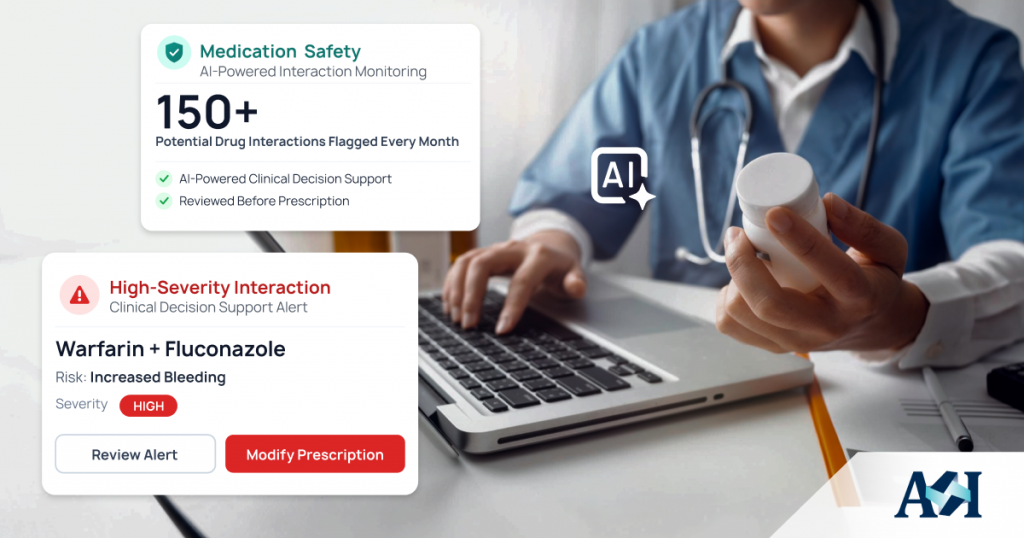
Strengthening medication safety with point-of-prescribing CDS
The client is a U.S.-based multi-specialty outpatient provider group managing a high volume of prescribing across a complex patient population. Many patients saw multiple providers and took multiple medications, increasing the potential for drug-drug interactions and other prescribing risks.
The existing EHR provided limited interaction checking, leaving providers to rely heavily on medication-list reviews and clinical recall during busy encounters. Existing alerts were also not well targeted, contributing to alert fatigue and making important interactions harder to distinguish.
To address these challenges, the client engaged A&I Solutions to integrate AI-assisted clinical decision support into its EHR. The solution consolidated medication data and surfaced targeted interaction and prescribing-risk alerts directly within the prescribing workflow, while keeping the final decision with the clinician.
Making medication safety checks more actionable
The Challenge
- Drug interaction checking depended heavily on provider recall and manual medication-list review.
- Existing alerts were not prioritized effectively, contributing to alert fatigue.
- Fragmented medication data limited the reliability of safety checks.
Our Solution
- Added real-time drug interaction checking directly to prescribing workflows.
- Introduced severity-based alerting to prioritize clinically significant interactions.
- Consolidated medication data using FHIR, HL7, and RxNorm-based normalization.
AI-assisted medication safety architecture
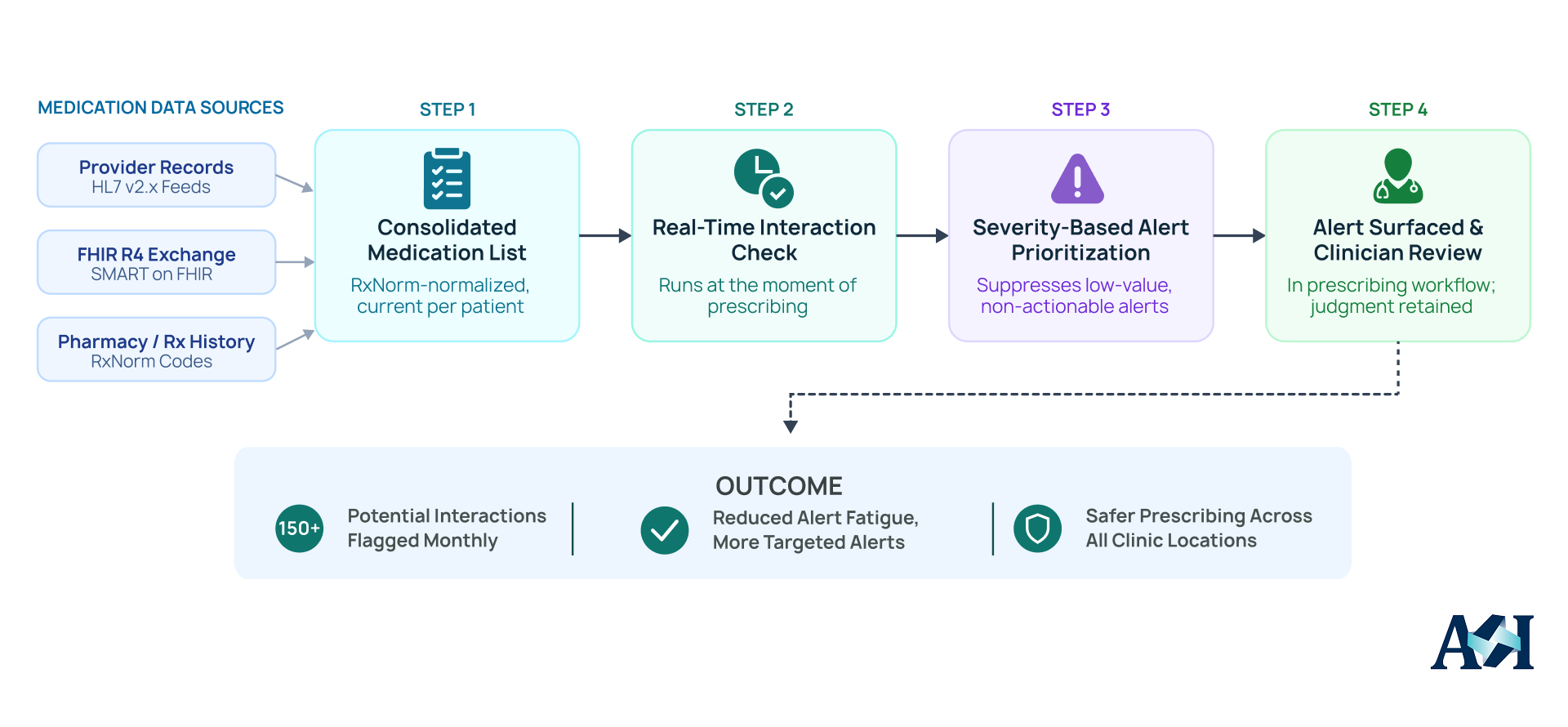
A&I Solutions deployed the clinical decision support capability on Microsoft Azure using React, .NET Core, Azure SQL, FHIR R4, HL7 v2.x, RxNorm, SMART on FHIR, Azure API Management, OAuth 2.0, RBAC, and SSO.
Custom EHR/EMR development for medication safety
A&I Solutions enhanced the client’s prescribing workflow through custom EHR/EMR development, embedding AI-assisted clinical decision support directly into the EHR. The solution consolidated medication information, normalized medications using RxNorm, and evaluated potential interactions when prescriptions were being entered. Through these A&I EHR development outcomes, the implementation demonstrates how EHR software development can add targeted clinical intelligence to existing workflows without replacing clinician judgment.
1. Point-of-prescribing interaction checking
A&I Solutions embedded real-time medication safety checks directly into the prescribing workflow.
The platform included:
- Real-time drug-drug interaction checking
- RxNorm-based medication normalization
- Checks against the patient’s current medication list
- Interaction information displayed within the prescribing workflow
Instead of relying on manual medication reviews, providers received potential interaction information at the moment it could be acted upon.
2. Targeted alerts and consolidated medication data
The solution improved the quality and relevance of medication safety alerts.
Interactions were prioritized according to clinical severity so providers could focus on significant risks.
Low-value and non-actionable alerts were suppressed to reduce unnecessary interruptions and alert fatigue.
Current medication information was consolidated across available sources, improving the completeness of interaction checks.
FHIR R4 and HL7 v2.x supported medication data exchange, while RxNorm provided standardized medication normalization.
Microsoft Azure, OAuth 2.0, RBAC, SSO, encrypted data storage and transmission, and HIPAA-compliant audit logging protected medication and clinical information across all locations.