A&I EHR Quality Reporting Automates MIPS Submissions
How A&I Solutions built a custom EHR quality reporting workflow that captures MIPS measures at the point of care, automates calculations, and prepares submissions.
Contact Us
Embedding MIPS reporting into everyday EHR workflows
The client is a U.S.-based multi-specialty outpatient provider group delivering primary and specialty care across multiple clinic locations and participating in the Merit-based Incentive Payment System (MIPS).
MIPS quality reporting was largely manual. Measure data depended on inconsistent documentation; staff extracted and compiled information from the EHR by hand, and performance calculations and submission preparation required significant end-of-period effort. Because measure-relevant information was not consistently captured at the point of care, reporting gaps often surfaced only when submission deadlines approached.
The client engaged A&I Solutions to automate MIPS quality reporting within its EHR. The solution embedded measure capture into clinical workflows, automated performance calculations, prepared submissions in the required format, and provided in-year visibility into quality performance.
Replacing deadline-driven MIPS reporting with automation
The Challenge
- Quality-measure data was captured inconsistently across providers and clinics.
- Staff manually extracted, compiled, and calculated measure data at the end of the reporting period.
- The organization lacked visibility into quality performance and care gaps during the year.
Our Solution
- Added structured quality-measure capture directly to point-of-care workflows.
- Automated measure calculations and prepared submissions in the required QRDA format.
- Added in-year dashboards showing measure performance and care gaps.
Connected architecture for automated MIPS reporting
A&I Solutions built the quality reporting workflow using React, .NET Core, Azure SQL, FHIR R4, HL7 v2.x, SMART on FHIR, Azure API Management, OAuth 2.0, RBAC, and SSO.
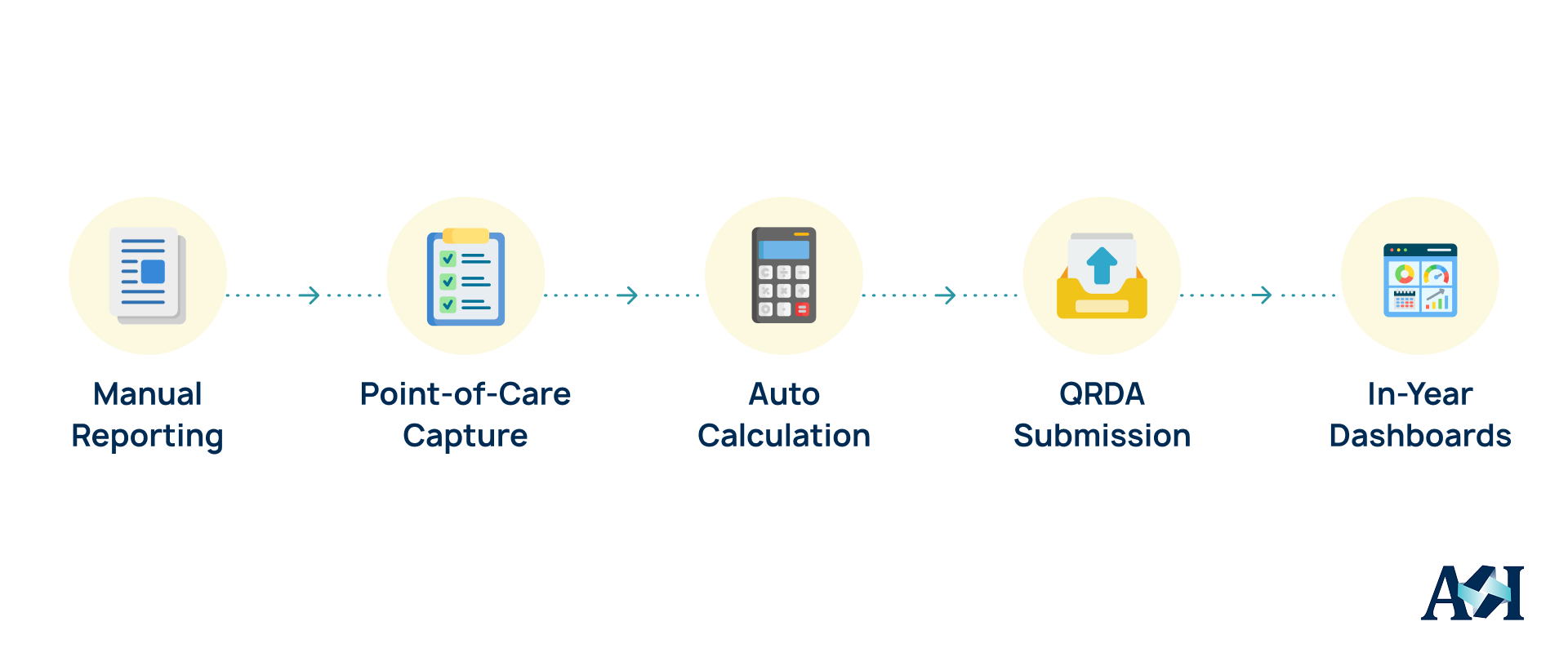
The workflow diagram illustrates the reporting flow: Manual Reporting → Point-of-Care Capture → Automated Calculation → QRDA Submission → In-Year Dashboards
This architecture shifted quality reporting from an end-of-period administrative task to a workflow that begins during clinical documentation. Measure-relevant information is captured during care, calculated automatically, prepared for submission, and surfaced through performance dashboards.
The platform was deployed on Microsoft Azure, with SSO, RBAC, OAuth 2.0, HIPAA-compliant audit logging, and encrypted data storage and transmission supporting secure handling of quality and clinical data.
Custom EHR development for automated MIPS reporting
A&I Solutions automated MIPS quality reporting within the client’s EHR by connecting measure capture, performance calculation, submission preparation, and in-year monitoring. Instead of extracting information manually at the end of the reporting period, quality data became part of the clinical documentation workflow.
Through custom EHR software development, A&I Solutions built quality reporting into the clinical system rather than treating compliance reporting as a separate administrative process. The custom EHR by A&I Solutions gave the organization structured measure data, automated reporting workflows, and ongoing visibility into performance.
1. Point-of-care quality-measure capture
A&I Solutions embedded MIPS measure capture directly into clinical workflows. The platform included:
- Structured capture of measure-relevant data
- Measure logic aligned to applicable MIPS measures
- Documentation prompts supporting complete measure capture
- Consistent data collection across providers and clinics
By capturing information during the patient encounter, quality reporting became a byproduct of clinical documentation rather than a separate end-of-period exercise.
2. Automated calculation and submission preparation
The platform automated the processing required to turn captured clinical data into reportable MIPS information.
The system automatically calculated measure performance using captured quality data.
Performance data was prepared in the required QRDA format for MIPS reporting.
The workflow supported electronic submission of prepared MIPS reporting information.
Automated capture and calculation reduced the need for staff to manually extract, compile, and calculate measure data at reporting time.
3. In-year quality performance dashboards
A&I Solutions also added dashboards that allowed the organization to monitor quality performance throughout the reporting period. The dashboards included:
- Measure performance during the reporting period
- Provider-level performance views
- Clinic-level performance views
- Identification of care gaps
- Ongoing visibility before submission
Instead of discovering performance gaps when reporting was due, providers and administrators could identify areas requiring attention while there was still time to address them. Clinical decisions remained with providers.