A&I Custom EHR for Mental Health: Outcome Measurement
How A&I Solutions built a custom mental health EHR that embedded standardized outcome measurement, progress tracking, and population-level reporting into everyday clinical workflows.
Contact Us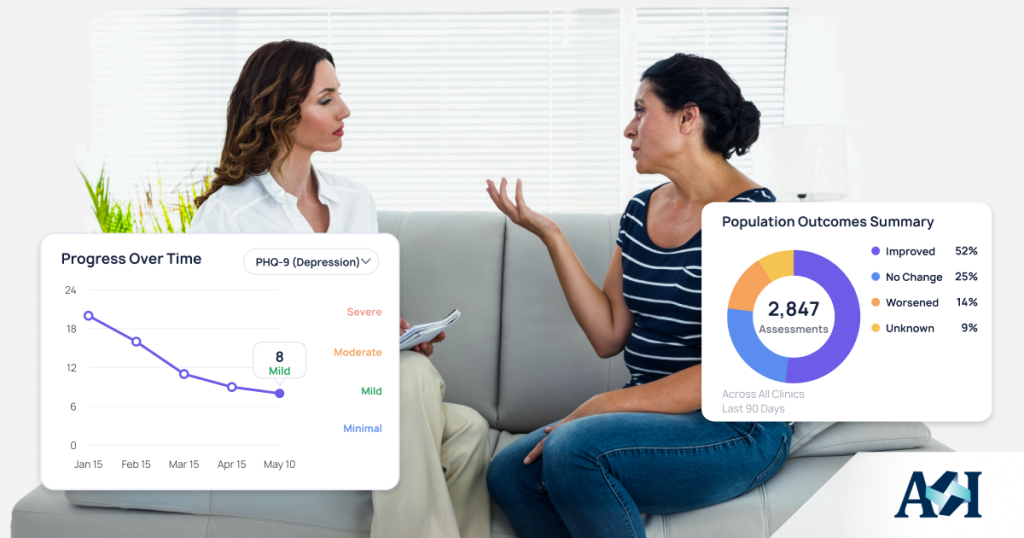
Embedding measurement-based care into the EHR
The client is a U.S.-based mental health provider delivering outpatient therapy, psychiatric care, and counseling across multiple clinic locations. The organization wanted to use standardized outcome instruments to track patient progress and support measurement-based care, but its general-purpose EHR did not support the workflow effectively.
Standardized measures were administered on paper or through separate tools, scored manually, and recorded inconsistently. Because results rarely entered the clinical record in a structured format, clinicians had difficulty comparing scores over time, while leadership could not aggregate outcomes across patients and programs or report them to payers and stakeholders.
The client engaged A&I Solutions to build a custom mental health EHR with standardized outcome measurement embedded directly into the clinical workflow. The solution enabled administration, automated scoring, structured storage, progress visualization, and organizational reporting within one platform.
Making outcome measurement part of clinical care
The Challenge
- Standardized outcome instruments were administered outside the EHR and scored manually.
- Unstructured results made it difficult for clinicians to track patient progress across visits.
- The organization could not aggregate standardized outcomes or report them effectively to payers and stakeholders.
Our Solution
- Embedded validated outcome instruments directly into the clinical workflow.
- Automated scoring and stored results as structured clinical data.
- Added progress visualization, population-level aggregation, and outcome reporting.
Connected architecture for measurement-based care
A&I Solutions developed the platform using React, .NET Core, Azure SQL, FHIR R4, HL7 v2.x, SMART on FHIR, Azure API Management, OAuth 2.0, RBAC, and SSO.
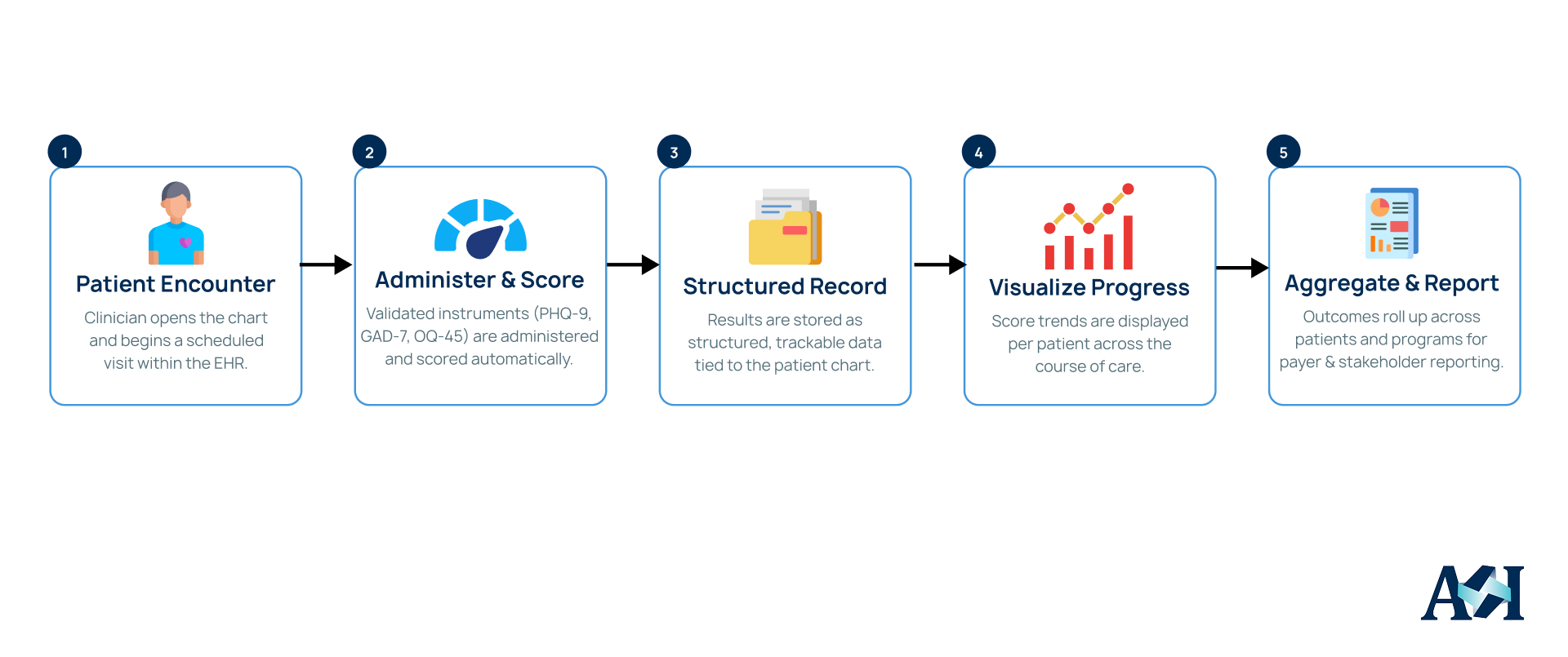
The workflow shown in the solution diagram follows: Patient Encounter → Administer & Score → Structured Record → Visualize Progress → Aggregate & Report.
This architecture brought outcome measurement into the clinical record rather than maintaining it as a separate assessment process. Structured results could then be surfaced at the point of care and aggregated for organizational reporting.
Custom EHR development for mental health outcome tracking
A&I Solutions built a custom EHR with standardized outcome measurement embedded throughout the mental health clinical workflow. The platform allowed providers to administer validated instruments, automatically score responses, store results in structured form, and review changes over the course of care.
Through its work as a custom EHR software company, A&I Solutions connected patient-level measurement with population-level reporting. The implementation demonstrates how custom EHR development can support measurement-based care without separating outcome assessment from everyday clinical documentation.
Explore more A&I EHR case study results in other topics.
1. Integrated outcome measurement
A&I Solutions embedded standardized measurement directly into the EHR workflow. The platform included:
- Administration of validated outcome instruments
- Automated scoring of standardized measures
- Structured storage of results
- Measures captured at intake
- Repeat measurement throughout the course of care
- Outcome information linked to the clinical record
Instead of completing assessments through paper forms or separate tools, clinicians could capture standardized measures within the patient’s EHR workflow.
2. Progress tracking and visualization
The platform gave clinicians a longitudinal view of outcome scores.
Outcome scores were displayed over time so clinicians could identify changes across visits.
Patient-level trends were surfaced directly within the clinical view.
Providers could compare scores across the course of care rather than manually reviewing individual assessment records.
The resulting progress view supported measurement-based treatment decisions while leaving interpretation and treatment decisions under clinician judgment.
3. Outcome aggregation and reporting
Structured outcome data also supported organization-wide analysis.
Outcomes could be aggregated across patients and programs.
The platform supported reporting of standardized outcomes to payers and other stakeholders.
Leadership gained access to population-level outcome information that was previously unavailable.
Structured measurements provided data that could be used to evaluate care and identify opportunities for quality improvement.
4. Security & compliance
The platform was deployed on Microsoft Azure using a scalable cloud architecture. Security capabilities included:
- Single Sign-On (SSO)
- Role-Based Access Control (RBAC)
- OAuth 2.0 authentication
- HIPAA-compliant audit logging
- Encrypted data storage and transmission
These controls supported secure handling of sensitive mental health information across the client’s clinic locations.