A&I Solutions EHR Integrates with 10+ Insurance Payers
How A&I Solutions connected the client’s EHR with 10+ insurance payers to automate eligibility verification, claim status, and remittance processing through standardized transactions.
Contact Us
Connecting payer workflows directly to the EHR
The client is a U.S.-based multi-specialty outpatient provider group delivering primary and specialty care across multiple clinic locations and working with a wide range of insurance payers. Before implementation, payer interactions were largely manual, with staff using individual payer portals and phone calls to verify eligibility, check claim status, and reconcile remittances.
The client’s EHR did not connect directly with the payers, forcing front-desk and billing teams to manage payer information across multiple systems. Manual entry also contributed to eligibility errors, downstream denials, billing surprises, and additional revenue-cycle rework.
To address these issues, the client engaged A&I Solutions to connect its EHR with 10+ major insurance payers through a standardized integration layer. The implementation introduced real-time eligibility verification, electronic claim status, claim submission, and remittance processing directly into the EHR workflow.
Replacing manual payer processes with automation
The Challenge
- Eligibility verification required staff to work through separate payer portals and phone calls.
- Claim status and remittance reconciliation were tracked manually across multiple systems.
- Manual payer workflows created errors, eligibility-related denials, and billing surprises.
Our Solution
- Integrated the EHR directly with 10+ major insurance payers.
- Automated eligibility, claim status, claim submission, and remittance transactions.
- Created one standardized integration layer with centralized monitoring and error handling.
Standards-based architecture for multi-payer connectivity
A&I Solutions developed a centralized payer integration architecture using .NET Core, Azure SQL, X12 EDI, FHIR R4, HL7 v2.x, Azure API Management, OAuth 2.0, RBAC, and SSO.
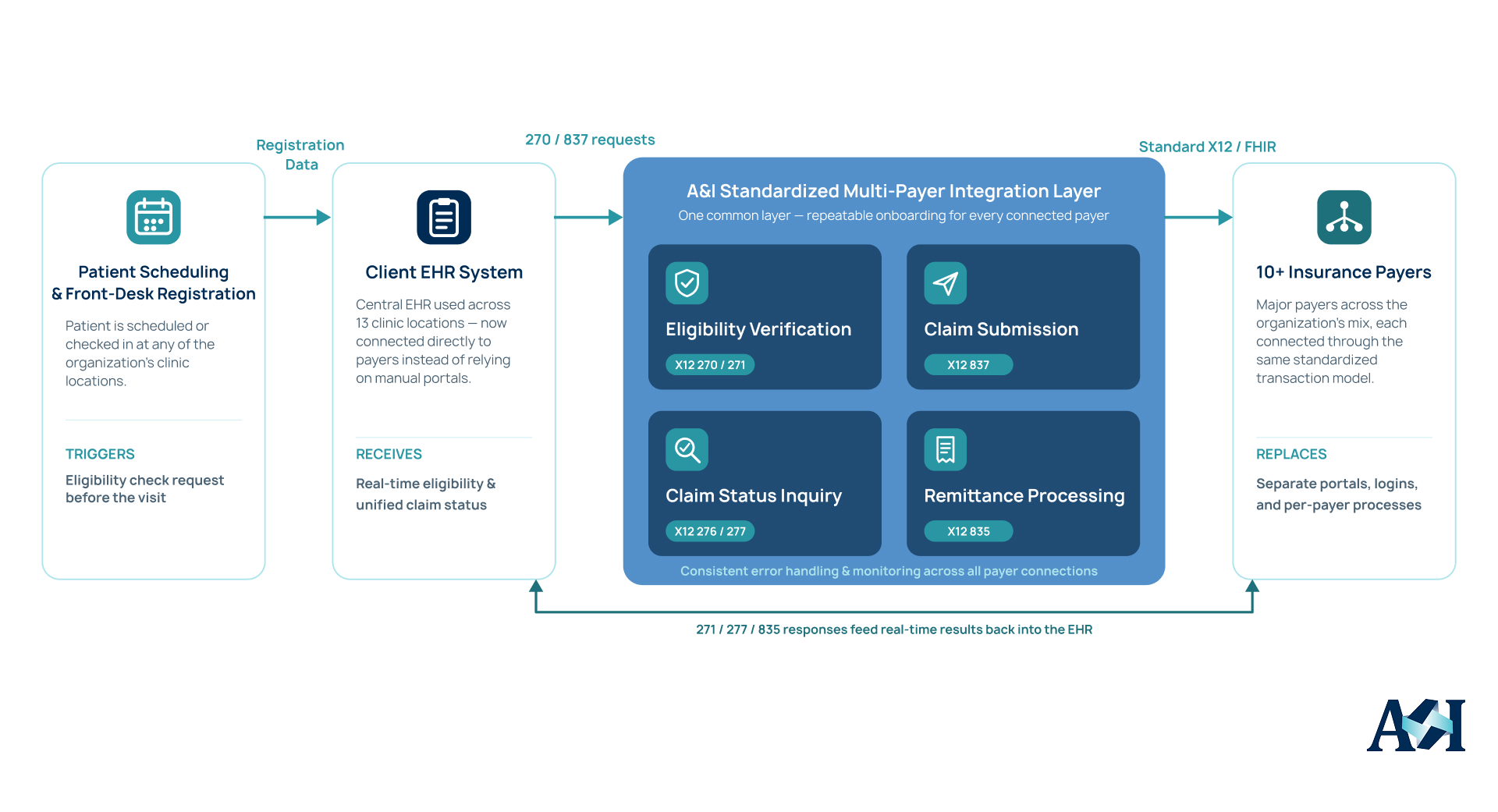
The integration layer contains dedicated workflows for eligibility verification, claim submission, claim status inquiry, and remittance processing. It receives EHR data, converts it into the appropriate standardized transaction, communicates with the payer, and returns the response to the EHR.
X12 270/271 supported eligibility verification, 276/277 supported claim status, 837 supported claim submission, and 835 supported electronic remittance processing.
EHR software development for automated payer connectivity
A&I Solutions connected the client’s EHR with its major insurance payers through a standardized electronic integration layer. The solution replaced payer-by-payer portal workflows with structured transactions that could be initiated and processed within the EHR.
Through EHR software development, A&I Solutions created a consistent framework for managing eligibility, claims, and remittance data across multiple payers. The A&I Solutions EHR delivery also established a repeatable model for onboarding additional payers without building an entirely separate workflow for each connection.
1. Real-time eligibility verification
A&I Solutions embedded eligibility verification directly into scheduling and registration workflows.
The platform included:
- X12 270/271 eligibility transactions
- Eligibility checks during scheduling
- Eligibility verification during registration
- Standardized benefits information
- Automated eligibility responses
Instead of requiring staff to log into individual payer portals, the EHR could initiate eligibility checks and surface coverage information within the existing workflow.
This allowed staff to identify coverage issues earlier, before services were delivered, reducing the potential for billing surprises and downstream eligibility-related denials.
2. Electronic claim status and remittance
A&I Solutions connected the EHR to payer claim and payment workflows using standardized X12 transactions.
X12 837 transactions supported electronic submission of claims to connected payers.
X12 276/277 transactions enabled electronic claim status inquiries and responses.
X12 835 transactions supported electronic processing of payer remittance information.
Instead of checking individual payer portals, billing staff could access claim status through a consolidated workflow.
Electronic remittance processing reduced the need to manually reconcile payment information across payer systems.
Eligibility, claims, status, and remittance information were connected through the EHR, helping billing teams manage the revenue cycle through a more consistent process.
3. Standardized multi-payer integration layer
The integration architecture provided a common framework for connecting multiple payers.
The platform included:
- Common integration layer across payers
- Standardized transaction handling
- Repeatable payer onboarding process
- Centralized error handling
- Integration monitoring
Rather than maintaining bespoke workflows for every payer, the client could use a consistent integration model for eligibility, claims, and remittance. This also created a repeatable path for adding additional payer connections.
4. Security & compliance
The platform was deployed on Microsoft Azure using a scalable cloud architecture.
Security capabilities included:
- OAuth 2.0 authentication
- Role-Based Access Control (RBAC)
- Single Sign-On (SSO)
- HIPAA-compliant audit logging
- Encrypted data storage and transmission
These controls supported secure exchange of eligibility, claims, and remittance information across the client’s clinic locations.