A&I Custom EHR for Oncology: Treatment Protocol Engine
How A&I Solutions built a custom oncology EHR with a structured treatment protocol engine for regimen selection, dosing, cycle scheduling, and treatment tracking.
Contact Us
Bringing oncology treatment protocols into the EHR
The client is a U.S.-based oncology practice providing medical oncology and infusion services across multiple centers. The practice manages complex, multi-cycle treatment regimens in which agents, doses, sequencing, and timing must be coordinated across multiple treatment cycles.
The client’s general-purpose EHR did not provide structured support for oncology treatment protocols. Oncologists relied on external references, spreadsheets, and manual calculations to select regimens, manage dosing, schedule cycles, and track treatment progress. Treatment information was then documented and ordered separately within the EHR.
This fragmented approach added manual work and made it difficult to maintain a clear view of a patient’s position within a multi-cycle regimen. The client engaged A&I Solutions to build a custom oncology EHR with a treatment protocol engine that brought structured regimen management into the clinical record while keeping every treatment decision under oncologist review and approval.
Structuring complex oncology treatment workflows
The Challenge
- Treatment protocols were managed through external references, spreadsheets, and manual processes rather than within the EHR.
- Dose calculations, cycle scheduling, and dose adjustments were handled manually.
- Oncologists and care teams had to reconcile regimen progress across multiple tools to understand treatment status.
Our Solution
- Built a structured treatment protocol engine directly into the EHR.
- Added dosing support and multi-cycle scheduling based on regimen and patient-specific parameters.
- Created in-record regimen tracking so care teams could monitor treatment progress across cycles and visits.
Structured architecture for oncology regimen management
A&I Solutions developed the oncology EHR using React, .NET Core, Azure SQL, FHIR R4, HL7 v2.x, RxNorm, SMART on FHIR, Azure API Management, OAuth 2.0, RBAC, and SSO.
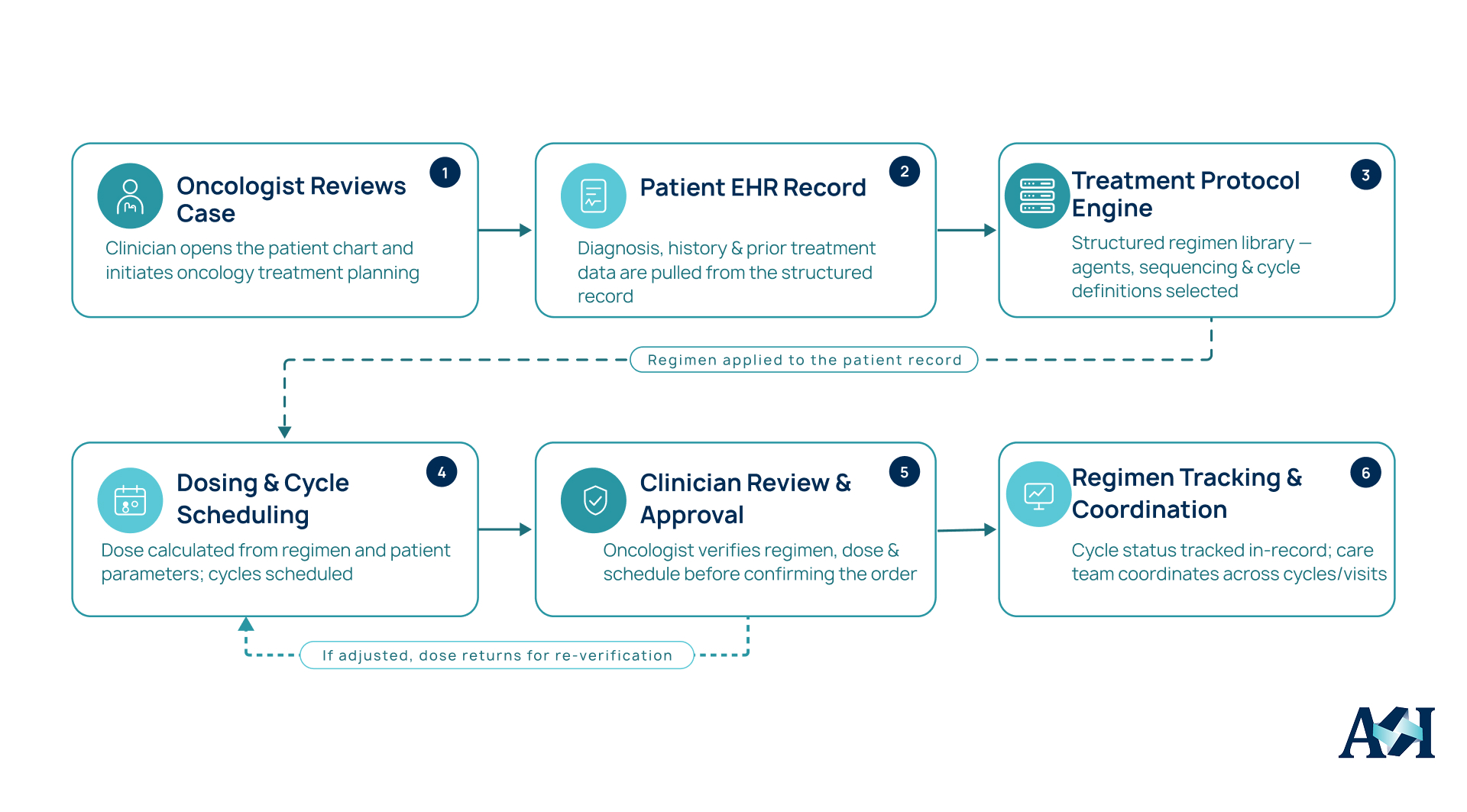
The workflow shown in the solution diagram follows: Oncologist Review → Patient EHR Record → Treatment Protocol Engine → Dosing & Cycle Scheduling → Clinician Review & Approval → Regimen Tracking & Care Coordination.
The diagram also shows a feedback loop for adjusted doses, where revised calculations return to clinician verification before treatment proceeds. This keeps the protocol engine supportive rather than autonomous.
Custom EHR platform built for oncology protocols
A&I Solutions built a structured treatment protocol engine into the client’s custom EHR platform, bringing regimen management into the patient record. The platform supported regimen selection, structured agents and cycle definitions, dosing calculations, cycle scheduling, and treatment tracking while preserving oncologist authority over every treatment decision.
Through its EHR software customization capabilities, A&I custom EHR platform was adopted around the specific requirements of multi-cycle oncology care rather than forcing oncologists to manage treatment protocols through external tools.
Explore more success stories in A&I Solutions client success.
1. Structured treatment protocol engine
A&I Solutions built a protocol library directly into the EHR. The platform included:
- A library of structured treatment regimens
- Regimen selection to support oncologist decision-making
- Structured agents, sequencing, and cycle definitions
- Regimens applied directly to the patient record
- Clinician review and approval before treatment
The protocol engine brought regimen information into the EHR while keeping the oncologist responsible for the final treatment decision.
2. Dosing support and cycle scheduling
A&I Solutions connected dosing and scheduling to the selected treatment regimen.
The system provided dosing support based on the selected regimen and patient-specific parameters.
Multi-cycle treatment schedules were aligned with the selected regimen, giving the care team a structured view of upcoming treatment cycles.
The platform supported dose adjustments while keeping changes under clinician control.
Calculated values were presented to the oncologist for verification and approval before being used in treatment workflows.
This reduced manual calculation while ensuring that treatment decisions remained with the clinician.
3. Regimen tracking and care coordination
The custom EHR platform also incorporated treatment progress directly into the clinical record.
The care team could see where a patient was within a multi-cycle regimen.
Cycle status was maintained within the patient’s clinical record.
Regimen information remained connected to the broader patient chart rather than being maintained in separate spreadsheets or external tools.
The structured treatment view helped the care team coordinate treatment across cycles and visits.
4. Security & architecture
The platform was deployed on Microsoft Azure using a scalable cloud architecture. Security capabilities included:
Centralized sign-on across all oncology centers.
Access to treatment and patient data scoped to each user’s clinical role.
Standards-based authentication across platform services and integrations.
Traceable records of access to oncology treatment and patient data.
Patient and treatment data protected at rest and in transit across all centers.
The architecture supported secure handling of oncology treatment and patient data across all centers.
Improved oncology regimen management
Treatment regimens brought into the EHR
Before implementation, oncology regimens were managed outside the EHR using external references and manual processes. Following deployment, structured regimens lived within the record, with the protocol engine supporting regimen selection for oncologist review and approval.
Dosing and cycle scheduling
Prior to implementation, dose calculations and cycle scheduling were performed manually. Built-in dosing support and cycle scheduling reduced manual calculation, with all values presented for clinician verification and every dose and adjustment under oncologist control.
Treatment progress visible in the record
Previously, tracking a patient’s progress through a multi-cycle regimen required reconciling information across tools. Structured regimen tracking gave the care team a clear, in-record view of cycle status and progress across cycles.