A&I Custom EHR for Behavioral Health: Complete Platform
How a multi-site ambulatory care provider enhanced its custom EHR with an ambient AI scribe—reducing clinical note time, minimizing after-hours charting, and improving provider-patient engagement.
Contact Us
Manual documentation slowed providers and reduced patient interaction
The client is a U.S.-based multi-specialty outpatient provider group operating ten clinics and serving more than 260,000 patients annually. Although the organization already used a custom EHR, providers continued to spend significant time creating clinical notes manually during and after patient encounters.
The growing documentation burden reduced face-to-face interaction with patients, increased after-hours charting, and contributed to provider fatigue. To address these challenges, the client partnered with A&I Solutions to integrate an ambient AI scribe directly into its EHR, automating clinical documentation while preserving provider review and approval.
Fragmented behavioral health workflows unified into one platform
The Challenge
- Multiple applications supported different stages of the behavioral health care lifecycle, creating disconnected workflows.
- General-purpose EHR functionality lacked native support for behavioral assessments, treatment plans, and group therapy documentation.
- Fragmented data limited clinical oversight, operational reporting, and organization-wide visibility.
Our Solution
- End-to-end behavioral health workflows built into one custom EHR.
- Integrated scheduling, billing, patient communication, and interoperability.
- Centralized reporting dashboards providing real-time operational and clinical insights.
A connected behavioral health platform built for the full care lifecycle
A centralized cloud platform unified intake, assessments, treatment planning, medication management, scheduling, billing, reporting, and patient engagement within a single behavioral health EHR. Using FHIR R4 APIs, HL7 v2.x messaging, and an API orchestration layer, the platform securely connected laboratory, pharmacy, referral, and payer systems while synchronizing clinical and operational data across all care programs.
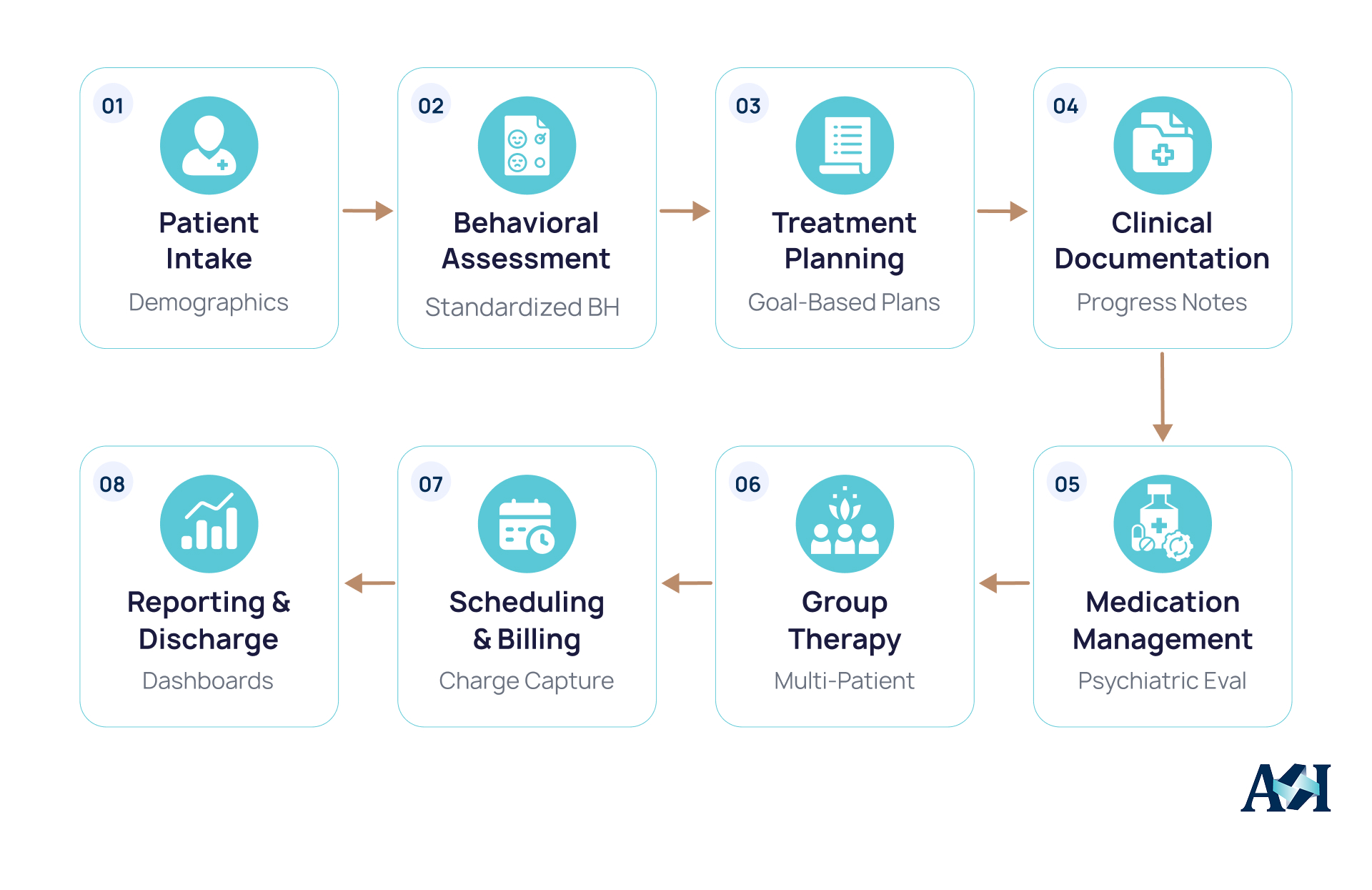
Specialty EHR software built for the complete behavioral health care lifecycle
A&I Solutions designed and implemented a complete behavioral health EHR that replaced fragmented applications with a unified platform supporting every stage of the care journey. Built on Microsoft Azure and integrated using FHIR R4, HL7 v2.x, and SMART on FHIR, the platform streamlined clinical, operational, and administrative workflows while supporting scalable growth across multiple programs and sites.
Through the A&I custom EHR results approach, the implementation demonstrated how specialty EHR software can deliver purpose-built workflows while giving healthcare organizations the flexibility of a customizable EHR designed around their unique clinical and operational requirements.
1. End-to-end behavioral health workflows
To support every stage of behavioral health care, the team developed specialty-specific workflows that connected intake, documentation, treatment planning, and discharge within a single platform.
- Behavioral assessments and intake documentation
- Treatment plans, psychiatric evaluations, and progress notes
- Group therapy, medication management, and discharge workflows
2. Connected clinical and operational ecosystem
To replace disconnected point solutions, the platform integrated operational systems and external healthcare services into one coordinated workflow.
Unified scheduling, charge capture, billing, referrals, and patient engagement within the EHR.
Connected laboratory systems, pharmacy networks, referral platforms, and payer systems using FHIR R4 APIs and HL7 v2.x messaging.
Delivered role-based dashboards for treatment plan compliance, provider productivity, patient engagement, and program performance.
Protected clinical and operational data using Microsoft Azure, OAuth 2.0, RBAC, SSO, encrypted data transmission, and HIPAA-compliant audit logging.
Measurable outcomes after go-live
Less cross-system data re-entry
A unified platform eliminated duplicate data entry
Better documentation consistency
Purpose-built behavioral health workflows standardized documentation
Faster operational reporting
Centralized dashboards gave leadership faster access to clinical and operational insights