A&I AI Scribe Reduces Clinical Note Time by 70%
How a multi-site ambulatory care provider enhanced its custom EHR with an ambient AI scribe—reducing clinical note time, minimizing after-hours charting, and improving provider-patient engagement.
Contact Us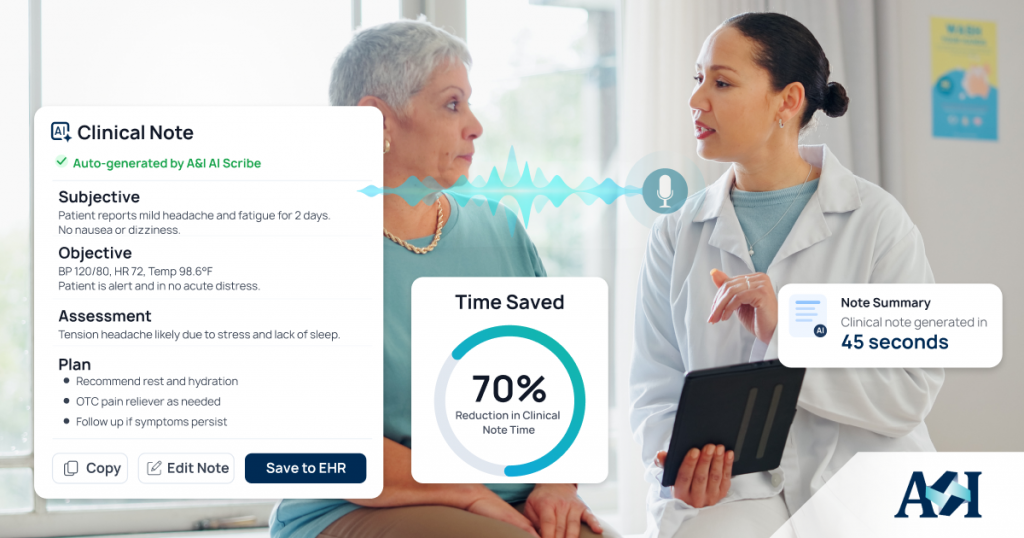
Manual documentation slowed providers and reduced patient interaction
The client is a U.S.-based multi-specialty outpatient provider group operating ten clinics and serving more than 260,000 patients annually. Although the organization already used a custom EHR, providers continued to spend significant time creating clinical notes manually during and after patient encounters.
The growing documentation burden reduced face-to-face interaction with patients, increased after-hours charting, and contributed to provider fatigue. To address these challenges, the client partnered with A&I Solutions to integrate an ambient AI scribe directly into its EHR, automating clinical documentation while preserving provider review and approval.
Manual documentation transformed into AI-assisted clinical workflows
The Challenge
- Providers spent excessive time manually typing clinical notes before, during, and after patient encounters.
- Real-time documentation divided provider attention between patients and the EHR during visits.
- After-hours charting delayed billing workflows and increased provider fatigue.
Our Solution
- Ambient AI captured provider-patient conversations and generated structured draft notes.
- HL7 v2.x translation so legacy systems join standardized exchange without replacement
- Provider review workflows ensured documentation quality while reducing manual effort.
An AI-powered documentation workflow embedded within the EHR
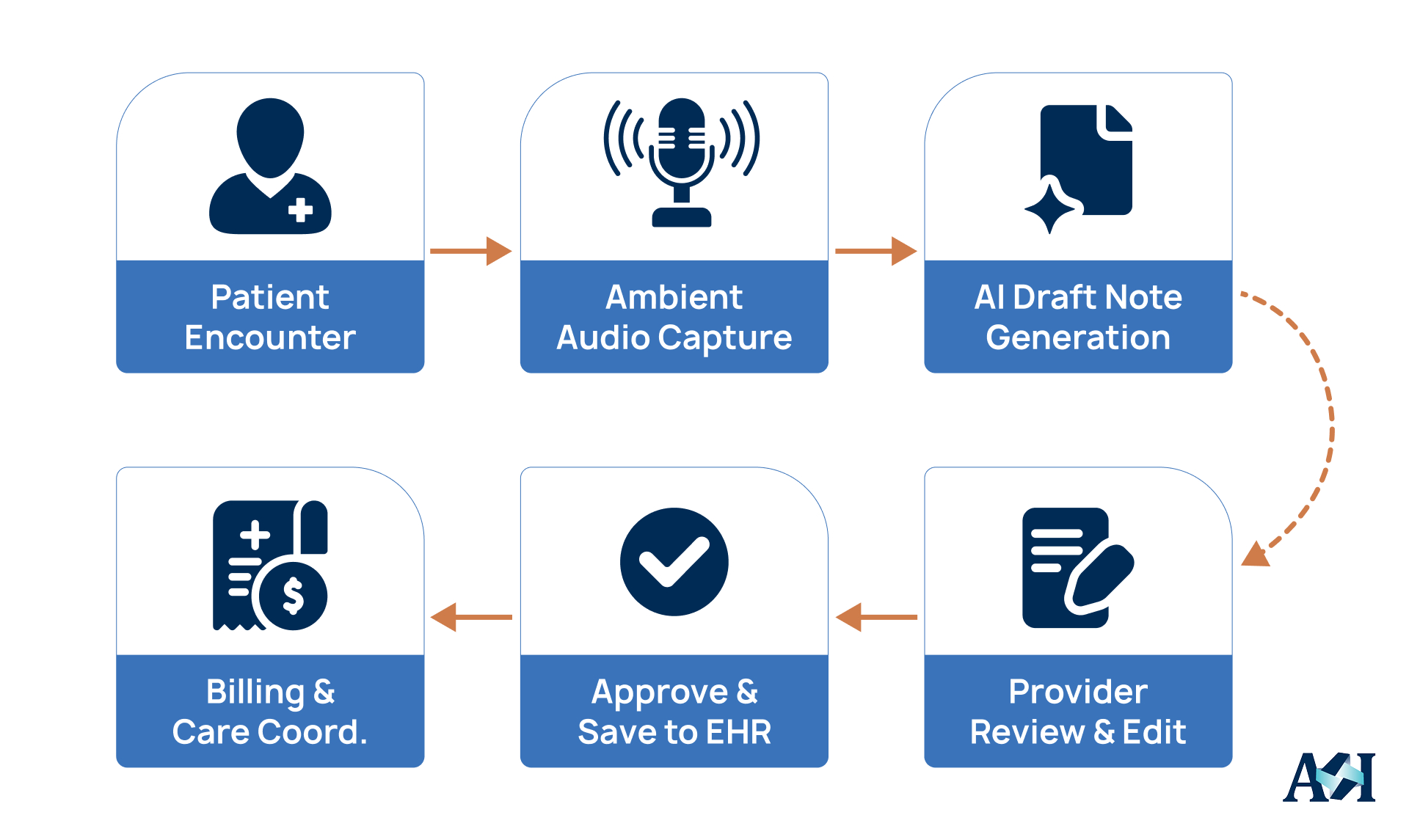
An ambient AI documentation layer captured encounter conversations, generated structured clinical notes using Azure OpenAI Service and Azure Speech Services, and synchronized finalized documentation with the EHR through SMART on FHIR and FHIR R4 standards. Built on Microsoft Azure with OAuth 2.0, RBAC, SSO, and HIPAA-compliant audit logging, the architecture securely supported documentation, billing, and downstream clinical workflows across all clinic locations.
An ambient AI scribe built into modern EHR software solutions
A&I Solutions designed and implemented an ambient AI scribe integrated directly into the client’s custom EHR, automatically converting provider-patient conversations into structured draft clinical notes for provider review and approval.
Built using Azure OpenAI Service, Azure Speech Services, SMART on FHIR, and FHIR R4, the solution reduced manual documentation while preserving existing clinical workflows and provider oversight.
Through the A&I Solutions EHR development process, the implementation demonstrated how modern EHR software solutions can incorporate AI-driven documentation while supporting scalable custom EHR software development.
1. Ambient AI documentation workflow
To reduce documentation time, the team developed an AI-powered workflow that generated structured clinical notes automatically from patient encounters.
- Ambient audio capture during clinical encounters
- AI-generated draft notes tailored to encounter type
- Specialty-aware note templates with provider review and approval
2. Seamless EHR integration
To maintain familiar provider workflows, the AI scribe integrated directly into the client’s existing EHR while supporting structured clinical data and downstream operational processes.
Mapped AI-generated content into structured FHIR R4 resources and populated patient records without manual re-entry.
Made finalized documentation immediately available for billing, coding, and care coordination workflows.
Required provider review, editing, and approval of every AI-generated note with comprehensive audit logging.
Protected encounter audio and clinical information using Microsoft Azure, OAuth 2.0, RBAC, SSO, encrypted data transmission, and HIPAA-compliant audit logging.
Measurable outcomes after go-live
Less clinical note time
Ambient AI-generated draft notes
Less after-hours charting
Providers completed more documentation during scheduled clinic hours
Better provider-patient engagement
By eliminating real-time typing