Audit Logging & Data Lineage in Multi-System EHR Integration
Before opening this blog or even thinking about audit logging, you might have wondered if healthcare integration audit logging is really that important.
Well, the answer is yes, because today, healthcare data moves from multiple systems during patient care. For instance, the patient data is created in the EHR and then moves to the lab system, then to the interface engine, through APIs, and finally appears in patient portals or decision-making tools.
And if you have to track how the data moved and where it was intercepted or edited after a security incident or during an audit, very few organizations can do that. Moreover, this issue is even more pressing in multi-system EHR integrations, where knowing tracking PHI across logs is crucial.
More importantly, having clinical data traceability in healthcare systems is one of the critical HIPAA requirements for healthcare organizations. However, only audit logging is not enough; you also need data lineage for visibility into how the patient data moves across different systems throughout its lifecycle.
So, the audit logging data lineage EHR integration is crucial for traceable and transparent data exchange, and you gain accountability for security breach events. And with the speed at which healthcare integration is growing, and healthcare organizations are connecting EHRs with various systems, this transparency is required more than ever.
That’s why, in this blog, we are going to break down how to implement audit logging in multi-system integrations and strategies for building scalable, end-to-end traceability across the connected healthcare ecosystem.
Understanding Audit Logging & Data Lineage in Healthcare
As the healthcare industry becomes more connected and the healthcare data moves from EHRs, lab systems, APIs, interface engines, and other integrated PHI access monitoring nd audit trails become important.
You need to know who interacts with the data and what changes are made on that interaction. This is where audit logging and data lineage integration within the ecosystem come into play. The audit logging tracks who accessed data and user activity, whereas multi-system EHR data lineage tracks the data flow across multiple systems.
These two give you visibility into how data moves across the systems and who accesses the data and when it was accessed. Most importantly, having these two integrated into the system helps you maintain compliance with HIPAA audit trail requirements for EHR systems.
For instance, audit logging tracks every user activity from user logins and data modifications to API calls and every change made to healthcare data and systems. This helps healthcare organizations understand who accessed patient data, what actions were performed, and when these actions happened through timestamps.
Additionally, the data lineage helps healthcare organizations like yours to track how data moved from one system to another. Moreover, it makes sure that you can track back the origin of data, maintaining traceability across the complex data pathways and systems.
All of this makes sure you have accountability and a way to track every user and system activity as per their actions and timestamps. This not only helps you meet compliance requirements but also helps in investigation after a breach or other security events happen.
In short, with the increasing complexity of healthcare integration, end-to-end traceability and data visibility are crucial. Together, audit logging and data lineage provide the tools to create stronger governance, better compliance readiness, and more secure healthcare data exchange.
Building a Scalable Audit Logging Architecture
One of the challenges that many of our clients face is that their audit logging does not scale with their integrations. Because of this, even if they have audit logging, it fails to track user and system activity as the number increases.
And the solution to this is using a scalable approach and strategies for how to implement audit logging in multi-system integration, so it adjusts to each new connection effortlessly. However, for this, only an API-based architecture is not enough; you need several other factors to work together. Let’s take a look at what those factors are:
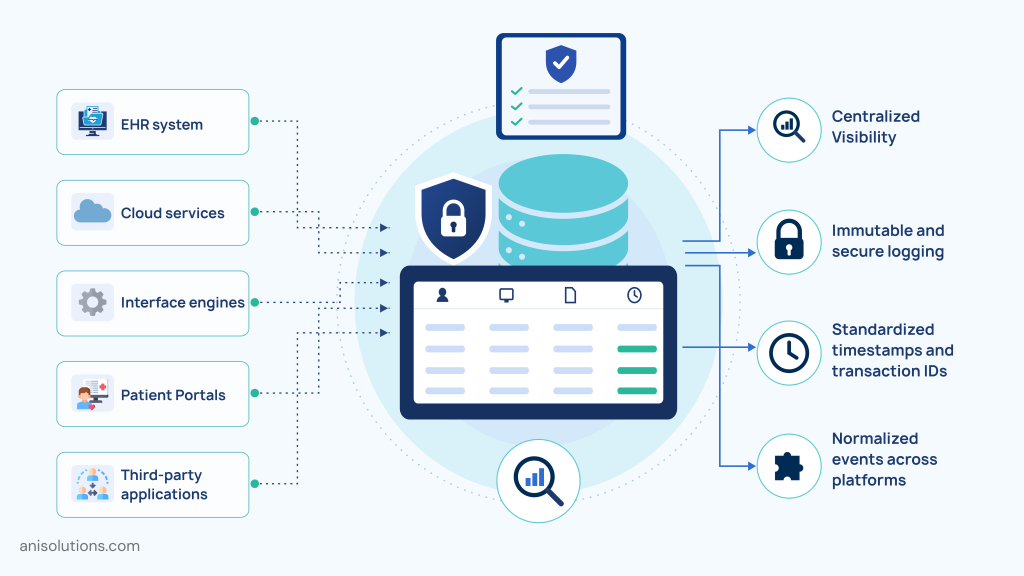
- Capture Logs Across All Connected Systems: If the audit logging is limited to only the EHR system, then it becomes difficult to maintain track of what happens in other connected systems. That’s why the audit logging must expand beyond EHR and collect event data from APIs, middleware, interface engines, cloud services, patient portals, and other third-party applications for a complete picture of PHI access, system activity, and security events.
- Centralize Audit Data for Better Visibility: Monitoring every single system becomes difficult if there are different dashboards, so you have to bring all system logs under one central platform on a single dashboard. This significantly improves incident investigation efficiency and operational transparency.
- Implement Immutable Logging Practices: Using write-once-read-many (WORM) storage is essential if you want to make the data tamper-proof. This storage allows editing only once and prevents deletion of data, increasing compliance readiness and making sure audit records remain true and trustworthy during audits or investigations.
- Standardize Timestamps & Transaction Identifiers: When you are connecting different systems, they use various formats for generating logs, transaction IDs, and event structures. You need to standardize these to ensure it is easier to organize and track the activity across multiple healthcare environments.
- Normalize Events Across Platforms: Event normalization makes all the data consistent, and this helps in ensuring that data from EHRs, APIs, cloud platforms, and integration engines can be analyzed instantly, improving reporting, monitoring, and traceability.
Tracking Data Lineage Across Integrated Healthcare Systems
Understanding who accessed data and when it was accessed is just one part. You also need to know where the data is coming from, how it was modified, which systems it traveled through, and where it was sent at the end.
Without this visibility, investigating how data was transferred through multi-system EHR integration is very difficult. And this is where tracking data lineage for integrated healthcare systems becomes important, and in this multi-system EHR, data lineage helps healthcare organizations.
Here is how it helps healthcare organizations maintain trust, transparency, and accountability in the interoperable systems:
- Trace Data From Source to Destination: This is the most important function of data lineage, as it helps understand where the data comes from and where it was transmitted. With this, you can have end-to-end visibility across the integrated ecosystem, making it easier to trace data exchange in multi-system environments.
- Maintain Multi-System EHR Data Lineage: In a healthcare environment, patient data moves from EHR to labs, pharmacy systems, cloud platforms, and multiple other systems. The data lineage helps understand how the data moves all over these systems and identify any abnormalities and gaps at the right time during the data flow.
- Monitor PHI Throughout Data Lifecycle: The right lineage tracking can track data across its lifecycle from PHI creation, modification, transmission, storage, and deletion events. This improves governance strategies significantly and makes accountability even better.
- Support Integration Troubleshooting: Data lineage tracking also helps healthcare organizations identify changes in the data and where the changes were made. This helps keep track of incomplete and inconsistent data in the systems.
- Establish Chain-of-Custody Visibility: This also helps you maintain clear reports for audits, investigations, compliance reviews, and patient safety initiatives by keeping a clear record of how clinical and operational data moves through different systems.
Operationalizing PHI Access Monitoring & Audit Trails
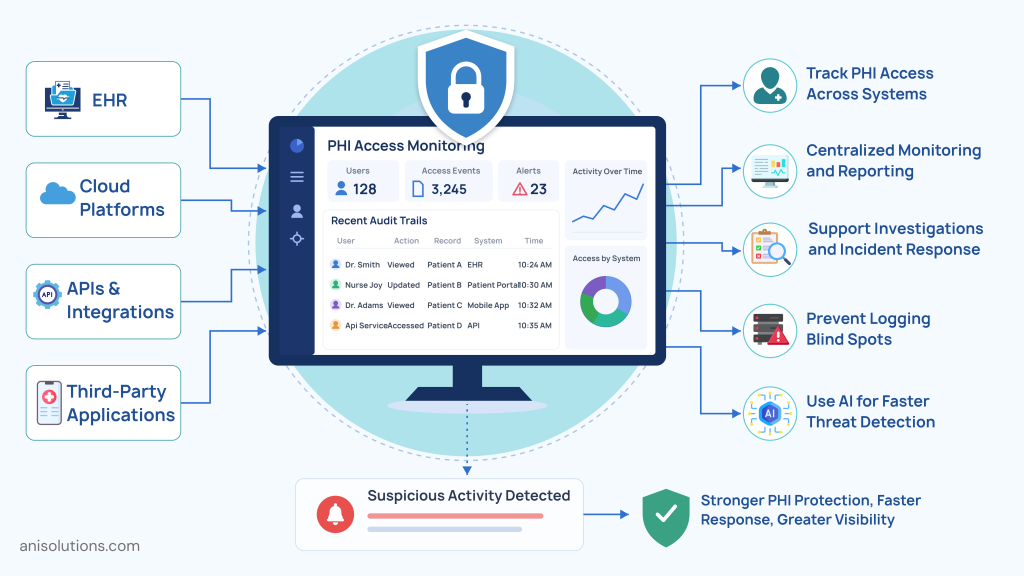
Collecting audit logs is only the first step. To gain meaningful security and compliance benefits, healthcare organizations must actively monitor and analyze those logs across connected systems.
Without ongoing visibility, suspicious access patterns, unauthorized data activity, and potential security incidents can go unnoticed. This is why tracking PHI access logs and maintaining effective PHI access monitoring and audit trails are essential for modern healthcare interoperability environments.
- Track PHI Access Across Systems: Organizations should monitor who accessed PHI, when access occurred, what records were viewed or modified, and which systems were involved. This improves accountability and visibility across connected environments.
- Centralized Monitoring and Reporting: Consolidating audit data from EHRs, APIs, interface engines, cloud platforms, and third-party applications enables security teams to monitor activity more efficiently and investigate issues faster.
- Support Investigations and Incident Response: Comprehensive audit trails help organizations determine the scope of security incidents, investigate unauthorized access, and support regulatory reporting requirements.
- Prevent Logging Blind Spots: Logging strategies should account for outages, failover events, and integration disruptions to ensure critical activity remains visible even during system interruptions.
- Use AI for Faster Threat Detection: AI-assisted monitoring tools can identify unusual access behavior, abnormal transaction patterns, and suspicious activity that may otherwise be difficult to detect manually.
By operationalizing audit monitoring rather than simply storing logs, healthcare organizations can strengthen PHI protection, improve incident response, and maintain greater visibility across complex interoperability environments.
Conclusion: Building Trust Through End-to-End Traceability
In a nutshell, as healthcare integration is growing, more connected tracking how data moves across systems and who accessed or modified it is becoming more difficult and important. That’s why you need to understand how to implement audit logging in multi-system integrations, along with integrating multi-system EHR data lineage.
With both audit logging and data lineage in your EHR integration, tracking data flow across EHRs, APIs, cloud platforms, interface engines, and middleware becomes easier and more efficient.
So, if you want traceability and visibility into your PHI access monitoring and audit trails, then connect with our integration team and get started today.
Frequently Asked Questions
Healthcare integration audit logging is the process of recording and monitoring activities across connected healthcare systems, including EHRs, APIs, interface engines, and cloud platforms. It helps organizations track PHI access, user actions, data modifications, and security events for compliance and investigation purposes.
Audit logging tracks system activities such as user access, record changes, and API events. Multi-system EHR data lineage focuses on the movement of data across systems, showing where information originated, how it changed, and where it was transmitted.
HIPAA requires healthcare organizations to implement audit controls that record and examine activities involving PHI. Audit trails should capture user access, timestamps, record modifications, system events, and other activities that support security monitoring and compliance investigations.
Organizations collect audit data from EHRs, APIs, interface engines, cloud platforms, and third-party applications, then centralize it within monitoring platforms. This provides visibility into who accessed PHI, when, and what actions were performed.
Organizations can implement audit logging by capturing events across all connected systems, centralizing logs in a single platform, standardizing timestamps and transaction identifiers, and maintaining immutable records to improve security visibility, compliance readiness, and incident response capabilities.
Clinical data traceability helps organizations track how healthcare information moves across systems throughout its lifecycle. This improves data accuracy, supports compliance requirements, assists with investigations, and helps healthcare teams identify interoperability issues more efficiently.
Transaction IDs act as unique identifiers that connect events across multiple systems. They help organizations follow a specific data transaction through APIs, interface engines, EHRs, and cloud platforms, making it easier to trace information throughout interoperability workflows.
AI helps analyze large volumes of audit data by identifying unusual access patterns, abnormal user behavior, suspicious transactions, and potential security threats. This enables faster risk detection and improves the effectiveness of PHI access monitoring and audit trail management.
- On July 8, 2026
- 0 Comment